

Notarization for Real Estate Transactions in Massachusetts: Deeds, Mortgages and Closings
Massachusetts is an attorney-closing state. The closing attorney runs the transaction; we are the commissioned notary and NNA Certified Loan Signing Agent who travels to the seller, buyer or borrower and completes the certificates the registry of deeds will accept. Seven days a week across 177 cities and towns.
Which real estate documents require notarization in Massachusetts?
Any instrument that will be recorded at a Massachusetts registry of deeds must carry a notarial acknowledgment: deeds, mortgages, mortgage discharges, recorded powers of attorney, 6D certificates, trustee certificates and homestead declarations. Under M.G.L. c.183 s.29 a registry will not record a deed without a certificate of acknowledgment, and the same practice applies to every other recorded instrument.
Most people meet these documents in a sale, a refinance or an estate transfer. In a sale the seller signs the deed and the buyer signs the mortgage; in a refinance the borrower signs a new mortgage and the old lender records a discharge; in an estate matter the personal representative or trustee signs a fiduciary deed with a trustee certificate. Our real estate document notary service covers all of them.
Deeds
Quitclaim, warranty and fiduciary deeds. The seller or fiduciary acknowledges the deed; the buyer does not sign it. Massachusetts requires no witnesses, only the acknowledgment.
Quitclaim deed notarizationMortgages
Every owner on title acknowledges the mortgage, including a spouse who is not on the loan. The note is signed but not notarized.
Loan signing agentMortgage discharges
Signed by an officer of the lender under M.G.L. c.183 s.54 and acknowledged. We notarize discharges for local banks, credit unions and private lenders.
Business notary servicesPowers of attorney for closing
A durable or limited POA that lets an agent sign the deed or mortgage. It is acknowledged, approved by the lender in advance and recorded with the instrument it supports.
POA notarization6D certificates
For condominium sales under M.G.L. c.183A s.6(d). The trustees certify that no common charges are unpaid; the certificate is acknowledged and recorded with the deed.
Real estate notaryTrustee certificates
Under M.G.L. c.184 s.35 a trustee certifies who the trustees are and that the trust authorizes the sale. Acknowledged and recorded.
Trust notarizationClosing affidavits
Title, FIRPTA non-foreign, name and occupancy affidavits. These take a jurat, so the signer swears to them rather than acknowledging.
Affidavit notarizationA declaration of homestead under M.G.L. c.188, easements and restrictions follow the same rule: if it goes to the registry, it carries a certificate.
What does the registry of deeds check on a notarial certificate?
The recording clerk checks four things: that the certificate is a proper Massachusetts acknowledgment, that the notary’s commission expiration date appears and has not passed, that the stamp or seal is legible and will reproduce on the scan, and that the name in the certificate matches the name under the signature line. If any one fails, the instrument comes back unrecorded and the attorney has to chase the signer down again.
Acknowledgment wording. M.G.L. c.222 s.15 defines what a Massachusetts acknowledgment must say. The certificate names the venue (Commonwealth of Massachusetts and the county), the date, the signer who personally appeared, the satisfactory evidence of identification presented, and the signer’s statement that the signature was given voluntarily for the document’s stated purpose. When a lender’s out-of-state form carries a different certificate, we attach the Massachusetts form instead. The difference between this and a sworn jurat matters at the registry; our guide to acknowledgments versus jurats in Massachusetts walks through both.
Commission expiration. Under M.G.L. c.222 the notary’s stamp must show the notary’s name, the words Notary Public and Commonwealth of Massachusetts, and the commission expiration date. A certificate dated after the commission expired is void, and a stamp with a smudged or missing date is treated the same way.
Legible seal. Registries in Massachusetts image every page. Middlesex North in Lowell, Middlesex South in Cambridge, Essex North in Lawrence, Essex South in Salem, Suffolk in Boston and the Worcester District registry all record from scans, and most attorneys file electronically. A raised embosser impression on its own often vanishes on the scan, so we stamp in black ink and add the embosser over it.
Names matching. The certificate must name the signer exactly as the signature block does. If the deed grants from Maria T. Santos, the certificate says Maria T. Santos, not Maria Santos. When the ID shows a different form of the name, the attorney adds an also-known-as recital or a name affidavit, and we match the certificate to what the attorney typed. Land Court registered land is reviewed more strictly than recorded land, so those certificates get an extra read before we leave the table.
Why do Massachusetts closings need an attorney, and what does the notary do?
In Massachusetts, conducting a mortgage closing is the practice of law, so a licensed attorney must run it. The Supreme Judicial Court confirmed that rule in its 2011 decision in Real Estate Bar Association v. National Real Estate Information Services, and lenders and title insurers follow it on every residential loan.
The notary’s role is narrower. We confirm each signer’s identity, watch the signatures go on the page, administer the oath on any affidavit, complete the certificates and record the act in the journal M.G.L. c.222 s.22 requires. We do not explain what a clause means, prepare or alter a deed, or handle funds. Those questions go to the closing attorney, and we say so at the table when a signer asks.
That makes HireMobileNotary.com a support service for the people who run the closing. Closing attorneys send us to sellers who cannot come to the office, title companies and lenders retain us as the signing agent on refinances, and buyers and sellers call us directly when their attorney has sent documents to sign ahead of time. Our page on notary versus attorney in Massachusetts draws the line in more detail, and our Massachusetts notary public page explains the commission behind the seal.

What if the seller is out of town, in a hospital or in a care facility?
The seller does not have to be at the closing table in Massachusetts. The closing attorney prepares the deed and seller package in advance, a mobile notary meets the seller wherever they are, takes the acknowledgments and returns the originals before the closing date.
We see three versions of this every month. The first is the estate sale, where the personal representative lives in Andover or Worcester and the property is in Boston; the fiduciary deed is signed at the representative’s kitchen table and couriered to the attorney. The second is the older seller in assisted living or a nursing home in Tewksbury, Chelmsford or Lowell who is selling the family house; we sign in the resident’s room with staff aware of the appointment. The third is the seller hospitalized a week before closing, which is why our hospital notary service covers Lowell General, Lahey Burlington, the Boston teaching hospitals and nearby rehab facilities.
A seller package typically holds the deed, a 6D certificate for a condominium, the title affidavit, the FIRPTA affidavit, the 1099-S form and sometimes a limited power of attorney for post-closing corrections. Three to five of those pages carry a certificate, and each needs the seller’s current government photo ID; see what ID is accepted for notarization in Massachusetts if the seller’s license has expired.
Two rules protect everyone in a care facility signing. The signer must be awake, aware of what the document is and willing to sign it; if a resident is sedated, confused or being pushed by a relative, we stop and tell the attorney. And Massachusetts deeds need no witnesses, but if the attorney’s form or a receiving state’s rules call for them, the family arranges witnesses. We do not provide, bring or coordinate witnesses.
A seller already out of state signs before a notary there; M.G.L. c.183 s.30 lets Massachusetts registries accept that acknowledgment. For sellers in our 177-town area, our traveling notary service comes to them, evenings and weekends included.
Can a refinance or HELOC be signed at home in Massachusetts?
Yes. Refinances and home equity lines are the most common real estate signings we handle at kitchen tables, because the lender’s closing attorney supervises the transaction while a certified signing agent handles the in-person signing and notarizations. The attorney remains responsible for the closing; we make sure every page is signed, dated and sealed correctly.
A refinance package runs 100 to 150 pages. Only a handful are notarized: the mortgage, any power of attorney, the signature and name affidavit and the occupancy affidavit. The note, the Closing Disclosure and the notice of right to cancel are signed but carry no certificate. On a primary residence the borrower has a three business day rescission period, so the attorney records the mortgage after that window closes.
HELOC packages are shorter, often 30 to 50 pages, with the mortgage as the only notarized instrument. Merrimack Valley credit unions and North Shore community banks send us these signings when the borrower works days. We sign at 7 p.m. in Billerica or on a Saturday morning in Lexington, scan the package back that evening and ship the originals the same day.
Both spouses sign the mortgage when both are on the deed, even if only one is on the note. Signers should have the photo ID the lender listed on the application and should not sign anything before we arrive. Our notary public near me page covers same-day scheduling, and weekend notary service covers Saturday and Sunday signings.
How does a real estate signing appointment work?
A real estate signing follows the same six steps whether it is a single deed in Dracut or a full refinance package in Newton. The attorney, title company or lender usually books it; signers can also book directly once their attorney has released the documents.
- Request
Call, text or book online with the document set, number of signers, location, deadline and the attorney or title contact receiving the originals.
- Confirm
We quote the appointment by package and zone, confirm the time window and send the signer a short checklist of what to have ready.
- Prepare
We review the package for every certificate, flag any missing or in another state’s form, and confirm printed names match title. Signers gather current photo ID; see how to prepare for a mobile notary visit.
- Sign
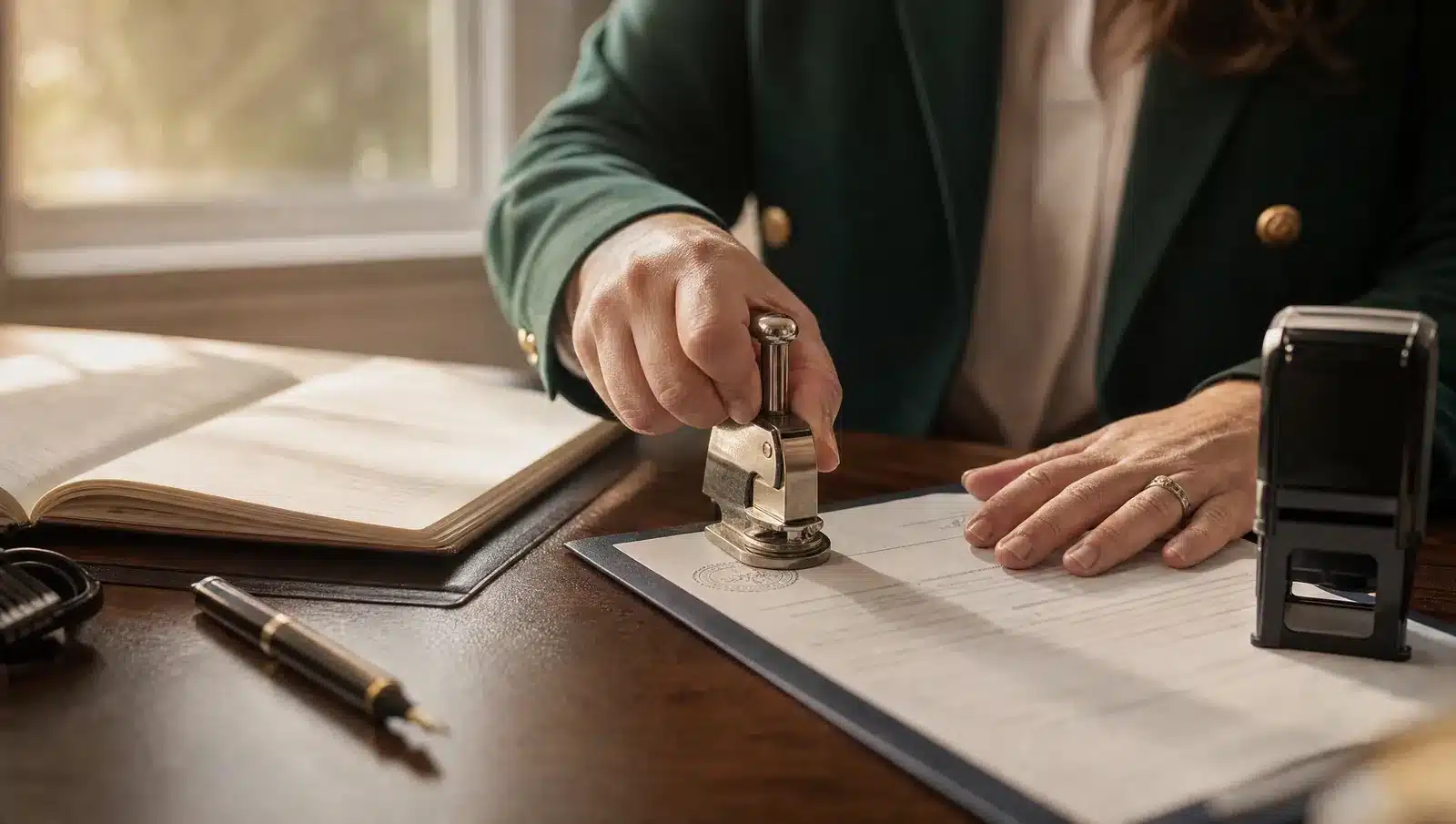
At the table we check ID, record the journal entry, watch each signature, administer the oath on affidavits, complete the certificates and apply stamp and embosser.
- Return
We scan the critical pages back to the attorney from the car and ship the originals the same day, with tracking.
- Record
The attorney records at the registry. If a clerk questions a certificate, we are reachable seven days a week to correct or re-execute.
Which certificate errors get a deed rejected, and how do we prevent them?
The rejections we see most are an expired or missing commission date, a seal that did not reproduce, a name mismatch between the certificate and the signature block, and a jurat used where an acknowledgment was required. Every one is avoidable with a review before the appointment and a second read at the table.
Wrong venue or blank date. A certificate that still says State of New Hampshire because the lender reused a template, or one with the date line left empty, is rejected on sight. We correct the venue to the county where the signing takes place and date the certificate the day the signer appears, never the closing date printed on the deed.
Missing identification clause. A Massachusetts acknowledgment states that the signer proved identity through satisfactory evidence of identification. Older and out-of-state forms often omit it. We carry Massachusetts loose certificates and attach one when the printed certificate falls short, noting the document title, date and page count so it cannot be moved to another instrument.
Capacity not stated. When a signer executes as trustee, personal representative or attorney-in-fact, the certificate should say so. A deed signed by Jane Doe as Trustee with a certificate naming only Jane Doe individually will be questioned.
Corrections made the wrong way. Correction fluid on a certificate invites rejection. A correction is a single line through the error, the correct text and the notary’s initials; if the certificate is badly wrong, we attach a fresh one.
Unreadable seal, or no printed name. The original looks fine; the registry scan shows a blank circle. Black ink stamp first, embosser second, and the notary’s printed name and signature beside it on every certificate, including the ones buried in the middle of a thick package.
M.G.L. c.222 s.22 requires a notary journal, and we keep one for every act: signer, document, ID presented and date, which is what the attorney needs if a title insurer later asks how the acknowledgment was taken. Our notary public page explains the standards the commission is held to.
How much does real estate notarization cost in Massachusetts?
Real estate signings are quoted by package, because a single deed acknowledgment and a 140-page refinance take very different amounts of time. Every mobile visit starts from a zone floor that includes travel, one notarial seal and 15 minutes of service: from $125 in Zone 1 (Tewksbury, Gardner, Ashby and Athol), from $179 in Zone 2 (Lowell, Billerica, Andover, Chelmsford, Dracut, Lawrence, Worcester and 40 more towns) and from $250 in Zone 3 (Boston, Cambridge, Newton, Lexington, Lynn, Gloucester and 110 more, hospital and nursing-home visits included).
Extra seals and extra time are quoted before we leave. A seller-side deed package with three to five certificates is one visit plus the additional seals. Loan packages are quoted flat by complexity, covering the full appointment, scan-backs and same-day shipping. Attorneys and title companies who send regular work get a standing rate.
In-office notarization at 1215 Main St, Suite 115, Tewksbury is $45 per notarial act, the least expensive way to notarize a single deed. The town-by-town list is on our notary zones page, and what a mobile notary costs in Massachusetts explains how the zones were drawn. On a refinance the lender or title company usually pays the signing agent through the closing; on a seller-side signing the seller or attorney books and pays directly.
Have a deed, mortgage or closing package to sign?
Attorneys, title companies, lenders and signers across 177 Massachusetts towns. Same-day and after-hours by confirmation.
Real estate notarization FAQ
Do I need an attorney to notarize a deed in Massachusetts?
No. Any commissioned Massachusetts notary public can take the acknowledgment on a deed. You do need an attorney to prepare the deed, because drafting it is legal work, and you need an attorney to conduct a mortgage closing. The notary’s job is identity, signature and certificate, not the content of the deed.
Does a Massachusetts deed or mortgage need witnesses?
No. Massachusetts requires an acknowledgment before a notary, not witnesses, for deeds and mortgages. Some out-of-state lenders and some receiving states still call for one or two witnesses on their forms. If your document requires them, you arrange the witnesses. We do not provide or coordinate witnesses.
Can you notarize a deed for property in another state?
Yes. A Massachusetts notary can notarize any document signed in Massachusetts, including a deed to property in Florida, New Hampshire or Maine. We use the certificate form the receiving state’s registry expects when the attorney supplies it, or attach a Massachusetts acknowledgment, which most states accept for recording.
What ID do I need for a real estate signing?
A current, unexpired government photo ID whose name matches the name on title, such as a Massachusetts driver’s license, a passport or a state ID card. If your legal name has changed since you took title, tell the attorney in advance so a name affidavit or also-known-as recital can be added to the package.
Can someone sign for me at a Massachusetts closing under a power of attorney?
Yes, if the lender and the closing attorney approve it in advance. The power of attorney must be properly executed and acknowledged, and it is recorded at the registry with the deed or mortgage it supports. We notarize the POA itself and later the agent’s signature on the closing documents, with the certificate naming the agent in that capacity.
Can real estate documents be notarized online in Massachusetts?
Massachusetts authorized remote online notarization under 2023 Acts c.2, and the registries now accept electronically notarized instruments that meet the statute. Acceptance still depends on the lender and the title insurer, and many closing attorneys continue to require in-person signing on deeds and mortgages. Ask the attorney before booking; we offer both in-person and remote online notarization.

1,190+ signings across Greater Boston and the Merrimack Valley, including deed, refinance and seller-side packages for closing attorneys and title companies. Bonded and E&O insured. Fluent in English, Arabic and French. About Hanson


