Remote I-9 Verification in 2026 for Massachusetts Employers: E-Verify Alternative Procedure vs an Authorized Representative
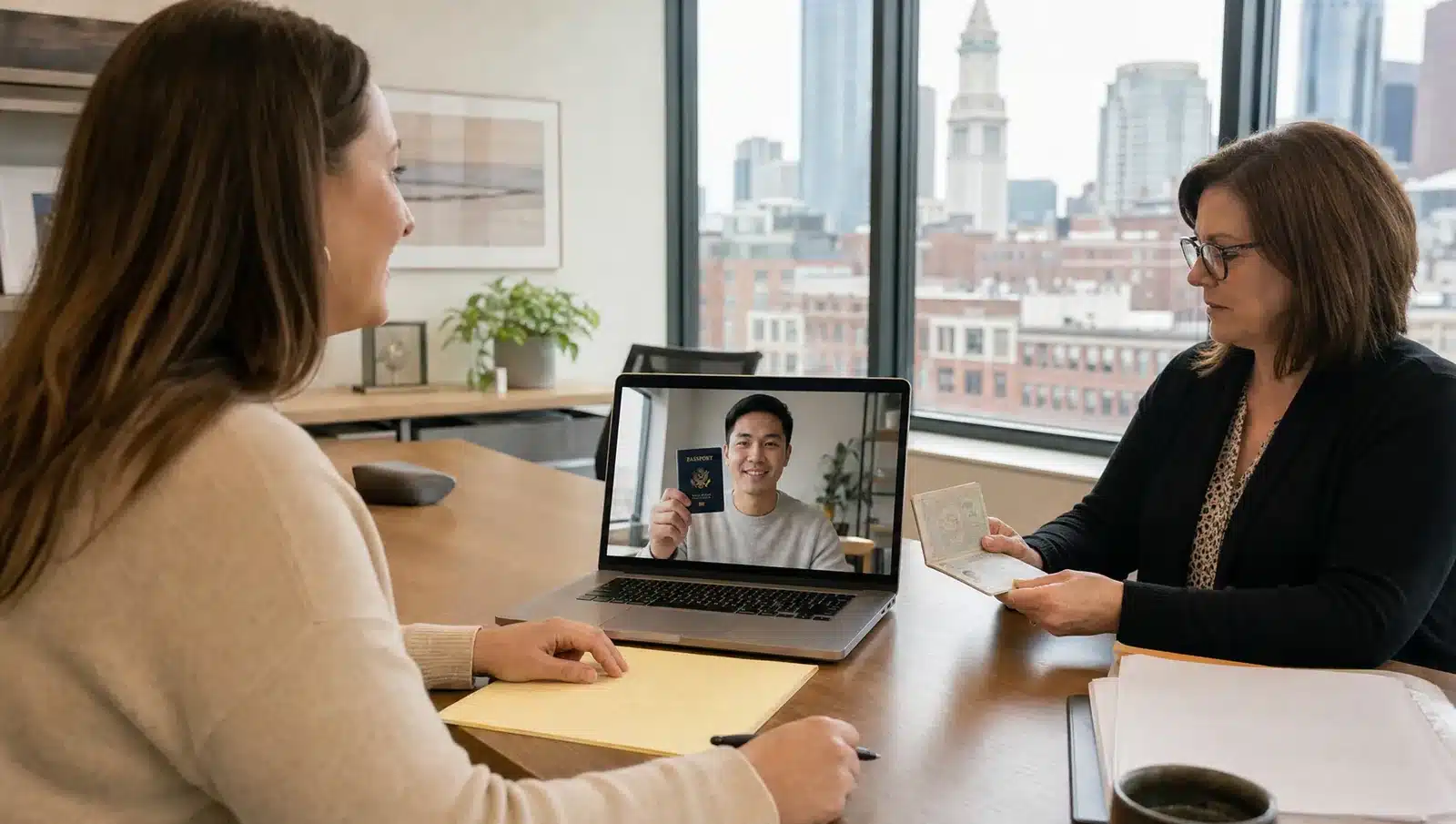
A Massachusetts employer can verify a remote hire's I-9 documents over live video only if it is enrolled in E-Verify and in good standing, under the DHS alternative procedure in effect since August 1, 2023. Every other employer must have originals examined in person within three business days, often by a notary as authorized representative.
Can a Massachusetts employer verify I-9 documents remotely in 2026?
Only E-Verify employers in good standing can. The Department of Homeland Security’s alternative procedure, published July 25, 2023 and effective August 1, 2023, lets qualified employers examine a new hire’s documents over a live video call instead of in person. Employers that do not use E-Verify have no remote option; Section 2 still requires in-person examination of the original documents.
Massachusetts does not require private employers to use E-Verify, so most small and mid-sized employers in Greater Boston are not enrolled, and for them a remote hire in Dorchester or a new engineer relocating to Cambridge means arranging an in-person document inspection by someone the employer designates. That designee is called an authorized representative, and a notary public is the person most HR teams send.
The COVID-era flexibility that let any employer inspect documents remotely ended July 31, 2023. If your handbook still describes “temporary remote I-9 inspection,” it is three years out of date. We handle these appointments through our I-9 form notary service at 1215 Main St, Suite 115, Tewksbury and at the hire’s home or your office.
What does the DHS alternative procedure require?
The alternative procedure lets an E-Verify employer in good standing examine copies of a new hire’s documents, confirm them with the employee on a live video call, check a box on Form I-9, and keep the copies. Each step is mandatory, and the procedure must be applied consistently at each hiring site where it is used.
- Be enrolled in E-Verify for the hiring site and in good standing, which includes completing the E-Verify tutorial on fraud awareness and anti-discrimination for every user.
- Have the employee send clear, legible copies of the front and back of every document they will present, before the video call.
- Hold a live video interaction with the employee, during which the employee holds up the same documents and the employer or its representative examines them to confirm they reasonably appear genuine and relate to the person.
- Check the “alternative procedure” box in the Section 2 Additional Information area of the current form (edition 01/20/25, expiring 05/31/2027).
- Retain the copies with the Form I-9 for the full retention period, including for documents that would not otherwise require copies.
- Create the E-Verify case within three business days of the first day of employment, as with any E-Verify hire.
Two limits trip employers up. First, consistency: an employer may offer remote examination to remote hires and in-person examination to on-site hires, but may not pick and choose among employees at the same site in a way that could be discriminatory. Second, if the employer falls out of good standing or leaves E-Verify, remote examination stops immediately, and remote verifications completed during a lapse are treated as violations. The procedure does not expire, applies to hires on or after August 1, 2023, and is not satisfied by recorded video, a still photo or a phone call.

What must non-E-Verify employers still do for remote hires?
A non-E-Verify employer must have the original documents physically examined, in the employee’s presence, within three business days after the employee’s first day of work for pay, by the employer or by an authorized representative the employer designates. The employee fills out Section 1 no later than the first day; Section 2 is the employer’s side and carries the deadline.
For a remote hire this is a logistics problem rather than a legal one. The regulation lets the employer appoint anyone to perform Section 2 on its behalf: a staffing agency, a branch manager, or a notary public. The authorized representative sees the original documents in person, completes and signs Section 2, and returns the form to HR.
The three-business-day clock does not pause for remote work. Monday start, Thursday deadline; weekends and federal holidays do not count. If the job will last fewer than three days, Section 2 is due on the first day. A late Section 2 is a paperwork violation, not a technicality.
Alternative procedure or authorized representative: which fits your company?
E-Verify employers in good standing may use either method; non-E-Verify employers must use in-person examination, typically through an authorized representative. This is how we explain the choice to HR teams in the 128 belt weighing E-Verify enrollment against a few in-person inspections a year.
| Question | DHS alternative procedure (remote video) | In-person examination by an authorized representative |
|---|---|---|
| Who can use it | E-Verify employers in good standing at that hiring site | Any employer, E-Verify or not |
| Who examines the documents | Employer’s own staff, over live video, using copies the employee sent | A person the employer designates, in the same room as the employee, looking at originals |
| Copies of documents | Required, front and back, kept with the I-9 | Optional unless the employer’s policy or E-Verify photo matching requires them |
| Form I-9 entries | Section 2 completed by employer, alternative procedure box checked | Section 2 completed and signed by the representative, title “authorized representative,” employer’s business name and address |
| Deadline | Three business days after the first day of work, plus the E-Verify case | Three business days after the first day of work |
| Who is liable for errors | The employer | The employer, for anything the representative does or misses |
| Typical cost in Greater Boston | E-Verify is free; staff time and a compliant electronic I-9 system | $45 at our Tewksbury office; from $179 (Zone 2) or $250 (Zone 3) for a mobile visit, travel included |
Both routes are compliant. What is not compliant is a non-E-Verify employer “doing a quick Zoom” because it saw a larger competitor do it.
How does a notary act as an I-9 authorized representative, and why no seal?
When a notary completes Section 2, the notary is acting as the employer’s agent, not as a notary public, so the notary does not notarize the form, does not affix a seal or stamp, and writes “authorized representative” in the title field. USCIS says this directly on I-9 Central: a notary public who serves as an authorized representative is not acting in the capacity of a notary and should not provide a notary seal on Form I-9.
The reason is that Form I-9 is not a notarial document. There is no oath, no acknowledgment and no notarial certificate on it. Section 2 is the representative’s attestation, under penalty of perjury, that the documents were examined and reasonably appear genuine and to relate to the employee. A seal does not make that attestation stronger; it makes it wrong, because it implies a notarial act that did not occur. The National Notary Association tells its members the same thing.
Why use a notary at all, then? Because the employer is choosing who to trust with a federal attestation it remains liable for. Notaries are commissioned by the Commonwealth, identity verification is their daily work, and they read passports, permanent resident cards and employment authorization documents every week. A notary commissioned since 2007 with more than 1,190 signings is a safer pair of eyes than the new hire’s neighbor, which is the other common choice.
What the notary does and does not do as your representative:
- Does: meet the employee in person, examine the original documents, complete every field in Section 2, enter the first day of employment you provide, sign, date, print their name, write “authorized representative” as the title, enter your business name and address, and return the form the same day.
- Does not: notarize or stamp the form, choose or suggest which documents the employee presents, complete Section 1, create your E-Verify case, or give legal advice about work authorization. If a document looks questionable, the representative notes the facts and tells HR; the employer decides.
Massachusetts has no rule like California’s, which bars most notaries from completing I-9s. A Massachusetts notary may act as an employer’s authorized representative in a non-notarial capacity, and the Section 2 signature is valid without any reference to the commission.
How is Section 2 completed, field by field?
Section 2 records which documents the employee presented, the issuing authority, document numbers and expiration dates, the first day of employment, and the examiner’s signature and attestation. The examiner must see originals (or an acceptable receipt), must not tell the employee which documents to present, and must complete the section within three business days.
- Confirm Section 1 is complete: signed, dated, one status box checked, required numbers entered. The March 2026 ICE guidance treats a missing Section 1 signature or date as a substantive violation, so the representative checks this first.
- Accept the employee’s choice of documents. One List A document (US passport, permanent resident card, employment authorization document with photo), or one List B identity document (driver’s license, state ID) plus one List C work authorization document (unrestricted Social Security card, birth certificate). The employer may not require a specific document.
- Examine the originals in the employee’s physical presence. Photocopies and phone images are not acceptable. The standard is whether the documents reasonably appear genuine and relate to the person presenting them; the examiner is not a forensic expert and is not expected to be one.
- Record each document’s title, issuing authority, number and expiration date exactly as printed.
- Enter the first day of employment, which the employer supplies.
- Sign and attest under penalty of perjury: signature, date, printed name, title (“authorized representative”), and the employer’s business name and full address.
- Use the Additional Information field for E-Verify case numbers, receipt follow-ups and, for E-Verify employers only, the alternative procedure checkbox.
- Return the form to HR for filing with Section 1; the employer, not the representative, retains it.
Copies of documents are optional for non-E-Verify employers, but an employer that copies for one employee should copy for all. E-Verify employers must copy List A documents used in photo matching.
What does an I-9 appointment look like for a remote hire in Boston, Cambridge or the 128 belt?
HR emails us the hire’s name, start date, meeting location and the Form I-9; we meet the employee within the three-day window, complete Section 2 as your authorized representative, and send the form back the same day. Appointments are $45 at our Tewksbury office, from $179 for a mobile visit in Zone 2 towns such as Burlington, Woburn, Lowell and Andover, and from $250 in Zone 3 for Boston, Cambridge, Waltham, Lexington, Newton and Wellesley, travel included.
A typical week: a Cambridge biotech that is not enrolled in E-Verify hires a research associate relocating from Chicago who starts remotely on Monday. HR sends the form Friday; we meet the employee Tuesday near their new apartment in Somerville, examine their passport, complete Section 2 and upload the form to HR by noon. A Burlington software company hires a sales rep who lives in Nashua; the rep drives to our Tewksbury office on day two for a $45 appointment.
For the employee, the appointment is ten minutes: bring the original documents, know your start date, and have Section 1 finished. For HR, tell us in advance which form edition you use and whether you want document copies; we do not decide that for you. Companies that also need corporate resolutions, CORI acknowledgments or fingerprinting for the same hire can combine them; see our pages on business and corporate notary services, CORI form notarization and mobile fingerprinting.

How long must Form I-9 be kept, and what happens in an ICE inspection?
Form I-9 must be retained for three years after the date of hire or one year after employment ends, whichever is later, and produced within three business days of an ICE Notice of Inspection. The employer keeps the form, not the authorized representative, and paper-only employers must keep the original with handwritten signatures; a photocopy does not satisfy the rule.
Practical retention rules for a remote workforce: store I-9s separately from personnel files; calendar the “later of” date for each separated employee; keep document copies and alternative-procedure records with the form; and log who acted as authorized representative for each remote hire so you can answer the inspector’s question about who examined the documents.
In an inspection, ICE serves a Notice of Inspection, you produce the forms, and ICE issues one of several notices. A Notice of Technical or Procedural Failures gives ten business days to correct technical errors; a Notice of Intent to Fine is more serious. Since the March 16, 2026 update to ICE’s Form I-9 inspection fact sheet, as reported by employment law firms, more than ten errors that used to be curable are classified as substantive violations with no correction window, including a missing Section 1 signature or date of birth and an unchecked alternative procedure box when the procedure was used.
What are the I-9 penalties in 2026?
Under the DHS civil penalty schedule effective January 2, 2025, which remains current as of October 16, 2026, paperwork violations (a missing, late or incomplete Form I-9) carry $288 to $2,861 per form, and knowingly hiring or continuing to employ an unauthorized worker carries $716 to $5,724 per worker for a first offense, $5,724 to $14,308 for a second, and $8,586 to $28,619 for a third or later offense. An employer with 100 flawed forms is exposed to between $28,800 and $286,100 before any knowing-hire charge.
ICE sets the amount within the range from the percentage of forms with substantive violations, adjusted for business size, good faith, seriousness, whether unauthorized workers were involved and prior history. A small Woburn contractor with five late Section 2s and no unauthorized workers is at the low end; a company that cannot produce forms at all is not.
Two 2026 realities matter for remote hiring. First, the March 2026 reclassification means a late or unsigned Section 2 from a mishandled remote hire is now a fine, not a correction notice. Second, a video “inspection” by a non-E-Verify employer is a Section 2 failure for every form it touched, however carefully the video was done. Penalty amounts are adjusted for inflation under federal law; check the current DHS schedule and confirm the ICE fact sheet with employment counsel, since a notary cannot give legal advice on either.
How do we serve HR teams across Massachusetts?
We act as the designated authorized representative for employers that hire remotely in Massachusetts, meeting new hires at our Tewksbury office, at the employee’s home or at your site, and completing Section 2 correctly inside the three-day window. Hanson Webb has been a Massachusetts notary public since 2007, is NNA certified, has completed more than 1,190 signings, and works in English, Arabic and French, which helps when a new hire’s questions are not in English.
What an HR team gets: one contact seven days a week at (978) 424-4629, same-day appointments when a start date slipped, a consistent process (originals only, every field completed, title “authorized representative,” no seal), same-day return of the form, and a quoted price before booking. Volume arrangements for regular remote hiring are quoted on request, and our I-9 mobile notary for Boston employers page covers downtown and Seaport logistics.
What we do not do: decide whether you should enroll in E-Verify, create E-Verify cases, judge a document beyond the “reasonably appears genuine” standard, give legal advice on work authorization, or notarize the I-9. For everything else that needs a commissioned notary at your office, from corporate resolutions to employee affidavits, start with our mobile notary service page or book online at hiremobilenotary.com/booking/.
Need this notarized this week?
Same-day and weekend mobile appointments across Greater Boston and the Merrimack Valley. Flat zone pricing, travel included.
Frequently asked questions
Can a Massachusetts employer verify I-9 documents remotely in 2026?
Only if it is enrolled in E-Verify and in good standing. The DHS alternative procedure, effective August 1, 2023, allows those employers to examine document copies over a live video call and check a box on Form I-9. Every other employer must have the original documents examined in person within three business days of the start date.
Who qualifies for the DHS alternative procedure?
Employers enrolled in E-Verify at the hiring site, in good standing, with users who have completed the E-Verify training. They must obtain legible copies of the documents, conduct a live video interaction, check the alternative procedure box, retain the copies, and apply the procedure consistently. Massachusetts does not require private employers to join E-Verify, so many Boston-area companies are not eligible.
What is an I-9 authorized representative and can a notary be one?
An authorized representative is any person the employer designates to complete Section 2 on its behalf. A notary public can serve, but acts as the employer's agent rather than as a notary. The employer remains liable for anything the representative does or misses, so most HR teams choose someone whose daily work is identity verification.
Should the notary stamp or seal the I-9?
No. USCIS states that a notary acting as authorized representative is not acting as a notary and should not provide a notary seal on Form I-9. The form contains no notarial certificate. The notary signs Section 2, prints their name, writes "authorized representative" as the title and enters the employer's business name and address.
Who carries liability when a notary completes Section 2?
The employer. USCIS is explicit that the employer is liable for any violations in connection with the form or the verification process, including those committed by its authorized representative. Give the representative the correct form edition and the first day of employment, and review the returned form on receipt.
What should a remote new hire in Boston bring to the appointment?
Original, unexpired documents: one List A document such as a US passport, permanent resident card or employment authorization document, or one List B identity document plus one List C work authorization document. No photocopies. Section 1 should already be completed and signed, and the employee should know their first day of employment. The appointment takes about ten minutes.
How fast must Section 2 be completed?
Within three business days after the employee's first day of work for pay; a Monday start means a Thursday deadline, and weekends and federal holidays do not count. If the job lasts fewer than three days, Section 2 is due on the first day. A late Section 2 is a paperwork violation carrying $288 to $2,861 per form under the 2025 schedule.
What is the current Form I-9 edition?
Edition 01/20/25, expiring 05/31/2027, shown at the bottom left and top right of the form. Earlier 08/01/23 editions remain usable until the expiration date printed on them. Always download the current form from USCIS rather than reusing a saved PDF.
How long do we keep I-9 forms for remote employees?
Three years after the date of hire or one year after employment ends, whichever is later, the same as for on-site staff. Keep any document copies and alternative-procedure records with the form, store I-9s apart from personnel files, and be ready to produce them within three business days of an ICE Notice of Inspection.