
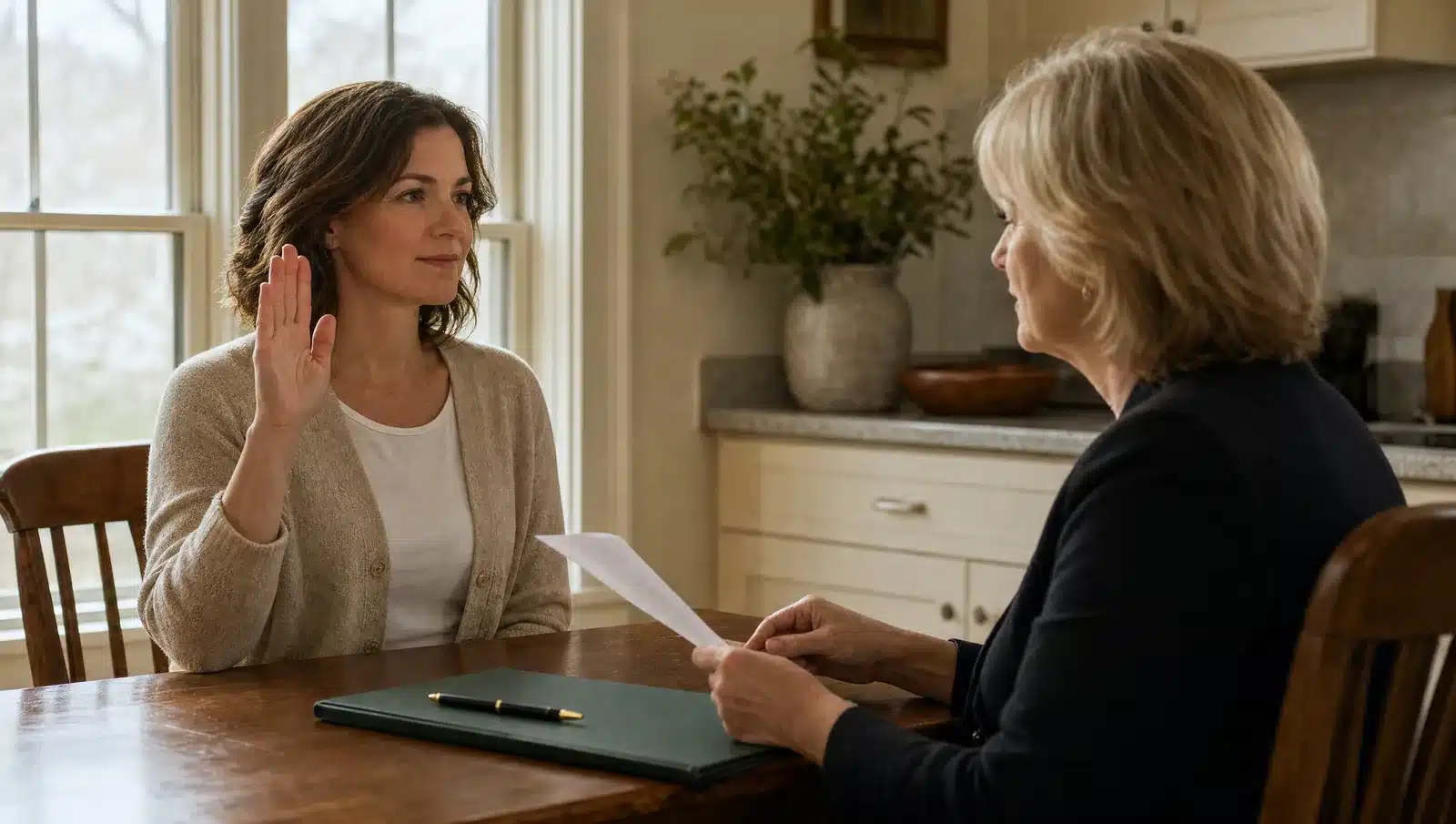
Oath Administration Notary in Massachusetts
Licensed Massachusetts notary administers oaths and affirmations under M.G.L. c.222 §1A. New notary swearing-in, municipal employees, depositions, affidavit oaths, and all sworn statements. Same-day mobile. Reviewed by James Lumas. Call (978) 424-4629.
Oath administration by a notary in Massachusetts is the act of placing a person under oath or affirmation so that what they say or sign carries the penalties of perjury. If you searched for an oath administration notary Massachusetts courts and agencies will accept, the short answer is that under M.G.L. c.222 s.1A any Massachusetts notary public may administer oaths and affirmations in all cases where one is required, with the same legal weight as an oath taken before a judge or clerk-magistrate. We administer oaths for affidavits, depositions, court filings, immigration declarations, corporate verifications, municipal oaths of office and new notary swearing-in, at our Tewksbury office for $45 per notarial act or at your location as a mobile visit. This page explains exactly what will happen and what to bring.
Hanson Webb has been a Massachusetts Notary Public since 2007, is NNA certified, and has completed 1,190+ signings. He administers oaths in English, Arabic and French. Call (978) 424-4629 or (978) 851-0199, or book an oath appointment online.
What does it mean when a Massachusetts notary administers an oath?
Administering an oath means the notary asks you, in person, to swear or affirm that a statement is true, and you answer out loud. From that moment the statement is made under the penalties of perjury, and a knowingly false statement can be prosecuted under M.G.L. c.268 s.1 exactly as if it had been made in a courtroom. That is the entire point of the ceremony: it converts a written claim into sworn testimony.
The authority comes from M.G.L. c.222 s.1A: “Unless otherwise expressly provided, justices of the peace and notaries public may administer oaths or affirmations in all cases in which an oath or affirmation is required and take acknowledgments of deeds and other instruments.” The grant is broad. Anywhere Massachusetts law or a receiving agency requires an oath, a notary may administer it, unless a specific statute reserves that oath to someone else.
Three things must be true for the oath to be valid. You must appear in person before the notary (or through an approved remote platform where Massachusetts allows it). The notary must identify you through satisfactory evidence of identity. And you must actually take the oath, by voice or by an unmistakable gesture, rather than simply signing a page that contains the words “sworn to.”
Oath vs. affirmation: what is the difference, and which should you choose?
An oath is a solemn promise that invokes a deity; an affirmation is the same promise made on your personal honor without any religious reference. Massachusetts treats them as legally identical. You choose which one you take, the notary may not insist on either, and the penalties for a false statement are the same.
M.G.L. c.222 s.1 defines both terms. People choose an affirmation for religious reasons, for conscientious objection to swearing, or simply because they prefer it. Nothing on the document changes except the word; a jurat certificate reads “swore or affirmed” so that either form is covered. If you have no preference, Hanson will ask which you would like and proceed.
The verbal ceremony we use
For an oath on a written statement: “Do you solemnly swear that the statements in this document are true and accurate to the best of your knowledge and belief, so help you God?” For an affirmation: “Do you solemnly affirm, under the penalties of perjury, that the statements in this document are true and accurate to the best of your knowledge and belief?” You answer “I do.” For a deposition or live testimony, the wording changes to “that the testimony you are about to give will be the truth, the whole truth and nothing but the truth.”
Hanson asks the question aloud, waits for the answer, and only then completes the certificate. Raising your right hand is customary but not required. What is required is a clear, audible, affirmative answer; a nod, a mumble or silence does not count, and a notary who skips the question and simply stamps the page has not administered an oath at all.
Oaths in Arabic and French
Because Hanson is fluent in Arabic and French, he administers the oath in the language the person understands best and records in the journal which language was used. This matters for immigration declarations, consular affidavits and family documents where the signer’s English is limited. A notary may not administer an oath to a person who cannot understand it, and an interpreter is not a substitute for the notary’s own understanding of the exchange. See our Arabic notary service for Arabic-language documents.
Jurat vs. acknowledgment: when does a document need an oath?
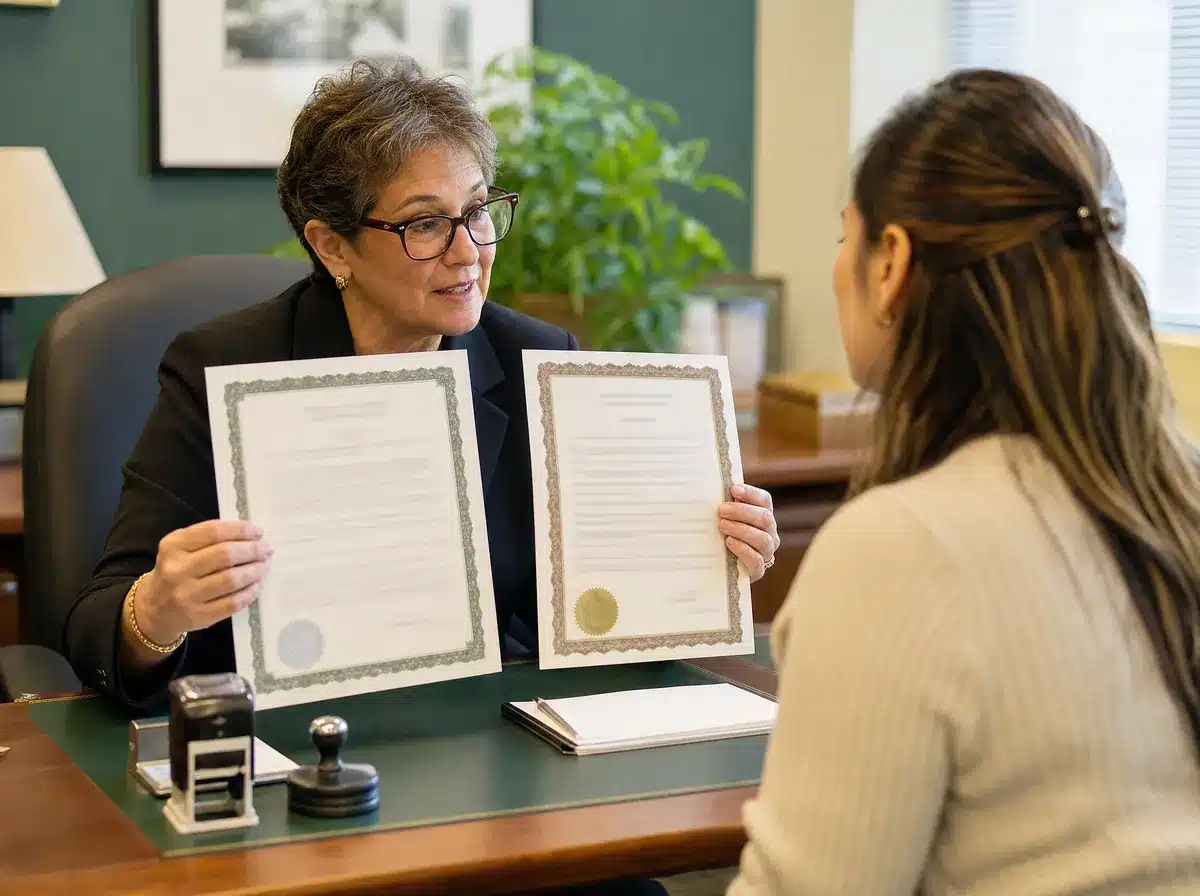
A jurat is the notarial act in which you sign in the notary’s presence and swear or affirm that the contents are true; it always includes an oath. An acknowledgment is the act in which you declare that you signed a document voluntarily for its stated purpose; it never includes an oath. The notarial certificate printed at the end of your document tells you which one the drafter intended.
Massachusetts prescribes both certificates in M.G.L. c.222 s.15. The jurat reads, in part: “…personally appeared ____, proved to me through satisfactory evidence of identification, which was ____, to be the person who signed the preceding or attached document in my presence, and who swore or affirmed to me that the contents of the document are truthful and accurate to the best of (his)(her) knowledge and belief.” The acknowledgment reads: “…to be the person whose name is signed on the preceding or attached document, and acknowledged to me that (he)(she) signed it voluntarily for its stated purpose.”
| Jurat (oath or affirmation) | Acknowledgment | |
|---|---|---|
| What you are doing | Swearing the contents are true | Confirming the signature is yours and voluntary |
| Sign in front of the notary? | Yes, always | No; you may sign earlier and acknowledge later |
| Oath administered? | Yes | No |
| Certificate language | “swore or affirmed to me that the contents of the document are truthful and accurate” | “acknowledged to me that (he)(she) signed it voluntarily for its stated purpose” |
| Typical documents | Affidavits, sworn statements, verified complaints, financial statements for court, immigration declarations, applications requiring verification | Deeds, powers of attorney, trusts, contracts, corporate resolutions, mortgages |
| Perjury exposure | Yes, for the contents | No oath, so no perjury for contents (other laws may still apply) |
If the certificate is missing, the notary cannot choose for you; that would be legal advice. Ask the court, agency or attorney who will receive the document which act they require. Our guide to acknowledgment vs. jurat in Massachusetts goes deeper, and the receiving party’s instructions always control.
An oath without a signature
Not every oath is attached to a document. A deponent is sworn before testifying and signs nothing at that moment. A new notary takes an oath of office. A town board member is sworn in. In these cases the notary administers the oath and either completes a separate certificate or signs the official’s qualification form; there is no jurat on a statement because there is no statement.
Who needs a notary to administer an oath in Massachusetts?
Anyone whose document or testimony must be “sworn,” “verified,” “under oath” or “under the penalties of perjury” before a notary needs oath administration. The most common requests we handle are affidavits for court, deposition oaths, immigration sworn statements, corporate verifications, municipal oaths of office and new notary swearing-in.
Affidavits and sworn statements
Court affidavits, financial statements in Probate and Family Court, affidavits of identity and residency, name-change affidavits, RMV title and lien affidavits, lost-document affidavits, and sworn statements for insurers and banks. Every one of these is a jurat. We administer the oath, watch you sign, and complete the certificate. Details on what to bring are on our affidavit and sworn statement notarization page.
Depositions
Under Massachusetts Rule of Civil Procedure 28(a) and M.G.L. c.222 s.1A, a notary may administer the oath to a deponent. The notary swears the deponent before testimony begins and takes no part in questioning. Court reporters are often commissioned notaries and swear the deponent themselves; when the reporter is not a notary, or the deposition is being recorded by video or by a remote reporter who is not commissioned in Massachusetts, counsel books us to attend. We travel to law offices in Boston, Cambridge, Lowell, Andover, Worcester and across our service area, and we can swear a deponent at a hospital bedside or a home when he or she cannot travel.
Court filings
Verified complaints, verified answers, sworn motions, affidavits in support of restraining orders, small claims statements of damages, and probate filings such as affidavits of domicile and petitions that require verification. Clerks reject unsworn verifications, and a jurat with a blank identification line is an unsworn verification as far as the clerk is concerned.
Immigration and consular documents
Sworn statements supporting I-130 and I-751 petitions, affidavits of support, declarations of relationship, single-status affidavits for marriage abroad, consent-to-travel letters for minors, and consular declarations that must be sworn before a U.S. notary and then apostilled. Hanson administers these in English, Arabic or French and completes the certificate to the standard the Secretary of the Commonwealth checks for apostille purposes.
Corporate and regulatory verifications
Officers swearing to the contents of resolutions, annual reports, license applications, regulatory submissions, insurance proof-of-loss statements and sworn financial certifications. We come to your office for same-day corporate oath administration anywhere in our service area.
Municipal and public oaths of office
Town board members, conservation commission and school committee appointees, election workers and new municipal employees are often required to take an oath of office before serving. The town clerk usually administers it, but when timing or location makes that impractical, a notary may. We administer oaths of office at town halls and at the official’s home or workplace.
New notary swearing-in
A newly commissioned Massachusetts notary must be sworn in before the commission is active. The sequence: the Governor’s Council approves the application, the applicant pays the $60 commission fee to the Secretary of the Commonwealth, the Secretary issues the commission, and the new notary brings the commission and government-issued ID to an authorized officer, commonly a current notary public, who administers the oath of office and completes the qualification section. We provide same-day new notary swearing-in at the Tewksbury office and at your location. Do not perform any notarial acts until you have been sworn in; doing so is a violation of Massachusetts law.
How does an oath appointment work, step by step?
You present a current government-issued photo ID, Hanson confirms your identity and that you understand the document, he administers the oath or affirmation aloud, you answer and sign in his presence, and he completes the jurat certificate, signs, seals and records the act in his journal. Most single-document oath appointments take 10 to 15 minutes.
- Do not sign in advance. A jurat requires the signature to be made in the notary’s presence. If you have already signed, you will sign again below or initial a fresh signature line, depending on what the receiving party will accept.
- Identification. Satisfactory evidence of identity under M.G.L. c.222 means a current document issued by a federal or state government with your photograph and signature, such as a driver’s license, passport, state ID card or permanent resident card, or the notary’s personal knowledge of you. Our guide to what ID is accepted for notarization in Massachusetts covers expired IDs, foreign passports and names that do not match.
- Review for completeness, not content. Hanson checks that the document has no blank spaces that should be filled, that your name matches your ID, and that the certificate is present. He does not read for legal effect and cannot advise you on what to swear to.
- The oath. Spoken aloud, in your language, answered aloud.
- Signature and certificate. You sign; Hanson completes the venue, date, your name, the identification used, signs exactly as commissioned, prints his name, adds the commission expiration and applies the seal.
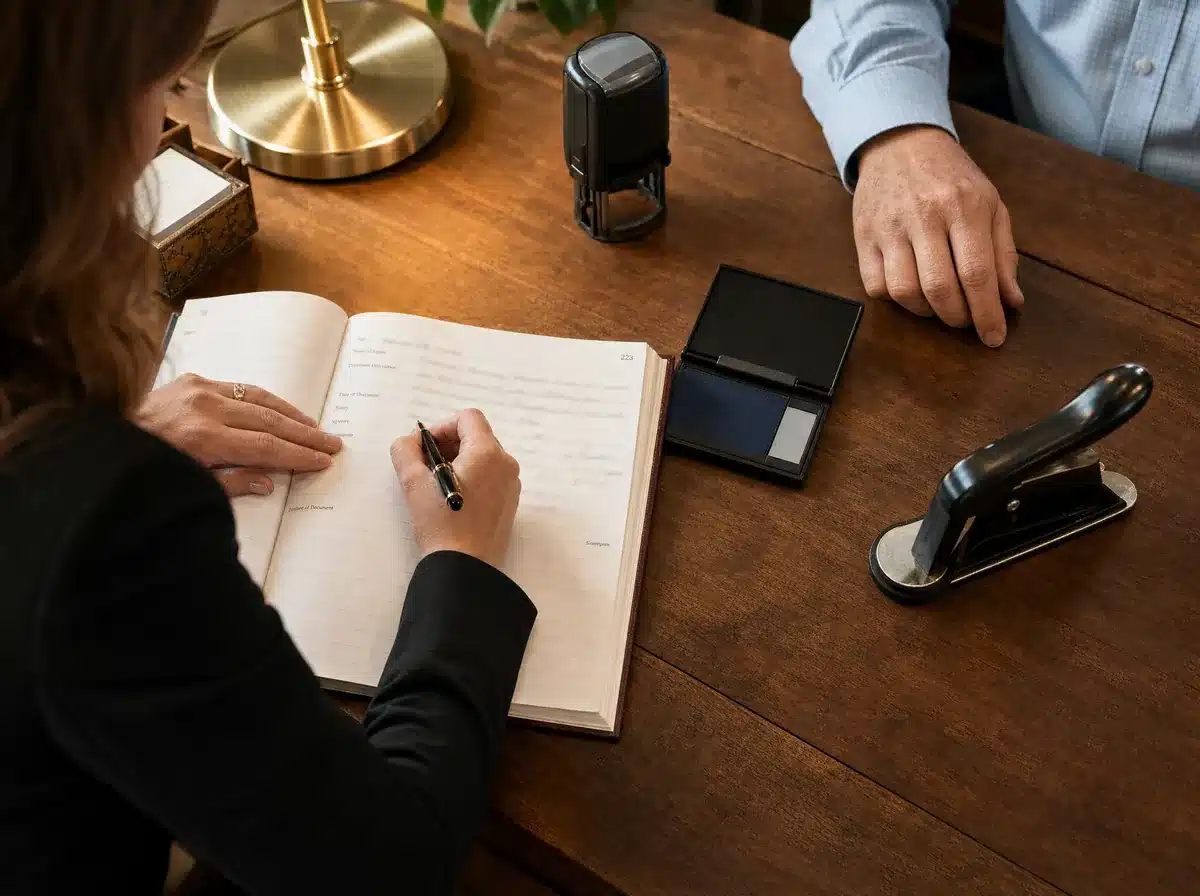
- Journal entry. Date, type of act, document description, your name and ID. Massachusetts requires the journal, and the entry is what allows the act to be verified later.
Each sworn document is one notarial act. Three affidavits for three agencies are three acts. At the office each act is $45; on a mobile visit the first seal is included in the zone fee and additional seals are quoted before we arrive.
Oath administration notary Massachusetts options: office, mobile, hospital and remote
We administer oaths at our Tewksbury office Monday through Friday by appointment, and at your home, office, law firm, hospital room or care facility 7 days a week across 177 Massachusetts cities and towns, with same-day and after-hours visits by confirmation. Massachusetts also authorized remote online notarization under 2023 Acts c.2 for notaries who register with the Secretary and use an approved platform.
Mobile oath administration pricing
- Zone 1, from $125 per visit: Tewksbury, Gardner, Ashby and Athol.
- Zone 2, from $179 per visit: Lowell, Billerica, Andover, Chelmsford, Dracut, Lawrence, Worcester, Fitchburg, Leominster, Concord, Burlington, Woburn and more than 40 other towns. Our most-booked zone.
- Zone 3, from $250 per visit: Boston, Cambridge, Newton, Lexington, Wellesley, Weston, Lynn, Gloucester, North Andover and more than 110 others. Hospital and nursing-home visits included.
Every mobile rate includes travel, one notary seal and 15 minutes of service. Extra seals and time are quoted up front. Deposition attendance is quoted by the hour because the notary stays for the session.
Hospital and bedside oaths
Affidavits and sworn statements are frequently needed from people who cannot travel: a patient swearing to a financial statement for court, a parent at a hospital swearing to a consent letter, an elder in a nursing home verifying a petition. The signer must be alert, able to understand the oath and able to answer it. If the person cannot respond, the oath cannot be administered, and we will say so rather than complete a certificate that would not hold up.
Remote online notarization
Massachusetts enacted remote online notarization in 2023 Acts c.2. A Massachusetts notary who has registered with the Secretary of the Commonwealth and uses an approved audio-video platform may administer an oath to a signer who appears by video, with identity proofing and a recorded session. Not every receiving party accepts a remote jurat, and some courts and consulates still require a wet-ink signature made in the physical presence of the notary. Ask the receiving party first, then read our remote online notarization page for current availability.
Why do sworn documents get rejected, and how do you avoid it?
Clerks, agencies and the Secretary of the Commonwealth reject sworn documents when the jurat is incomplete, when the signature was not made in the notary’s presence, when the identification line is blank, or when the wrong certificate was used. Each of these is preventable at the appointment, and each is something Hanson checks before he seals.
- Pre-signed affidavit. A jurat says you signed in the notary’s presence. If you signed at home, the notary cannot truthfully complete it. Bring the document unsigned.
- Blank identification line. The Massachusetts jurat states what identification was used. A certificate that leaves that blank is incomplete and is routinely rejected by Probate and Family Court clerks and by the Commissions Section for apostilles.
- Acknowledgment used where a jurat was required. A verified complaint or a financial statement with an acknowledgment certificate is unsworn. The receiving party will send it back.
- Name mismatch. The name on the document should match the ID. A maiden name, a missing middle initial or a nickname can hold up a filing. Fix the document before the appointment or bring supporting ID.
- Missing pages or exhibits. The oath covers the document as presented. If an exhibit is referenced but not attached, attach it before the oath.
- Oath not actually administered. If a notary stamps a jurat without asking the question aloud, the document is not sworn, and the signer may later find that out in the worst possible setting. We administer every oath aloud, every time.
- Wrong venue or date. The venue is the county where the oath was taken, and the date is the date of the appointment, not the date typed on the document.
When a sworn document comes back rejected, re-execution is usually a single appointment: a fresh copy, a new oath, a new signature and a complete certificate. Call and we will tell you whether the original can be salvaged or should be re-sworn.
What a notary cannot do when administering an oath
A Massachusetts notary may not tell you what to swear to, draft or edit the statement, explain its legal effect, or administer an oath to someone who does not understand it or appears to be acting under pressure. The notary also may not administer an oath to a document that is incomplete or to a person who refuses to take it aloud.
- No legal advice. Whether your affidavit says the right things, whether it needs an exhibit, or whether a jurat or an acknowledgment is required are questions for an attorney or for the receiving party.
- No oaths to absent signers. The person must appear before the notary, in person or by approved remote platform. A spouse cannot swear on your behalf, and we cannot notarize a signature that was made somewhere else.
- No witnesses supplied. Some sworn documents, such as self-proving affidavits attached to wills, require witnesses as well as a notary. You arrange your own witnesses and bring them to the signing; we do not provide, coordinate or act as witnesses.
- No oath for a person who cannot answer. If a signer is sedated, confused or unable to communicate, the oath cannot be administered that day.
- No blank-document oaths. Blanks that should be filled are filled before the oath, or lined through.
Massachusetts is an attorney-closing state, and the same discipline applies here: we provide the notarial act the court, agency or attorney needs, and we leave the legal work to them. M.G.L. c.222 sets the standards of conduct Massachusetts notaries follow, and Hanson’s 18-plus years of practice are built on it.
Frequently asked questions
Can a notary administer an oath in Massachusetts?
Yes. Under M.G.L. c.222 s.1A, a Massachusetts notary public may administer oaths and affirmations in all cases where one is required. The oath has the same legal weight as one taken before a judge or clerk-magistrate, and a knowingly false statement under it is perjury under M.G.L. c.268 s.1. The person must appear in person, be identified, and take the oath aloud.
What is the difference between an oath and an affirmation?
An oath invokes a deity (“so help you God”); an affirmation is made on personal honor under the penalties of perjury without a religious reference. Both are defined in M.G.L. c.222 s.1, both are legally equivalent, and you choose which you take. The notary may not require one or the other.
What is the difference between an oath and a jurat?
The oath is the spoken act of swearing or affirming. The jurat is the full notarial act and certificate that records it: you appeared, were identified, signed in the notary’s presence, and swore or affirmed that the contents are true. Nearly every affidavit notarization is a jurat, and the oath is the part that makes the affidavit sworn.
What words does the notary say when administering the oath?
For a written statement: “Do you solemnly swear (or affirm) that the statements in this document are true and accurate to the best of your knowledge and belief?” For testimony: “…that the testimony you are about to give will be the truth, the whole truth and nothing but the truth?” You answer “I do” aloud. Hanson administers the oath in English, Arabic or French.
What ID do I need for an oath administration notary Massachusetts appointment?
A current government-issued identification with your photograph and signature, such as a Massachusetts driver’s license or ID card, a U.S. or foreign passport, or a permanent resident card. The name on the ID should match the name on the document. If you have no acceptable ID, call before booking so we can discuss what Massachusetts law allows.
Can a notary administer the oath at a deposition?
Yes. Massachusetts Rule of Civil Procedure 28(a) and M.G.L. c.222 s.1A allow a notary to swear the deponent. The notary places the deponent under oath before testimony and takes no part in questioning. We attend depositions at law offices, hospitals and homes across our service area, and attendance is quoted by the hour.
Does a new Massachusetts notary need to be sworn in?
Yes. After the Governor’s Council approves the application and the $60 commission fee is paid, the Secretary of the Commonwealth issues the commission, and the new notary must take the oath of office before an authorized officer, commonly a current notary public, before performing any notarial act. We provide same-day new notary swearing-in at our Tewksbury office and at your location.
How much does oath administration cost?
At our Tewksbury office, $45 per notarial act. As a mobile service, from $125 in Zone 1 (Tewksbury, Gardner, Ashby, Athol), from $179 in Zone 2 (Lowell, Billerica, Andover, Worcester, Burlington, Woburn and more) and from $250 in Zone 3 (Boston, Cambridge, Newton, Lexington, Wellesley, Weston, Lynn, Gloucester and more), including travel, one seal and 15 minutes. Extra seals and deposition time are quoted.
Can the oath be administered over video?
Massachusetts authorized remote online notarization in 2023 Acts c.2 for notaries registered with the Secretary of the Commonwealth using an approved platform. Some courts, agencies and consulates still require an in-person, wet-ink jurat. Confirm with the receiving party first; if remote is acceptable, see our remote online notarization page for current availability.
Do you provide witnesses for sworn documents that require them?
No. If a sworn document such as a self-proving will affidavit requires witnesses in addition to the notary, you arrange your own witnesses and bring them to the appointment. We administer the oath and complete the notarial certificate; we do not supply, coordinate or act as witnesses.

1,190+ signings across Greater Boston and the Merrimack Valley. Fluent in English, Arabic and French. About Hanson