
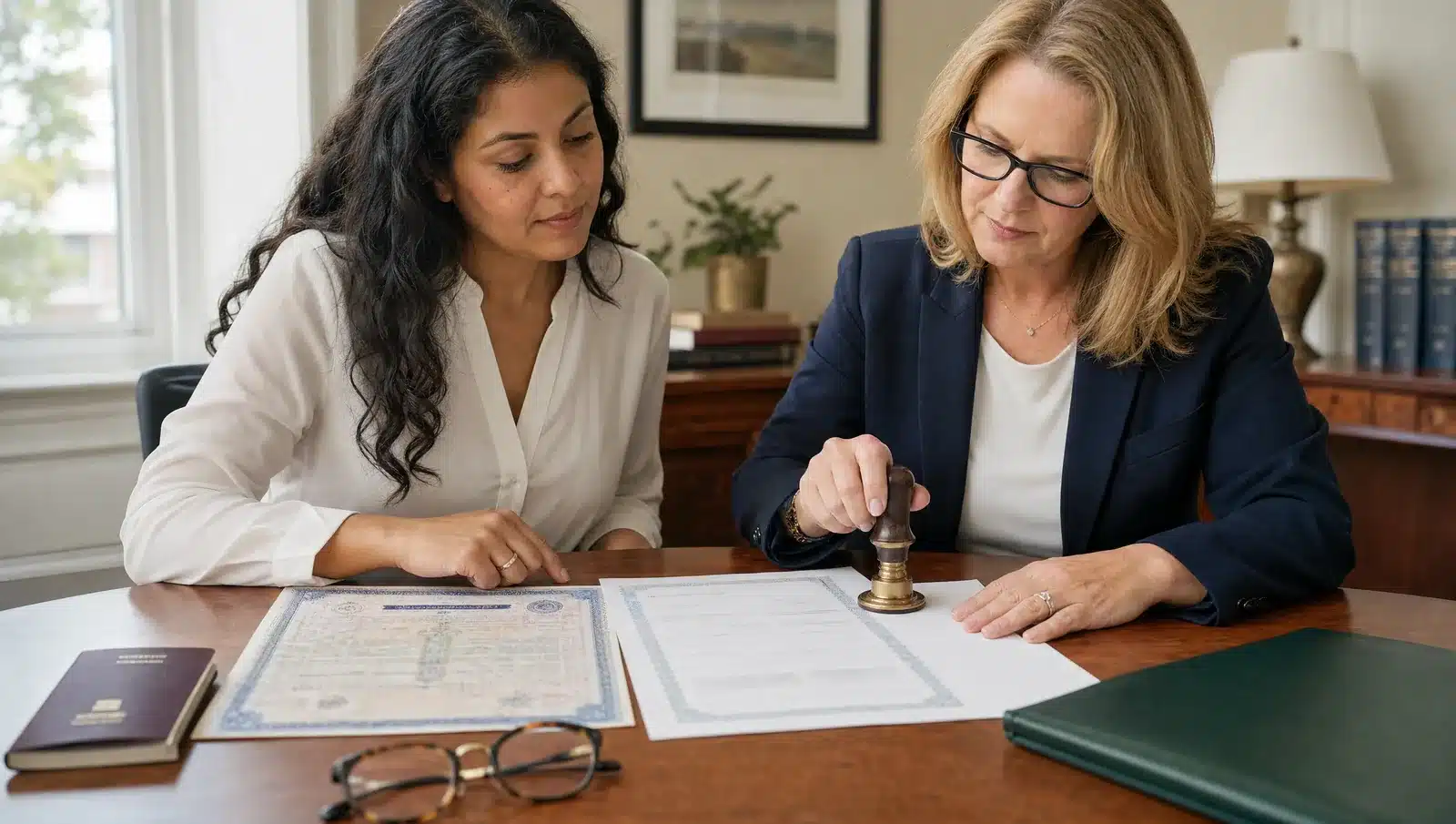
Certified Translation Services in Massachusetts
Certified translation services in Massachusetts from Hire Mobile Notary: birth and marriage certificates, diplomas, legal and business documents. Call (978) 424-4629.
Our certified translation services Massachusetts clients use for USCIS filings, apostilles, university admissions and legal matters produce a complete, accurate translation accompanied by a signed translator’s certification, and, when the receiving party requires it, a notarized translator’s statement. Arabic and French translations are handled in house by Hanson Webb, who is fluent in both languages and has been a Massachusetts Notary Public since 2007; Spanish, Portuguese, Chinese, Russian, Ukrainian, Italian, Greek, Turkish, Romanian, Vietnamese and other languages are produced through our network of professional, accredited translators. Quotes are given by document and language. Notarization of the translator’s statement is $45 per notarial act at our Tewksbury office.
Hire Mobile Notary is a service of Neighborhood Parcel at 1215 Main St, Suite 115, Tewksbury, MA 01876. Call (978) 424-4629 or (978) 851-0199, email a scan of your document for a quote, or book an appointment online if you also need the translator’s statement notarized or the original apostilled.
Certified, notarized or sworn translation: which one do you need?
A certified translation is a translation plus a signed statement from the translator that it is complete and accurate and that the translator is competent in both languages. A notarized translation is a certified translation whose translator’s statement has been signed before a notary public, so the signature can be verified and, if needed, apostilled. A sworn translation is produced by a translator appointed by a foreign court or government, and exists only in countries that have that system. USCIS wants the first; many consulates and foreign universities want the second; Spain, France, Italy, Brazil and several other countries want the third for documents used inside their borders.
| Certified translation | Notarized translation | Sworn translation | |
|---|---|---|---|
| What it is | Translation plus translator’s signed certification of completeness, accuracy and competence | Certified translation whose translator’s statement is signed before a Massachusetts notary | Translation by a translator officially appointed in the destination country |
| Who signs | The translator (and our quality assurance reviewer) | The translator, with the notary’s jurat or acknowledgment attached | The appointed sworn translator, with his or her official stamp |
| Who accepts it | USCIS, most U.S. courts, universities, employers, credential evaluators | Consulates, foreign universities, foreign banks, Secretary of the Commonwealth for apostille | Courts and agencies inside the country that appointed the translator |
| Where we fit | We produce it in English, Arabic and French in house and in other languages through partners | We produce it and notarize the statement for $45 per act in office | We produce the certified U.S. translation if the foreign authority accepts it, and tell you when it will not |
Ask the receiving party which of the three it wants before ordering. A notarization you did not need costs $45; a sworn translation you did need, obtained after the fact in the destination country, costs weeks. We will read the instructions with you, in English, Arabic or French, and tell you which column applies.
What “certified” means in the United States
There is no government license for translators in the United States. “Certified translation” refers to the certification statement, not to the translator’s status. Our certifications are signed by the translator and by a quality assurance reviewer, dated on the date of completion, addressed to the applicant, printed on letterhead, and include the translator’s credentials. That format satisfies USCIS, state courts, universities and the Secretary of the Commonwealth.
What does USCIS require for a translated document?
USCIS requires that any foreign-language document submitted with an application or petition be accompanied by a full English translation and a certification from the translator stating that the translation is complete and accurate and that the translator is competent to translate from the foreign language into English. The rule is at 8 CFR 103.2(b)(3). USCIS does not require the translation to be notarized.
Our USCIS translations follow that rule exactly. Each one includes:
- A complete, literal translation of the entire document, including stamps, seals, signatures, handwritten notes, margins and the back of the page. Nothing is summarized or omitted; “illegible” is written where the original cannot be read.
- A layout that mirrors the original so an officer can match each field.
- A certification page with the translator’s statement of accuracy and competence, name, signature, date and contact details, and the signature of our quality assurance reviewer.
- A copy of the source document attached behind the translation.
Documents we translate for USCIS every week: birth certificates, marriage and divorce certificates, death certificates, police clearance certificates, passports and national ID cards, military records, academic diplomas and transcripts, bank statements and employment letters for affidavits of support, adoption decrees, medical records for waivers, and sworn declarations from family members abroad. For Arabic-language civil records from Egypt, Lebanon, Jordan, Syria, Iraq, Morocco and the Gulf states, and French-language records from France, Haiti, Quebec, West Africa and the Maghreb, the translation is done by Hanson personally.
What USCIS will reject
- Partial or summary translations, including “extract” translations unless the issuing country produces an official extract.
- Translations by the applicant or a family member with an interest in the case. USCIS does not prohibit this outright, but officers routinely issue requests for evidence when the translator is the beneficiary’s spouse.
- Machine translations without a competent human certification.
- Certifications missing the competence statement, the date or the signature.
When an officer issues a request for evidence over a translation, the clock on the case keeps running. Getting the certification right the first time is cheaper than a second filing.

How do translations work with an apostille?
An apostille authenticates a signature, not a translation. For a translation to be apostilled, the translator’s statement must be signed before a Massachusetts notary, and the Secretary of the Commonwealth then authenticates the notary’s signature for the $6 state fee. In many cases, though, the receiving country prefers to have the original apostilled in Massachusetts and the translation done locally, so the sequence must be confirmed before anything is ordered.
The three sequences we see, and when each applies:
- Apostille the original only; translate abroad. Spain, Italy, France, Brazil and other countries with sworn-translator systems usually want a Massachusetts apostille on the original certified record and a sworn translation made in their own country. We handle the apostille; you take the apostilled original to a sworn translator there.
- Apostille the original and the notarized translation together. The United Arab Emirates, Saudi Arabia, Morocco, Egypt, Lebanon and many consulates accept a U.S. translation when the translator’s statement is notarized and apostilled alongside the original. Two documents, two $6 state fees, one packet. Hanson translates to or from Arabic and French, notarizes the statement, and submits both for apostille.
- Translate into English for use in the United States, then apostille for use abroad. Less common, but it comes up with dual-citizenship files and international adoptions where a foreign document must be read by a U.S. agency and then sent on with the agency’s response.
The notarization of the translator’s statement is a separate notarial act at $45 in the office. Because a notary may not notarize his own signature, when Hanson is the translator his statement is signed before another Massachusetts notary public, and we build that step into the quote and the timeline. Details on the state step are on our Massachusetts apostille service page.
What the notarized translator’s statement says
The statement is a short affidavit by the translator: that he or she is competent in the source and target languages, that the attached translation of the described document is complete and accurate to the best of his or her knowledge, and the date. It is signed before the notary, who completes a Massachusetts jurat under M.G.L. c.222 s.15 recording that the translator appeared, was identified, signed in the notary’s presence and swore or affirmed to the contents. The notary is certifying the translator’s oath and signature, not the quality of the translation; that is why the Secretary of the Commonwealth can apostille it and why the translator’s own credentials still matter to the receiving party.
Which documents do we translate, and what does each package include?
We translate civil records, identity documents, academic records, legal instruments, police and medical records, financial statements and business materials. Every certified package includes the full translation, the signed certification page and a copy of the source; notarization and apostille are added only when the receiving party requires them.
| Document | Usual recipient | Certification needed | Notarization or apostille |
|---|---|---|---|
| Birth, marriage, divorce and death certificates | USCIS, consulates, Probate and Family Court, Social Security | Certified | Notarized for consulates; apostilled with the original for use abroad |
| Passports, national ID cards, residence permits | USCIS, banks, employers | Certified | Rarely; a notarized copy certification of the original may be requested instead |
| Police clearance and criminal record certificates | USCIS, foreign employers, licensing boards | Certified | Often notarized when going abroad |
| Diplomas, transcripts, course descriptions | Universities, WES and other evaluators, licensing boards | Certified | Notarized on request; apostille follows the registrar route |
| Powers of attorney, wills, trusts, inheritance declarations | Foreign courts and notaries, Massachusetts probate court, banks | Certified | Usually notarized and apostilled with the original |
| Contracts, judgments, pleadings, exhibits | Courts, attorneys, arbitrators | Certified, with translator’s affidavit when counsel requests | Affidavit sworn before a notary |
| Medical records, vaccination records, disability determinations | USCIS waivers, schools, insurers, physicians | Certified | Rarely |
| Bank statements, tax returns, employment letters | USCIS affidavits of support, consulates, lenders | Certified | Rarely |
| Adoption decrees and home studies | USCIS, foreign central authorities | Certified | Notarized and apostilled for the foreign authority |
| Employee manuals, HR policies, safety materials, marketing, product descriptions | Your own workforce and customers | Usually not certified | No |
For documents in the last row, accuracy still matters, but there is no certification page because no agency is receiving the file. Those jobs are priced by volume, delivered in editable formats, and can run under a translation account for businesses with ongoing needs.
Translations for universities and credential evaluation
Universities, licensing boards and credential evaluators such as World Education Services require certified translations of foreign diplomas, transcripts, course descriptions and degree certificates, usually alongside official records sent directly by the issuing school. The translation must reproduce the grading scale, credit hours, course titles and any notes exactly as printed, because the evaluator converts them to U.S. equivalents line by line.
What we provide for academic use: a complete translation of each page in a layout that matches the original, a glossary where the source country’s academic terms have no direct English equivalent, and a certification page the evaluator will accept. For Arabic-language records from Egyptian, Lebanese, Jordanian, Moroccan and Gulf universities, and French-language records from French, Belgian, Swiss, Quebec, Haitian and West African institutions, Hanson handles the translation personally and understands the grading conventions. Students applying to UMass Lowell, Northeastern, Boston University, Tufts, Harvard, MIT and the state universities, and professionals applying to Massachusetts licensing boards in nursing, engineering, pharmacy and teaching, use the same service.
If the evaluator or university also wants a notarized statement, we add the $45 notarial act. If the receiving school is overseas and wants an apostille on the U.S. degree, that is the registrar-certification route described on our apostille page, and the translation follows the sequence above.
Translations for legal, court and business use
Courts, attorneys and businesses need translations that can be relied on in a proceeding or a transaction: contracts, powers of attorney, court judgments, affidavits and declarations, deposition exhibits, corporate records, financial statements, employee manuals and product documentation. We produce certified translations in those categories and, because Hanson is a notary who speaks Arabic and French, we can also administer an oath in those languages to a signer whose statement is being translated.
Litigation and court filings
Massachusetts courts expect foreign-language exhibits to be accompanied by a certified English translation. We translate judgments, pleadings, correspondence, text messages and recordings transcribed in Arabic or French, and provide a translator’s affidavit sworn before a notary when counsel wants it in affidavit form. See our affidavit and sworn statement notarization page for how that affidavit is executed.
Contracts, powers of attorney and estate documents
A Massachusetts power of attorney destined for Morocco, a Lebanese inheritance declaration to be used in Massachusetts probate, a French employment contract for a relocating executive. We translate the document, notarize the translator’s statement when required, and, for documents going abroad, submit the packet for apostille. A notary cannot draft or interpret these documents; translation reproduces what the document says, and legal questions go to an attorney.
Business and HR documents
Employee manuals and human resources documents, product descriptions, advertising and marketing materials, financial statements and balance sheets, PDF documentation and safety materials for multilingual workforces. These are usually not certified, since no agency is receiving them, and they are priced by volume. Business clients who translate regularly can open a translation account for recurring work; non-disclosure agreements are welcome and the translators in our network work under binding confidentiality contracts.
Arabic-language and French-language notarizations that accompany these translations are described on our Arabic notary service and French documents notary service pages.
How do certified translation services Massachusetts clients order from us actually work?
Send us a clear scan or photo of every page of the document, tell us the target language and who will receive the translation, and we reply with a written quote and a delivery date. Most translations are delivered within 24 to 72 hours of approval, with proofreading and one round of revisions included; same-day service is available for urgent documents when the schedule allows.
- Send the document. Email or upload a scan at 300 dpi or a sharp phone photo of each page, front and back, including blank pages with stamps. Illegible scans produce “illegible” in the translation, so send the best image you have, or bring the original to the Tewksbury office and we will scan it.
- Tell us the purpose. USCIS, a consulate, a university, a court, an employer, an apostille. The purpose determines the format of the certification and whether notarization is needed.
- Approve the quote. Pricing is by document and language, stated in writing before work begins. Multi-page documents, handwritten text and rare language pairs take longer and are quoted accordingly.
- Translation and review. The translator produces the draft; a second reviewer proofreads it against the source for completeness, numbers, names and dates. Names are spelled exactly as they appear in the passport you provide, which prevents mismatches at USCIS.
- Delivery. A PDF with the certification page by email, and signed hard copies by mail, courier or pickup at 1215 Main St, Suite 115, Tewksbury. One round of revisions is included if the receiving party asks for a change.
- Notarization and apostille, if required. The translator’s statement is signed before a notary at the office for $45 per act, and the packet goes to the Secretary of the Commonwealth if the destination needs an apostille.
What to send, by document type
- Civil records (birth, marriage, divorce, death): the full certificate including the back, plus the passport page showing the exact spelling of each name in Latin letters.
- Academic records: every page of the transcript, the diploma, and any grading-scale legend printed on the back.
- Police certificates: the certificate and any attached stamps or apostilles already on it.
- Legal documents: the complete document with all exhibits and signature pages, and the name of the receiving court or agency.
- Business documents: editable files where possible, a glossary of product or company terms, and the target audience.
How much do certified translations cost, and how long do they take?
Translations are quoted by document and language after we see the pages, because a one-page birth certificate and a twelve-page transcript with a dense grading legend are different jobs. The quote is in writing before work starts and does not change unless you change the scope. Notarization of the translator’s statement is $45 per notarial act at the Tewksbury office. Apostilles carry the $6 Massachusetts state fee plus our service fee.
Turnaround for most documents is 24 to 72 hours from approval. Same-day delivery is available for urgent single documents when the schedule permits; tell us the deadline and we will say yes or no up front rather than miss it. Hard copies by USPS Priority Mail or FedEx add transit time; pickup in Tewksbury does not.
If you need the translator’s statement notarized at your location rather than at the office, the mobile notary fee applies: from $125 per visit in Zone 1 (Tewksbury, Gardner, Ashby, Athol), from $179 in Zone 2 (Lowell, Billerica, Andover, Chelmsford, Dracut, Lawrence, Worcester, Fitchburg, Leominster, Concord, Burlington, Woburn and more than 40 other towns) and from $250 in Zone 3 (Boston, Cambridge, Newton, Lexington, Wellesley, Weston, Lynn, Gloucester, North Andover and more than 110 others), each including travel, one seal and 15 minutes. For a single statement, the office rate on our in-office notary service page is the economical choice.
Quality control and confidentiality
Every translation is proofread by a second person against the source before it is certified, and every certification is signed by the translator and the reviewer. Documents and personal details are handled confidentially; translators in our network work under binding confidentiality agreements, and non-disclosure agreements are available for business and legal clients on request.
What we check before a translation leaves the office: every name against the passport spelling you gave us; every date in the format the receiving agency expects; every number, including identity numbers and registry references; every stamp and seal described in brackets; and the certification page for the statement of competence, the signatures and the date. Hanson’s 18-plus years as a Massachusetts notary, and the Secretary of the Commonwealth’s habit of returning anything with a blank or a mismatch, have made that checklist a reflex.
What we do not do: promise that an agency will accept a document, since acceptance is the agency’s decision; translate documents we cannot read clearly; or give legal or immigration advice. A notary cannot tell you which USCIS form to file or whether your foreign divorce is recognized in Massachusetts. For those questions, consult an immigration attorney; for the translation and the notarization, call us.
Frequently asked questions
What are certified translation services Massachusetts agencies and USCIS will accept?
A certified translation is a complete, accurate translation accompanied by a signed statement from the translator that it is complete and accurate and that the translator is competent in both languages. USCIS requires exactly that under 8 CFR 103.2(b)(3) and does not require notarization. Our certifications are signed by the translator and a quality assurance reviewer, dated, on letterhead, with the translator’s credentials.
Does USCIS require a notarized translation?
No. USCIS requires a certified translation with the translator’s statement of accuracy and competence. Notarization is not required for USCIS filings. Consulates, foreign universities and the Secretary of the Commonwealth for apostille purposes often do require the translator’s statement to be notarized, which we provide for $45 per notarial act at our Tewksbury office.
Which languages do you translate?
Arabic and French are translated in house by Hanson Webb, who is fluent in both. Spanish, Portuguese, Chinese, Russian, Ukrainian, Italian, Greek, Turkish, Romanian, Vietnamese, Japanese and other languages are produced through our network of professional, accredited translators under the same certification and review process. Tell us the language pair and we will confirm availability with the quote.
How much does a certified translation cost?
Quotes are given by document and language after we see the pages, in writing, before work begins. Notarization of the translator’s statement is $45 per notarial act at the office. Apostilles are the $6 Massachusetts state fee plus our service fee. We do not publish a per-page rate because document length, legibility and language pair change the work involved.
How long does a certified translation take?
Most documents are delivered within 24 to 72 hours of quote approval, with proofreading and one revision included. Same-day service is available for urgent single documents when the schedule permits. Notarization adds an appointment at the office; an apostille adds the Secretary of the Commonwealth’s processing time, which is same day in person for up to four documents or about 10 business days by mail.
Can you translate my document and then apostille it?
Yes, when the destination country accepts a U.S. translation. The translator’s statement is signed before a notary, and the Secretary of the Commonwealth apostilles the notary’s signature for $6 per document. Some countries instead require a sworn translation made locally, in which case we apostille the original only and tell you to translate abroad. Tell us the destination country first.
Can I translate my own documents for USCIS?
USCIS regulations do not expressly forbid it, but officers frequently issue requests for evidence when the translator is the applicant, the beneficiary or a close relative, because the certification of competence and impartiality carries less weight. A translation by an independent translator with a proper certification avoids that delay.
Do I need to send the original document?
No. A clear scan or photo of every page is enough to translate and certify. Bring or send the original only if the receiving party also wants a notarized copy certification or an apostille on the original record, both of which require the physical document at our office.
Will the translation match my name exactly as it appears on my passport?
Yes, if you send us the passport page. Transliteration from Arabic, Cyrillic, Chinese and other scripts can produce several valid English spellings, and USCIS and universities match records by the spelling on your passport. We use the spelling you provide and note any variant that appears in the source document.
Do you provide witnesses for translated documents that need them?
No. Translation and notarization of a translator’s statement never require witnesses. If the underlying document you are signing, such as a will or a power of attorney, requires witnesses under Massachusetts law or the law of the receiving country, you arrange your own witnesses and bring them to the signing; we do not supply, coordinate or act as witnesses.

1,190+ signings across Greater Boston and the Merrimack Valley. Fluent in English, Arabic and French. About Hanson