
Affidavit and Sworn Statement Notarization in Boston
Licensed mobile notary for affidavit and sworn statement notarization across Boston and Greater Massachusetts. Jurat notarizations, oaths & affirmations, identity and residency affidavits, financial statements, RMV corrections, and more. In-office Tewksbury or mobile statewide. Call (978) 424-4629.
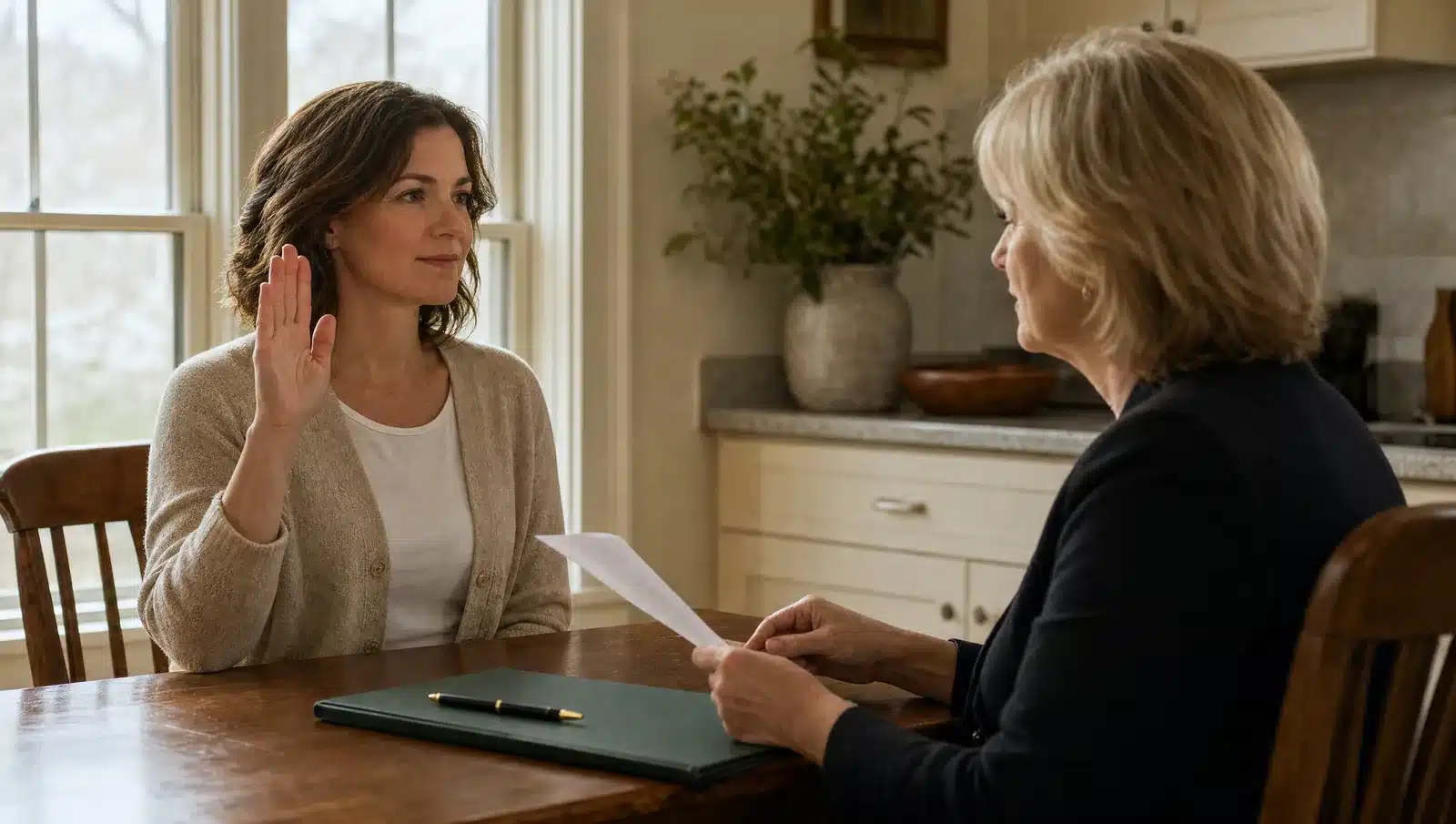
An affidavit is a written statement of facts that you swear or affirm to be true in front of a notary public. Our affidavit notarization Boston service brings a Massachusetts notary to your home, office, hospital room or attorney’s conference room anywhere in Greater Boston and the Merrimack Valley, administers the oath, watches you sign and completes the jurat certificate so the document is accepted by the court, agency or institution that asked for it. Mobile visits follow our zone fees: from $125 in Zone 1, from $179 in Zone 2 and from $250 in Zone 3, travel included. In-office notarization at 1215 Main St, Suite 115, Tewksbury, MA 01876 is $45 per notarial act.
Hanson Webb has been a Massachusetts Notary Public since 2007, is NNA certified, BBB A+ accredited and has completed more than 1,190 signings in English, Arabic and French. Call (978) 424-4629 or (978) 851-0199, or book an affidavit appointment online. Bring the finished, unsigned affidavit and a current government photo ID; we handle the rest.
What is an affidavit and why does it need a notary?
An affidavit is a sworn written statement. The person making it, the affiant, swears or affirms before a notary public that the facts in the document are true, and the notary records that oath in a certificate called a jurat. Knowingly making a false statement in a sworn affidavit is perjury under Massachusetts law.
The notary is not there to judge whether your statement is correct. The notary is there to confirm who you are, put you under oath, watch you sign and certify that all three things happened on a stated date in a stated place. That certificate is what turns a piece of paper into evidence a clerk, judge, bank or consulate will rely on without calling you in to testify.
Under M.G.L. c.222, a Massachusetts notary may perform four core notarial acts: acknowledgments, jurats (oaths and affirmations), signature witnessings and copy certifications. Affidavits use the jurat. M.G.L. c.222 sets the standards of conduct the notary follows while doing it: verify identity from satisfactory evidence, confirm the signer is acting willingly and is aware of what the document is, complete the certificate fully and record the act in the notary’s journal.
A sworn statement, a declaration under oath, a verification and a sworn affidavit all work the same way. If the receiving party wants it “sworn,” “notarized” or “under oath,” you need a jurat, and you need to sign in front of the notary, not before.
Jurat vs. acknowledgment: why an affidavit always takes a jurat
A jurat certifies that you swore an oath and signed in the notary’s presence. An acknowledgment certifies only that you appeared, were identified and confirmed that a signature already on the page is yours and was made willingly. An affidavit is a sworn statement, so it must carry a jurat; an acknowledgment on an affidavit leaves the document without the oath that gives it legal weight, and many courts will reject it.
| Feature | Jurat (oath or affirmation) | Acknowledgment |
|---|---|---|
| What the notary certifies | You swore or affirmed the contents are true and signed in the notary’s presence | You appeared, were identified and declared the signature is yours and voluntary |
| Oath administered | Yes, aloud, before you sign | No |
| When you may sign | Only in front of the notary | Before or during the appointment |
| Certificate wording begins | “Subscribed and sworn to (or affirmed) before me…” | “…personally appeared … and acknowledged to me that he/she signed it voluntarily…” |
| Typical documents | Affidavits, sworn statements, financial statements for court, verifications, applications that say “sworn” | Deeds, powers of attorney, trusts, contracts, mortgages |
| Statute | M.G.L. c.222 s.15 | M.G.L. c.222 s.15 |
Most affidavits arrive with the correct jurat wording already printed under the signature line. When a document arrives with no certificate at all, we attach a loose Massachusetts jurat certificate. When a document arrives with an acknowledgment block but the title and body say “sworn,” we will ask you which act the receiving party requires, because a notary may not choose the act for you. If you are unsure, read our guide to the difference between an acknowledgment and a jurat in Massachusetts or ask the clerk or attorney who gave you the form.
Oath or affirmation: you choose
An oath invokes a higher power (“Do you solemnly swear…”). An affirmation does not (“Do you solemnly affirm, under the penalties of perjury…”). Both have identical legal effect in Massachusetts, and you may take either for religious or personal reasons. Hanson administers the oath or affirmation in English, Arabic or French so you understand exactly what you are swearing to.
How does affidavit notarization work, step by step?
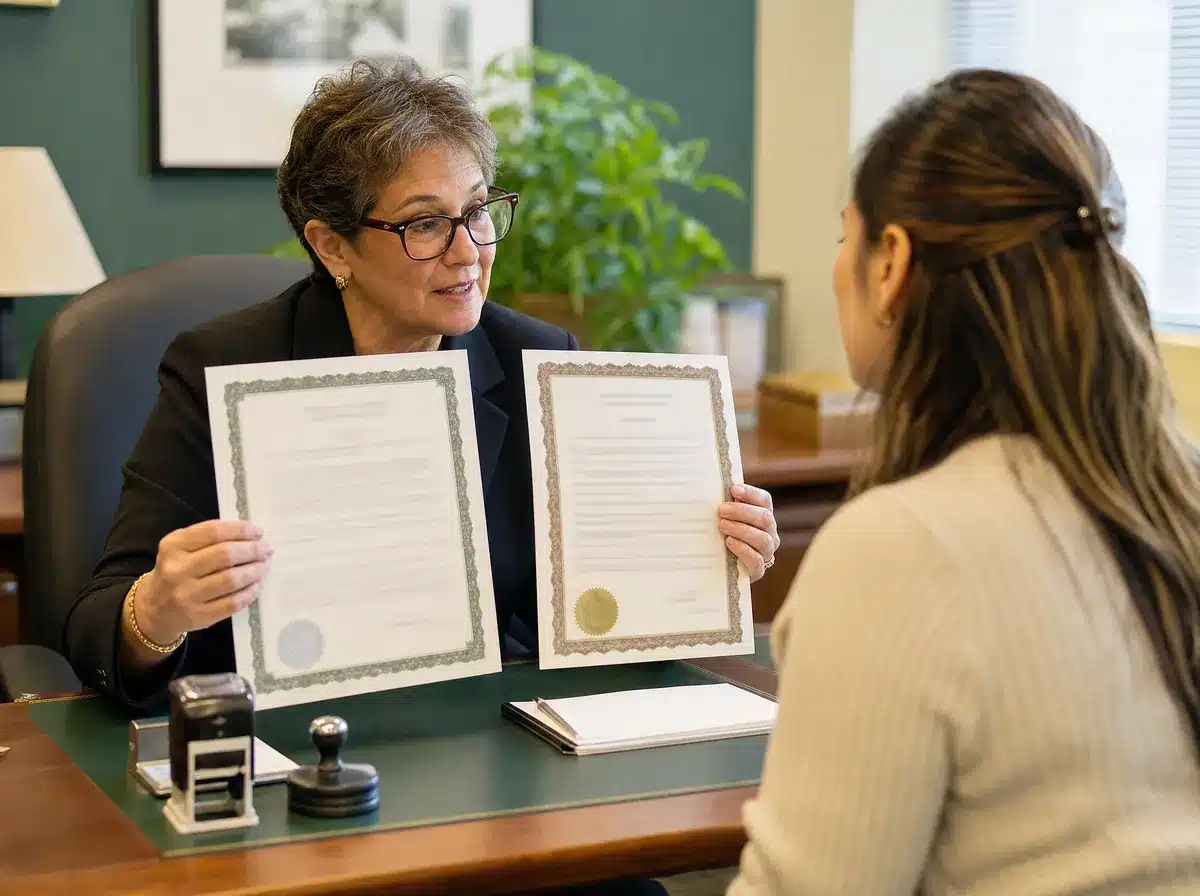
You prepare the affidavit in full, leave the signature line blank, and meet the notary with your photo ID. The notary checks the ID and the document, administers the oath, watches you sign, completes and seals the jurat certificate and records the act in the journal. A single-signer affidavit takes about 10 to 15 minutes.
- Book and prepare. Call (978) 424-4629 or book online. Tell us how many affidavits, how many signers and where you are. Fill in every blank in the document before the appointment. Do not sign it.
- Meet the notary. For a mobile visit Hanson comes to your home, office, hospital room or attorney’s office. For in-office service, come to 1215 Main St, Suite 115, Tewksbury, Monday through Friday by appointment.
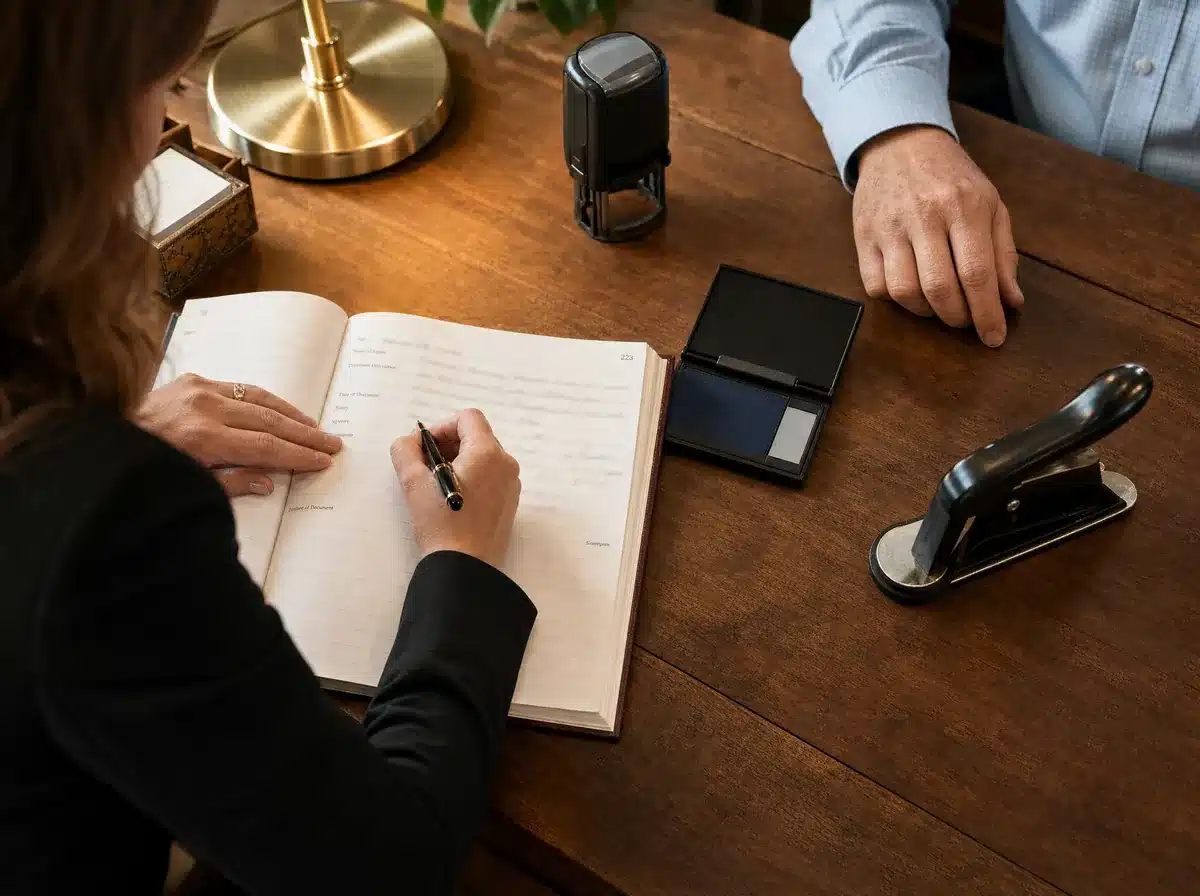
- Identity check. The notary examines your current government-issued photo ID and confirms the name on the ID matches the name on the affidavit. Details are entered in the notary’s journal as M.G.L. c.222 s.22 requires.
- Document review. The notary scans the document for blank spaces, missing pages and the type of certificate it carries. A notary does not read for legal content and cannot tell you whether the statement helps your case.
- Oath or affirmation. Hanson asks you to swear or affirm that the contents are true and correct. You answer aloud. This is the step that makes the document an affidavit.
- Sign in the notary’s presence. You sign the affidavit while the notary watches. If the affidavit has initials on each page, you initial them now as well.
- Jurat completed. The notary fills in the venue (Commonwealth of Massachusetts, county), the date, your name, how you were identified, then signs, prints the commissioned name, adds the commission expiration date and applies the seal.
- You keep the original. Deliver it to the court, agency or institution. If it is going abroad, we can take it on to the Secretary of the Commonwealth for an apostille.
What the jurat certificate must contain
M.G.L. c.222 s.15 sets out the required elements of a Massachusetts notarial certificate. A jurat that is missing any of them can be bounced by a clerk months later, when you may no longer be able to find the notary. We complete every one of these on every affidavit:
- Venue: “Commonwealth of Massachusetts” and the county where the notarization took place
- The date of the notarization
- The name of the affiant exactly as it appears in the document
- A statement that the affiant appeared in person and was identified through satisfactory evidence, naming the type of ID
- The words “subscribed and sworn to (or affirmed) before me”
- The notary’s signature exactly as commissioned, printed name, the words “Notary Public” and the commission expiration date
- The notary’s official seal or stamp
Which affidavits and sworn statements do we notarize?
Any statement that must be sworn before a Massachusetts notary, in English, Arabic or French, at your location or in our Tewksbury office. These are the categories we see every week in Boston, Cambridge, Lowell, Andover and Worcester, with the detail that matters for each.
Court and litigation affidavits
Affidavits in support of motions, affidavits of service, affidavits of indigency, affidavits of compliance and sworn statements filed in the Massachusetts Trial Court, the Probate and Family Court, Housing Court, Land Court and the federal courts in Boston and Worcester. Court rules in Massachusetts also allow many filings to be signed “under the pains and penalties of perjury” without a notary; your attorney or the clerk will tell you which form your filing needs.
Financial affidavits
Income and asset statements for divorce and child support, bankruptcy schedules, probate inventories and sworn statements of debt. Probate and Family Court financial statements are a frequent request because a clerk will not accept them unsigned or unsworn. Bring supporting pages so nothing is left blank.
Affidavit of identity and name change affidavits
Statements that explain a middle initial, a hyphenated surname, a maiden name or a name that appears differently across a passport, a Massachusetts license and a birth certificate. Banks, the Social Security Administration, the RMV and pension funds ask for these. The name on your ID must match at least one version of the name in the affidavit; bring the secondary document that shows the other version.
Affidavit of residency and domicile
Proof of address for school enrollment in Boston, Newton, Lexington and Wellesley, residency for in-state tuition, vehicle registration, licensing applications and lease disputes. Many districts supply their own sworn form; use theirs rather than a generic template.
Affidavit of title and real estate affidavits
Seller’s and owner’s affidavits at closing, affidavits of no liens, affidavits under M.G.L. c.183 s.5B prepared by attorneys to clear a chain of title at the Registry of Deeds, and death and heirship affidavits recorded with a deed. Massachusetts is an attorney-closing state; we notarize these documents for the closing attorney or title company, who remain responsible for the transaction.
RMV affidavits
Registry of Motor Vehicles affidavits to correct a title or registration error, support a lost title claim or explain an odometer discrepancy, where the RMV form specifically calls for a notary.
Travel consent affidavits
Sworn parental consent for a child traveling abroad with one parent, a grandparent or alone. Airlines, border officers and foreign consulates each have their own expectations; many want the consent in the destination country’s language, so clients often pair this with an apostille.
Witness statements and incident affidavits
Sworn accounts of an accident, a workplace incident, a landlord dispute or an insurance loss. The person who saw the event is the affiant; they appear, swear and sign. This is a sworn statement by someone who observed something, not a witness to your signature, and it does not change the rule that we do not supply witnesses for any document.
Heirship and small estate affidavits
Declarations identifying the heirs of a person who died without a will, used to transfer bank accounts, vehicles and other assets without a full probate proceeding. Banks and the RMV in Massachusetts often require them to be sworn.
Employment, income and relationship affidavits
Sworn confirmations of employment, salary, family relationship or cohabitation for mortgage lenders, landlords, pension funds, insurers and immigration petitions.
Immigration affidavits
USCIS no longer requires a notary on Form I-864, but consulates, immigration attorneys and foreign ministries still ask for sworn declarations of support, relationship, single status, residence and good moral character. We notarize these daily for clients in Boston’s Arabic- and French-speaking communities, and Hanson reads the document in the signer’s language before administering the oath.
Business and corporate affidavits
Sworn statements by officers and managers: lost stock certificate affidavits, affidavits of authority, trade name affidavits, sworn construction statements and lien waivers, and sworn statements that accompany bids and licensing applications.
Who uses our affidavit notarization Boston service?
Four groups make up most of our affidavit work: individuals and families handling a court or agency deadline, attorneys and law firms who need a field notary, HR and corporate teams, and immigrant and international clients with documents in Arabic or French.
- Individuals and families. Name changes, residency, heirship, travel consent, RMV corrections, Probate and Family Court financial statements. We come to your kitchen table in Billerica or your hospital room at Beth Israel.
- Attorneys and law firms. Client affidavits for motions, discovery and estate matters, signed at the client’s home when the client cannot come to the office. Attorney billing and document drop-off at the Tewksbury office are available.
- HR teams and businesses. Employment verifications, corporate declarations, sworn statements for lenders and regulators, on site at your office in Burlington, Woburn or the Seaport.
- Immigrant and international clients. Sworn declarations for USCIS and consular cases, and affidavits in Arabic or French that must be sworn by a notary who understands them. See our Arabic notary service in Boston for how a bilingual notarization works.
What do you need to bring, and which IDs are accepted?
Bring the completed, unsigned affidavit, a current government-issued photo ID, any witnesses the document itself calls for, and your payment. The name on the ID must match the name on the affidavit, and the ID must be unexpired.
Checklist for the appointment
- Finished document. Every blank filled, every exhibit attached, every page present. We cannot notarize a document with blanks that could be completed later.
- Unsigned signature line. If you already signed, print a clean copy. A jurat cannot be completed on a signature the notary did not watch.
- Personal knowledge of the facts. You will swear the contents are true. If a paragraph is wrong, correct it before the appointment; a notary cannot edit your statement.
- Government photo ID. See the table below.
- Your own witnesses, if the form requires them. Some affidavits, especially those drafted for other states or countries, have signature lines for one or two witnesses. You arrange those people and bring them with ID. We do not provide, supply, bring, coordinate or serve as witnesses.
- Payment. Card, Apple Pay, Zelle, PayPal or cash.
Satisfactory evidence of identity in Massachusetts
| Document | Accepted for an affidavit? |
|---|---|
| Massachusetts driver’s license or Mass ID | Yes |
| Out-of-state driver’s license or state ID | Yes |
| U.S. passport or passport card | Yes |
| U.S. military ID | Yes |
| Permanent resident card | Yes |
| Foreign passport with photo and signature | Yes |
| Expired ID of any kind | No |
| Student ID, work badge, Social Security card, birth certificate | No, not on their own |
M.G.L. c.222 requires a current document issued by a government with the signer’s photograph and signature, or another form of satisfactory evidence allowed by the statute. For the full list and the edge cases, read what ID is accepted for notarization in Massachusetts. If your name has changed and your ID shows the old name, bring the marriage certificate or court order along with the ID.
How much does affidavit notarization cost in Massachusetts?
In our Tewksbury office an affidavit is $45 per notarial act. A mobile visit is priced by zone, with travel, one notary seal and 15 minutes of service included: from $125 in Zone 1 (Tewksbury, Gardner, Ashby, Athol), from $179 in Zone 2 (Lowell, Billerica, Andover, Chelmsford, Dracut, Lawrence, Worcester, Fitchburg, Leominster, Concord, Burlington, Woburn and more than 40 other towns) and from $250 in Zone 3 (Boston, Cambridge, Newton, Lexington, Wellesley, Weston, Lynn, Gloucester, North Andover and more than 110 others).
| Service | Fee | What is included |
|---|---|---|
| In-office, 1215 Main St, Suite 115, Tewksbury | $45 per notarial act | One jurat and seal per affiant per document |
| Mobile, Zone 1 | From $125 per visit | Travel, one seal, 15 minutes |
| Mobile, Zone 2 | From $179 per visit | Travel, one seal, 15 minutes |
| Mobile, Zone 3 | From $250 per visit | Travel, one seal, 15 minutes |
| Hospital or care facility visit | Quoted at booking | Zone fee plus any coordination the visit requires |
| Additional affidavits or signers at the same visit | Quoted up front | Each additional seal and extra time |
Each affiant on each document is a separate notarial act, because each one takes a separate oath and gets a separate certificate. If three family members each sign an affidavit of heirship, that is three acts. We tell you the total before we start, and we do not add fees afterward.
Which mistakes get affidavits rejected, and how do you avoid them?
Affidavits come back from clerks for a short list of reasons, and every one is preventable at the appointment. Pre-signing, blanks, name mismatches and the wrong certificate are the four we see most.
- Signed before the appointment. The notary did not see you sign, so no jurat can be issued. Reprint and sign in front of the notary.
- Blank spaces. A date, a dollar figure or an address left empty. Complete the form first, or draw a line through the blank and initial it if the field does not apply.
- Name on the affidavit does not match the ID. “Mike” on the form, “Michael” on the license. Correct the document before the appointment, or bring the secondary document that bridges the two names.
- Acknowledgment instead of jurat. A sworn document with the wrong certificate. We attach the correct one when the receiving party confirms it.
- Missing pages or unattached exhibits. The notary certifies the document as presented. Staple exhibits before the oath.
- Affiant does not understand the document. If you cannot explain what you are swearing to, the notary will pause. For Arabic and French speakers, Hanson reads the document in that language so the oath means something.
- Corrections after notarization. Changing a word after the seal is applied voids the notarization. Bring a corrected version and swear again.
- Wrong venue or missing commission date on the certificate. The notary’s error, not yours. We complete every certificate element on every affidavit.
Affidavits at hospitals, for out-of-state courts and for use abroad
An affiant who is in a hospital bed, a rehab unit or a nursing home can still swear an affidavit, as long as they are awake, understand what they are signing and have ID. An affidavit for another state’s court is sworn under Massachusetts law and is accepted everywhere in the United States. An affidavit for use in another country usually needs an apostille after the jurat.
Bedside affidavits
We notarize affidavits at Massachusetts General, Brigham and Women’s, Beth Israel Deaconess, Tufts Medical Center, Boston Medical Center, Lahey in Burlington, Lowell General and skilled nursing facilities across Middlesex and Essex counties. We call the floor first, confirm the patient is alert, and keep the oath short and clear. Hospital and facility visits are quoted at booking and confirmed in advance.
Affidavits for other states
A Massachusetts jurat is valid in every U.S. state. If the form arrives with another state’s certificate wording, we attach a Massachusetts-compliant jurat so the certificate is legal where it was signed. Tell the receiving court it was notarized in Massachusetts; nobody will object.
Affidavits for use abroad
Single status affidavits for marriage abroad, consent to travel, declarations of residence for a foreign tax authority and sworn statements for inheritance cases in Lebanon, Morocco, France or Brazil need a jurat first and then an apostille from the Massachusetts Secretary of the Commonwealth. Our Massachusetts apostille service takes the sworn affidavit from your signing to the Commissions Section in Boston and back.
Can an affidavit be notarized online in Massachusetts?
Massachusetts authorized remote online notarization under Chapter 2 of the Acts of 2023, so an affidavit can be sworn by audio-video link through a notary who holds the state’s remote authorization and uses an approved platform. Even so, many courts, registries, consulates and apostille destinations still expect a wet-ink signature and a physical seal, and some reject electronically notarized affidavits outright.
We perform affidavit notarization in person, at your location or in our office, because that is what the courts and agencies our clients deal with accept without question. Before you choose a remote option, ask the receiving party in writing whether an electronic notarization will be accepted. Our comparison of remote online notarization and in-person notarization in Massachusetts explains when each one fits.
A notary cannot draft your affidavit, tell you what to put in it or advise you on its legal effect. Notarization confirms identity, oath and signature; it does not make the contents true or legally sufficient. For help writing an affidavit, consult a licensed Massachusetts attorney. Hire Mobile Notary is a service of Neighborhood Parcel, 1215 Main St, Suite 115, Tewksbury, MA 01876, serving 177 Massachusetts cities and towns.
Frequently asked questions
What is the difference between an affidavit and a sworn statement?
An affidavit is a formal written statement made under oath before a notary, who completes a jurat certificate confirming the oath and the signature. A sworn statement is the broader term for any declaration made under oath. When an institution requires a sworn statement to be notarized, the process is identical: oath, signature in the notary’s presence, jurat certificate and seal.
Does a notary administer an oath for an affidavit?
Yes. An affidavit requires a jurat, so the notary verbally administers an oath or affirmation before you sign. You swear or affirm that the contents are true. This is what separates a jurat from an acknowledgment, which has no oath. An acknowledgment on an affidavit can cause the document to be rejected.
Can I sign my affidavit before meeting the notary?
No. For a jurat you must sign in the notary’s presence after taking the oath. If you have already signed, print a fresh copy and sign it at the appointment. A pre-signed affidavit cannot be notarized with a jurat.
Can the notary help me write or correct my affidavit?
No. A notary public cannot draft, prepare or advise on the content of an affidavit, and cannot tell you whether it will be accepted or help your case. Our role is to verify identity, administer the oath, watch the signing and complete the jurat. For drafting help, consult a licensed Massachusetts attorney or the clerk’s office that issued the form.
How much does affidavit notarization in Boston cost?
Affidavit notarization Boston visits fall in Zone 3, from $250 per visit with travel, one seal and 15 minutes included. Zone 1 (Tewksbury, Gardner, Ashby, Athol) is from $125 and Zone 2 (Lowell, Billerica, Andover, Worcester, Burlington, Woburn and more) is from $179. In our Tewksbury office an affidavit is $45 per notarial act. Additional affiants and documents are quoted before we start.
Can you notarize an affidavit written in Arabic or French?
Yes. Hanson Webb is fluent in English, Arabic and French, reads the document in its language and administers the oath in the language you understand. No interpreter is needed. The jurat certificate itself is completed in English, as Massachusetts requires.
Can you come to a hospital to notarize an affidavit?
Yes. We notarize affidavits at hospitals, rehabilitation centers, nursing homes and assisted living facilities across Greater Boston and the Merrimack Valley. The affiant must be awake, understand the statement and have valid photo ID. Hospital and facility visits are quoted at booking and confirmed in advance.
Do you provide witnesses if my affidavit has witness lines?
No. If your affidavit form includes signature lines for witnesses, you arrange those people and bring them to the appointment with their own photo ID. We do not provide, supply, bring, coordinate or serve as witnesses for any document. The notary’s jurat is separate from any witness signatures the form may call for.
Is remote online notarization available for affidavits in Massachusetts?
Massachusetts permits remote online notarization under Chapter 2 of the Acts of 2023 through notaries with remote authorization. Many courts, registries and foreign authorities still require an original wet-ink signature and physical seal. We notarize affidavits in person at your location or in our Tewksbury office. Confirm with the receiving party before choosing a remote option.
What happens if I swear to something that turns out to be false?
Knowingly making a false statement in a sworn affidavit is perjury under Massachusetts law and can carry criminal penalties. If you are unsure about a fact, correct the document or consult an attorney before the appointment. The notary administers the oath; the truth of the statement is your responsibility.

1,190+ signings across Greater Boston and the Merrimack Valley. Fluent in English, Arabic and French. About Hanson