

Power of Attorney Notarization in Massachusetts
Massachusetts Power of Attorney notarization at home, hospital, office, or our Tewksbury location. Durable POA, healthcare proxy, limited POA, business POA – same-day, statewide mobile, multilingual. NNA-certified since 2007. ================================================================
A power of attorney is the document by which you, the principal, authorize another person, your agent or attorney-in-fact, to act for you in financial, legal, property or personal matters. Our power of attorney notarization Massachusetts service brings a notary public to the principal at home, at a hospital bedside, in a nursing home, at the attorney’s office or to our office at 1215 Main St, Suite 115, Tewksbury, MA 01876, verifies identity, confirms the principal is signing willingly and with awareness, and completes the acknowledgment certificate that banks, the Registry of Deeds and foreign institutions expect. Mobile visits follow our zone fees, from $125, $179 or $250 with travel included; in-office acts are $45 each.
Hanson Webb has been a Massachusetts Notary Public since 2007, is NNA certified, BBB A+ accredited, and has notarized more than 1,190 signings in English, Arabic and French. Call (978) 424-4629 or (978) 851-0199, or book your POA notarization online. We notarize the document your attorney prepared; we do not draft powers of attorney, recommend which type to use or advise on their legal effect.
Does a power of attorney have to be notarized in Massachusetts?
Massachusetts law does not set a notarization requirement for a durable power of attorney to be valid; M.G.L. c.190B s.5-501 defines a durable POA by its language, not by a seal. In practice, almost every institution that will see the document requires the principal’s signature to be acknowledged before a notary, and any POA used to sign a deed or mortgage must be notarized to be recorded at a Registry of Deeds.
That gap between the statute and daily practice is why nearly every Massachusetts estate planning attorney has the principal sign in front of a notary. A bank officer in Lowell, a brokerage compliance desk, the IRS, a title examiner at the Middlesex North Registry and a consulate in Boston will each look for the notarial certificate before honoring the agent’s authority. A POA without one tends to be refused or sent back for a legal opinion, and by then the principal may no longer be able to sign.
Under M.G.L. c.190B s.5-501, a power of attorney is durable when it states, in substance, that it “shall not be affected by subsequent disability or incapacity of the principal” or that it remains effective despite later incapacity. Without that language the agent’s authority ends when the principal loses capacity, which is usually the exact moment the family needs it. Your attorney chooses the wording; the notary acknowledges the signature.
Witnesses are a separate question. Massachusetts does not require witnesses on a financial power of attorney, but some banks, foreign governments and other states’ forms have witness lines. If your document has them, you arrange the witnesses and bring them to the signing with ID. We do not provide, supply, bring, coordinate or serve as witnesses.
Power of attorney vs. health care proxy: two different documents
A power of attorney covers money, property and legal affairs. A health care proxy, governed by M.G.L. c.201D, appoints someone to make medical decisions when a physician determines you cannot. They are separate Massachusetts documents with separate execution rules, and most complete plans include both.
| Feature | Durable power of attorney | Health care proxy |
|---|---|---|
| Governing law | M.G.L. c.190B s.5-501 and following | M.G.L. c.201D |
| What the agent controls | Banking, bills, taxes, real estate, benefits, investments, business, litigation | Medical treatment decisions once a physician finds the principal unable to decide |
| Notarization | Not required by statute; required by registries and expected by institutions | Not required; added on request of a facility or attorney |
| Witnesses | Not required in Massachusetts unless the form or receiving party demands them | Two adult witnesses required; neither may be the named agent or alternate |
| Who arranges witnesses | The signer, if any are needed | The signer; we do not provide them |
| Takes effect | Immediately, or on a stated event if “springing” | When a physician determines incapacity |
Families often sign both at one visit, and we notarize the POA acknowledgment and, if asked, an acknowledgment on the proxy after the family’s two witnesses have signed it. Our guide to health care proxy notarization in Massachusetts covers the proxy in detail.
Which types of power of attorney do we notarize?
Durable, limited, real estate, business, springing, military and international powers of attorney, plus the revocations and agent certifications that go with them. The document type changes what the agent can do; it does not change what the notary does, which is to acknowledge the principal’s signature.
Durable power of attorney
The most common form. Survives the principal’s later incapacity and is used for ongoing financial management: banking, bill payment, tax filings, real estate, insurance, benefits and investment decisions. Usually part of an estate plan drafted by a Massachusetts attorney alongside a will, trust and health care proxy.
Limited or special power of attorney
Narrow authority for one transaction or a short window: signing a vehicle title, closing on one property, handling a tax matter or managing one account while the principal is abroad. Many state agencies and companies publish their own limited POA forms.
Real estate power of attorney
Authorizes the agent to sign a deed, mortgage, closing disclosure or other recordable instrument. Massachusetts is an attorney-closing state; the closing attorney or title company typically drafts or approves the POA, and it must be acknowledged before a notary to be recorded at the Registry of Deeds. Registries also expect the POA itself to be recorded with the deed, so the original must be clean and complete.
Business and corporate power of attorney
Lets an officer, member or manager delegate signing authority for filings, contracts, banking resolutions and licensing. Often paired with a corporate resolution or certificate of incumbency.
Springing power of attorney
Takes effect only on a triggering event, usually a physician’s written determination of incapacity. Less common because institutions must then verify that the trigger occurred. Your attorney will explain the trade-offs; a notary cannot.
Military power of attorney
Prepared for service members under 10 U.S.C. s.1044a and often notarized by a military legal assistance office; when a deploying service member or spouse in Massachusetts needs a civilian notary, we acknowledge the signature like any other POA.
International and consular powers of attorney
Used to sell property, settle an inheritance, open or close accounts or handle family matters in another country. Often drafted in the foreign language or bilingual. After the Massachusetts acknowledgment, most countries require an apostille from the Secretary of the Commonwealth, and some consulates require their own legalization. Hanson reads Arabic and French documents directly, which matters for POAs bound for Lebanon, Morocco, Egypt, France or Quebec. Our Massachusetts apostille service handles the state step.
Revocations and agent certifications
A revocation of power of attorney is notarized the same way as the POA it cancels and should be delivered to every institution that holds a copy of the original. An agent’s certification, in which the agent swears the POA is in force and the principal is alive, takes a jurat rather than an acknowledgment.
How does power of attorney notarization work, step by step?
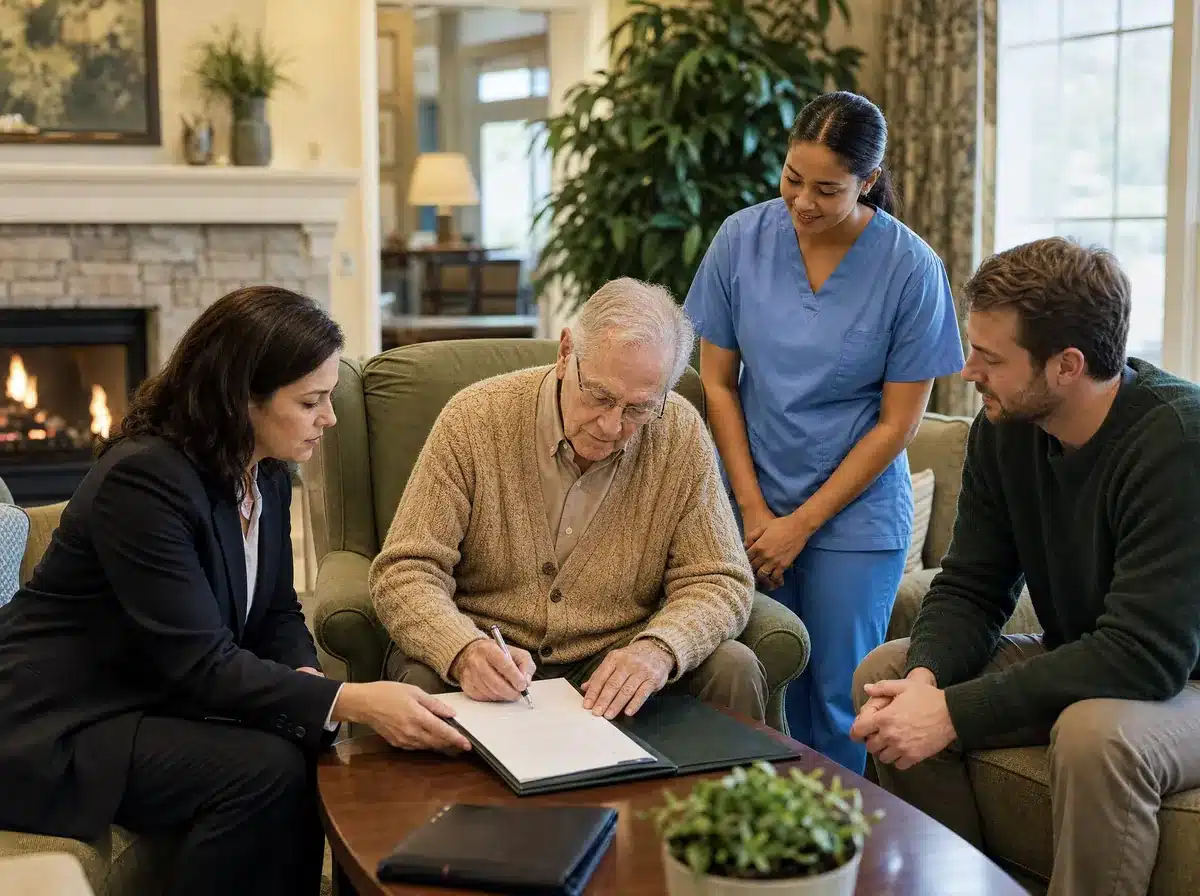
The attorney drafts the POA; the principal and the notary meet with the unsigned document and the principal’s ID; the notary identifies the principal, confirms willingness and awareness, watches the signature, completes the acknowledgment and records the act. Most POA appointments take 10 to 25 minutes, longer at a bedside or with a multi-document packet.
- Book. Call (978) 424-4629 (Hanson direct), (978) 851-0199 (office) or book online. Tell us the type of POA, where the principal is, whether the document has witness lines, the deadline and the language. Same-day and next-day appointments are routine; hospital and nursing-home visits are quoted and confirmed at booking.
- Confirm the document is ready. Drafted by a Massachusetts attorney, an estate planning service, a financial institution or another trusted source. All pages present, every blank filled, signature page attached, not pre-signed. We do not supply POA forms.
- Arrange witnesses if the form has them. You bring them, with ID. For a health care proxy signed at the same visit, you bring the two adult witnesses c.201D requires, neither of whom may be the agent or alternate.
- Identity verification. The notary examines the principal’s current government-issued photo ID with signature and records the details in the journal under M.G.L. c.222 s.22.
- Willingness and awareness. A short conversation with the principal: what is this document, who are you appointing, are you signing freely. At a bedside we ask the named agent to step out for this part when we can.
- Signing. The principal signs in the notary’s presence. Any witnesses the family arranged sign where the form directs.
- Acknowledgment certificate. Hanson completes the Massachusetts acknowledgment under M.G.L. c.222 s.15: venue, date, principal’s name, how identified, statement that the principal acknowledged signing voluntarily for its stated purpose, then signature, printed name, commission expiration and seal.
- Delivery. The original goes to the principal or the attorney. We can scan it for a hospital or bank, certify copies under M.G.L. c.222 s.15 when the receiving party accepts them, or carry it on for an apostille.
Who must be present
Only the principal must appear before the notary. The agent does not sign a Massachusetts POA and does not need to attend, although some forms include an agent’s acceptance that can be acknowledged later. If the agent is present, that is fine; the notary will still speak with the principal alone about willingness when the setting allows it.
What do you need to bring to a POA signing?
The unsigned power of attorney, the principal’s current photo ID, any witnesses the document calls for, and payment. If the document is going abroad, bring the receiving country’s instructions so the certificate can be prepared to match.
- The complete, unsigned POA. Every page, including the notary page, with no blanks left for later.
- Principal’s government photo ID. Massachusetts or out-of-state driver’s license, state ID, U.S. passport or passport card, military ID, permanent resident card or foreign passport. Current and unexpired, with signature. Expired IDs cannot be accepted, even at a bedside.
- Witnesses, only if the form has witness lines. Arranged by you, present with ID. Not the agent or alternate.
- Attorney contact. If the drafting attorney is reachable by phone during the signing, last-minute questions about the form get answered without rescheduling.
- Payment. Cash, major credit cards, Apple Pay, Zelle or business check. Attorney and facility billing is available on request.
If the principal’s name has changed or the ID is at home
The name on the ID must match the name on the POA. If a middle name or suffix differs, correct the document before the appointment or bring the marriage certificate or court order that bridges the two. If the ID is at home while the principal is in the hospital, a family member brings it before we begin; Massachusetts gives the notary very little room to identify a signer without a government ID.
Capacity: what the notary confirms and what the notary cannot judge
A notary confirms three things at a POA signing: the principal’s identity, that the principal is signing willingly, and that the principal is aware of what the document is. A notary does not and cannot assess legal or medical capacity; that is for physicians and, if necessary, the Probate and Family Court.
M.G.L. c.222 s.16 directs a notary to refuse a notarization when the signer appears confused, unaware of the nature of the document or under pressure. At the table we ask the principal to introduce themselves, tell us what the document is, say who is being appointed and confirm they are doing this freely. If the principal can do that, we proceed. If the principal cannot name the document or the agent, signs only when prompted, or appears sedated, we stop, explain politely, and leave.
When we decline, families usually choose one of two paths: try again at a better time of day, because lucidity often follows a medication and rest cycle, or speak with an elder law attorney about guardianship or conservatorship under M.G.L. c.190B. A declined notarization is not a judgment about the principal; it is the notary following Massachusetts law. For a hospital visit we still charge the travel fee quoted at booking, so if capacity is uncertain, ask the care team before you book.
Undue influence
Massachusetts courts set aside powers of attorney obtained through pressure. For that reason we prefer to speak with the principal without the named agent in the room, and we will not proceed if a family member answers for the principal or the principal looks to someone else before every response. Attorneys appreciate this; it protects the document they drafted.
POA notarization at hospitals and nursing homes
We notarize powers of attorney at the bedside at Massachusetts General, Brigham and Women’s, Beth Israel Deaconess, Tufts Medical Center, Lahey Hospital in Burlington, Lowell General, Newton-Wellesley and at skilled nursing, rehabilitation, assisted living and hospice facilities across Middlesex, Essex and Suffolk counties. The procedure is identical to any other POA signing; the setting requires more coordination and more patience.
- We call the floor nurse, social worker or facility administrator before arriving to confirm visiting rules, room number and whether a quiet space is available.
- We time the visit for the principal’s alert hours when the family can tell us what they are.
- We bring our own pens, journal and loose certificates and do not borrow facility supplies.
- We respect HIPAA and discuss the patient only with the patient and the people the patient authorizes.
- Any witnesses the family needs for a health care proxy are arranged by the family; floor staff may or may not be permitted to sign, and the agent never can.
- Hospital and facility visits are quoted at booking and confirmed in advance.
Our dedicated hospital notary service for Boston and Massachusetts page covers bedside procedure, facility etiquette and the Boston hospitals we visit most.
How much does power of attorney notarization Massachusetts service cost?
In our Tewksbury office, a power of attorney is $45 per notarial act. A mobile visit is priced by zone, with travel, one notary seal and 15 minutes included: from $125 in Zone 1 (Tewksbury, Gardner, Ashby, Athol), from $179 in Zone 2 (Lowell, Billerica, Andover, Chelmsford, Dracut, Lawrence, Worcester, Fitchburg, Leominster, Concord, Burlington, Woburn and 40 more towns) and from $250 in Zone 3 (Boston, Cambridge, Newton, Lexington, Wellesley, Weston, Lynn, Gloucester, North Andover and 110 more).
| Service | Fee | Included |
|---|---|---|
| In-office POA notarization, Tewksbury | $45 per notarial act | One acknowledgment and seal; by appointment Monday through Friday |
| Mobile visit, Zone 1 | From $125 | Travel, one seal, 15 minutes |
| Mobile visit, Zone 2 | From $179 | Travel, one seal, 15 minutes |
| Mobile visit, Zone 3 | From $250 | Travel, one seal, 15 minutes |
| Hospital or nursing-home visit | Quoted at booking | Zone fee plus coordination the visit requires |
| Estate plan packet (POA, proxy, HIPAA, trust, will affidavit) | Quoted by document count | Each additional seal and extra time |
| Apostille for a POA going abroad | $6 state fee plus service fee | Submission to the Secretary of the Commonwealth and return |
A POA with one principal is one notarial act. Spouses each signing their own POA is two. A full estate planning packet is quoted in advance by the number of seals. We bill estate planning practices, hospital social work departments and corporate clients directly when asked, and we quote every total before the appointment.

Which mistakes cause a power of attorney to be rejected?
Pre-signing, missing durability language, blanks, name mismatches and an incomplete notarial certificate account for most rejected POAs. A bank or registry may not catch the problem until months later, when the principal can no longer sign a corrected version.
- Signed before the notary arrived. For an acknowledgment the principal can confirm an earlier signature, but many institutions and all foreign destinations want the signature made in front of the notary. Sign at the appointment.
- No durability clause. Without the c.190B s.5-501 language, authority ends at incapacity. Ask your attorney, not the notary.
- Blank agent name, date or powers. Complete the form fully before the signing.
- Name mismatch with ID. Correct the document or bring the bridging record.
- Wrong certificate. An acknowledgment is standard; some foreign destinations or institutions require a jurat or a signature witnessing. Read the certificate or ask the receiving party.
- Missing witnesses the form requires. If the form has witness lines, they must be filled by people you bring; the notary will not sign them.
- Agent signs for the principal. Only the principal signs a POA.
- Copies instead of originals. Registries and most banks want the original or a notary-certified copy. Keep the original safe and let us certify copies when the receiving party accepts them.
Our plain-language guide to powers of attorney in Massachusetts walks through these points for families, and our trust and will notary page covers the other documents usually signed at the same visit.
Common power of attorney scenarios we handle
Most POA calls fall into a handful of situations: an aging parent, a hospital admission, a real estate closing, an overseas matter or a business delegation. Here is how each one usually runs.
- Aging parent at home in Andover. The attorney mails the signed-off draft; the adult children call us; we come to the kitchen table, speak with the parent alone, acknowledge the signature and leave the family with the original and a scan for the bank.
- Pre-surgery at Lahey or MGH. The family needs a POA signed before sedation. We coordinate with the pre-op nurse, keep the conversation short and finish before the patient is moved.
- Closing next week, seller abroad. The closing attorney drafts a limited real estate POA; the seller signs it before us while in Massachusetts, or signs abroad before a consular officer. We notarize and, if needed, apostille.
- Property or inheritance in Lebanon or Morocco. A bilingual POA is signed before Hanson, who reads it with the principal in Arabic or French, then apostilled for the foreign court or notary.
- Business owner traveling for a quarter. A corporate POA and resolution are acknowledged at the office in Woburn so the operations manager can sign contracts and bank documents.
- Nursing home resident in Tewksbury. Family arrives from out of state; we meet at the facility in the morning when the resident is sharpest and notarize the POA the elder law attorney prepared.
A notary cannot give legal advice, choose a POA form for you or explain what a clause does. Hire Mobile Notary and Neighborhood Parcel are not a law firm. For legal guidance on any power of attorney, consult a licensed Massachusetts attorney. Our office is at 1215 Main St, Suite 115, Tewksbury, MA 01876, and we serve 177 Massachusetts cities and towns.
Frequently asked questions
Does a power of attorney have to be notarized in Massachusetts?
Massachusetts law does not require notarization for a durable power of attorney to be valid under M.G.L. c.190B s.5-501, but a POA used to sign a deed or mortgage must be notarized to be recorded at the Registry of Deeds, and banks, brokerages, the IRS and foreign institutions routinely refuse POAs without an acknowledgment. Virtually every attorney-drafted Massachusetts POA is signed before a notary for that reason.
What is the difference between a power of attorney and a health care proxy?
A power of attorney appoints an agent for financial, legal and property matters under M.G.L. c.190B. A health care proxy under M.G.L. c.201D appoints an agent for medical decisions once a physician determines you cannot make them. The proxy requires two adult witnesses, neither of whom may be the agent or alternate; the POA does not. We notarize both documents; you arrange any witnesses.
Can the principal sign a POA in the hospital?
Yes, if the principal is awake, understands what the document is and who is being appointed, and has valid photo ID. We visit Massachusetts General, Brigham and Women’s, Beth Israel Deaconess, Tufts, Lahey Burlington, Lowell General, Newton-Wellesley and nursing, rehabilitation and hospice facilities across the region. We call the floor first, and hospital visits are quoted at booking.
What ID does the principal need?
A current, unexpired government-issued photo ID with signature: a Massachusetts or out-of-state driver’s license, state ID, U.S. passport or passport card, military ID, permanent resident card or foreign passport. Expired IDs cannot be accepted under Massachusetts notary law, including at a bedside. If the ID is at home, a family member brings it before we begin.
How much does power of attorney notarization Massachusetts service cost?
Power of attorney notarization Massachusetts pricing is $45 per notarial act at our Tewksbury office, or a mobile visit from $125 in Zone 1, $179 in Zone 2 or $250 in Zone 3 with travel, one seal and 15 minutes included. Hospital and nursing-home visits are quoted at booking. Multi-document estate plans are quoted by the number of seals before we arrive.
Can you provide witnesses for the power of attorney?
No. We do not provide, supply, bring, coordinate or serve as witnesses for any document. A Massachusetts financial POA does not need witnesses by statute, but if your form has witness lines or the receiving institution requires them, you arrange the witnesses and bring them with ID. For a health care proxy, you bring the two adult witnesses M.G.L. c.201D requires.
Can you notarize a power of attorney in Arabic or French?
Yes. Hanson Webb is fluent in English, Arabic and French and reads the document with the principal in that language before the signing, so no interpreter is needed. The notarial certificate is completed in English. POAs bound for Lebanon, Morocco, Egypt, France or other countries can then be apostilled through the Secretary of the Commonwealth.
Do you provide the power of attorney form?
No. We do not draft, prepare or supply POA forms, and we cannot recommend which type you need. Obtain the document from a licensed Massachusetts attorney, an estate planning service, your financial institution or, for a health care proxy, the hospital social work office. We notarize it once it is complete and ready to sign.
Can a power of attorney be notarized online?
Massachusetts authorized remote online notarization under Chapter 2 of the Acts of 2023, but POAs headed for a Registry of Deeds, a foreign country or many banks are still expected with wet-ink signatures and a physical seal. For broad acceptance we recommend in-person notarization at your location or in our Tewksbury office, and we confirm the receiving party’s requirements with you before the appointment.
What happens if the notary decides the principal cannot proceed?
If the principal cannot identify the document or the agent, appears sedated or signs only when prompted, the notary must decline under M.G.L. c.222 s.16. We explain this to the family and leave without performing the act. Families then often retry at a more alert time of day or consult an elder law attorney about guardianship or conservatorship under M.G.L. c.190B. The travel fee quoted at booking still applies to the visit.

1,190+ signings across Greater Boston and the Merrimack Valley. Fluent in English, Arabic and French. About Hanson