
Copy Certification Notary in Massachusetts
Massachusetts notary copy certification under M.G.L. c.222 §15(e). Diplomas, passports, contracts, business records & more. Learn what CAN and CANNOT be copy-certified by a notary in MA — and why birth certificates require a different process. Reviewed by James Lumas.
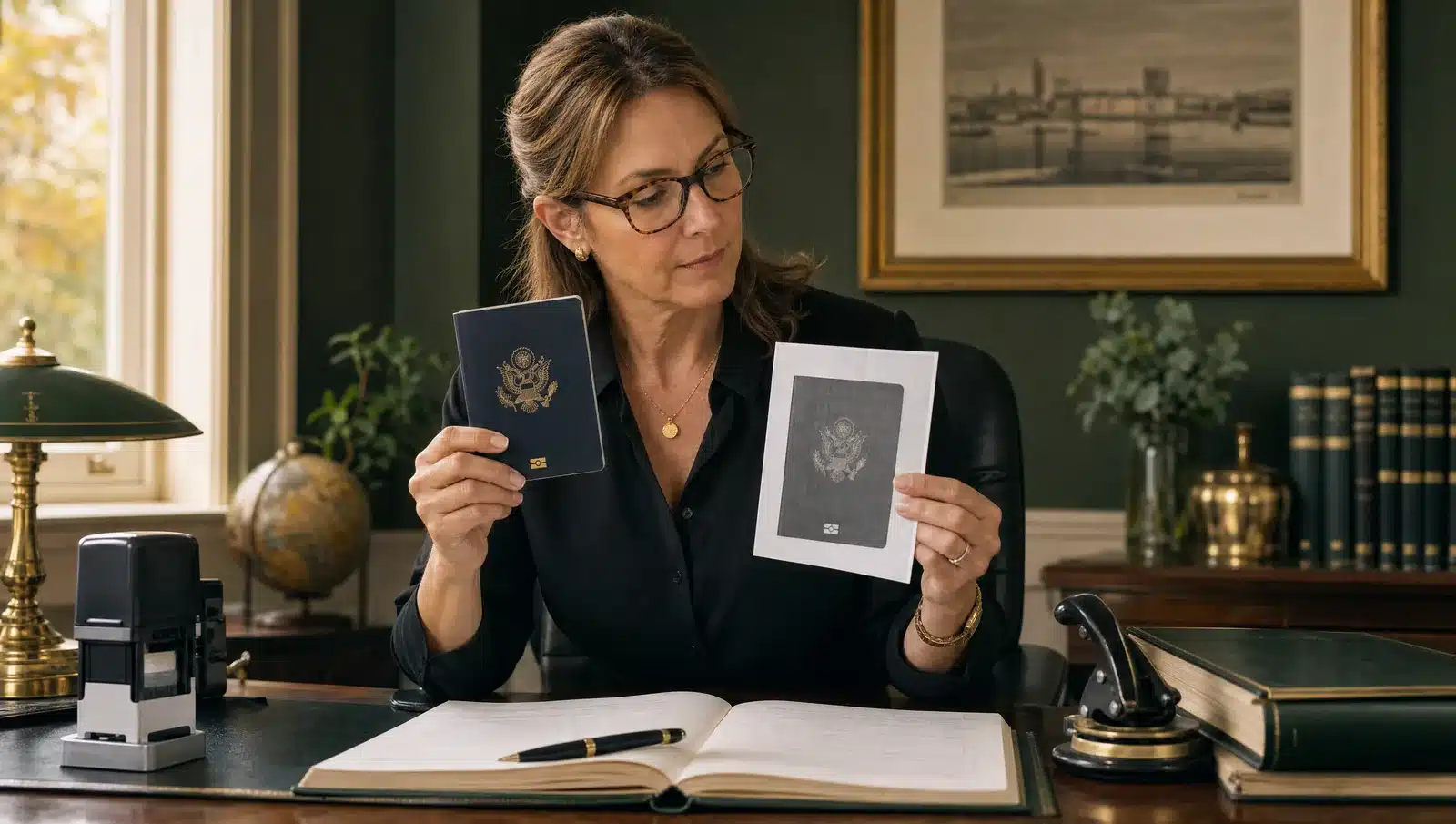
A copy certification notary Massachusetts law authorizes under M.G.L. c.222 certifies that a photocopy is a true, exact, complete and unaltered copy of an original document presented to the notary. It is one of the notarial acts authorized by M.G.L. c.222 s.15, and it is the right tool for diplomas, passports, licenses, contracts, trusts and powers of attorney. It is the wrong tool for birth certificates, marriage certificates, death certificates, court orders and recorded deeds, which only the issuing agency can certify. This page explains the difference, shows you the certificate wording, and walks through how we do it at our Tewksbury office for $45 per notarial act or at your location as a mobile visit.
Hanson Webb has been a Massachusetts Notary Public since 2007, is NNA certified, and has completed 1,190+ signings in English, Arabic and French. Call (978) 424-4629 or (978) 851-0199, or book a copy certification online. Bring the original; we cannot certify a copy of a copy.
What is copy certification under Massachusetts law?
Copy certification is a notarial act in which a Massachusetts notary public makes a photocopy of an original document, or supervises someone else making it, compares the copy to the original, and certifies in writing that the copy is accurate and complete. The definition comes from M.G.L. c.222 s.1 and the certificate form comes from M.G.L. c.222 s.15.
Three things make a copy certification different from the other notarial acts. First, nobody signs anything in front of the notary; the person presenting the document is not a “signer” and takes no oath. Second, the copy itself must be produced in the notary’s presence, by the notary or under the notary’s direct supervision, from an original that is physically on the table. Third, the certificate speaks only to the accuracy of the reproduction. It says nothing about whether the original is genuine, valid, current or issued by a legitimate authority.
That last point is the one receiving institutions sometimes misunderstand. A notary copy certification is not an authentication. If a university abroad wants proof that a diploma is real, it wants the registrar’s certification, and possibly an apostille on top of that. If it simply wants a faithful copy of the diploma you hold, a notary copy certification is exactly right. Ask the institution which one it means before you book.
Why Massachusetts allows it when some states do not
Massachusetts is one of the states whose notary statute expressly includes copy certification. Several neighboring states do not authorize it at all, which is why clients from New Hampshire and Rhode Island sometimes drive to our Tewksbury office with a stack of credentials. The authority is Massachusetts law, so the original must be presented to a Massachusetts-commissioned notary, inside Massachusetts, regardless of where the document was issued or where it is going.
What can a Massachusetts notary certify, and what must come from the issuing agency?
A Massachusetts notary can certify copies of private documents and personal documents in your possession: diplomas, transcripts you hold, passports, driver’s licenses, green cards, professional licenses, contracts, corporate records, trusts and powers of attorney. A Massachusetts notary cannot certify copies of vital records or other public records such as birth, marriage and death certificates, court orders, divorce decrees or recorded deeds; certified copies of those come only from the agency that holds the record.
The reason is practical rather than technical. Public records live in a registry, and the registry is the only office that can attest that a document matches what is on file. A notary seal on a photocopy of a birth certificate does not create a certified copy under Massachusetts law, and every agency that matters (USCIS, the Secretary of the Commonwealth, foreign consulates, probate courts) knows the difference.
| Document | Notary copy certification? | Where a certified copy comes from | Notes |
|---|---|---|---|
| Birth certificate | No | Massachusetts Registry of Vital Records and Statistics, or the clerk of the city or town where the birth was recorded | For international use, the certified copy is apostilled by the Secretary of the Commonwealth, not copy-certified. |
| Marriage certificate | No | City or town clerk where the marriage was recorded, or the Registry of Vital Records | Same rule for civil union and domestic partnership records. |
| Death certificate | No | City or town clerk where the death occurred, or the Registry of Vital Records | Probate courts, insurers and banks require the registry copy. |
| Divorce decree, judgment, court order | No | Clerk of the Probate and Family Court or Superior Court where the case was filed | Attorney file copies cannot be converted into certified copies by a notary. |
| Deed or other recorded land document | No | The Registry of Deeds for the county | A notary copy is not a certified copy for recording or title purposes. |
| Certificate of Good Standing, Articles of Organization | No | Secretary of the Commonwealth, Corporations Division | Order the certified copy directly; the same office apostilles it. |
| U.S. passport | Yes, personal copy | You present the passport book or card | Accepted for employer files, immigration file copies, bank and brokerage KYC, foreign visa applications. Not a substitute for the passport itself. |
| Driver’s license or state ID | Yes, personal copy | You present the card | Common for onboarding packets, background check files and overseas applications. |
| Permanent resident card, EAD, visa | Yes, personal copy | You present the card or visa page | USCIS generally wants photocopies of its own documents without notarization; check the form instructions first. |
| Diploma or degree certificate | Yes | You present the original diploma | Used for employment verification, licensing boards and foreign credential evaluation. For an apostille, the registrar certification route is usually required instead. |
| Academic transcript | Yes, if you hold an original | You present the sealed or printed original | Most universities and USCIS want official transcripts sent directly by the school. |
| Professional license or certification | Yes | You present the original | Nursing, teaching, engineering, trade and other credentials issued to you personally. |
| Power of attorney | Yes | You present the signed original | Agents often need several certified working copies while the original stays in a safe. |
| Trust agreement, certification of trust | Yes | You present the signed original | Banks and brokerages opening or managing trust accounts. |
| Contracts, leases, NDAs, employment agreements | Yes | You present the signed original | Any private agreement between parties. |
| Corporate bylaws, resolutions, operating agreements | Yes | You present the original | International banking and business registration often request certified copies. |
| Medical records, tax returns, bank statements | Yes, if the original is presented | You present the original printout or record | A printout you made from a portal is treated as the original you present; the certificate says only that the copy matches it. |
When the answer in the second column is “no,” we will tell you on the phone, so you do not pay for an appointment that cannot help you. For vital records we point you to the right clerk; for anything going overseas we explain the Massachusetts apostille process, which is a different service with a different authority behind it.
What does the Massachusetts copy certification certificate say?
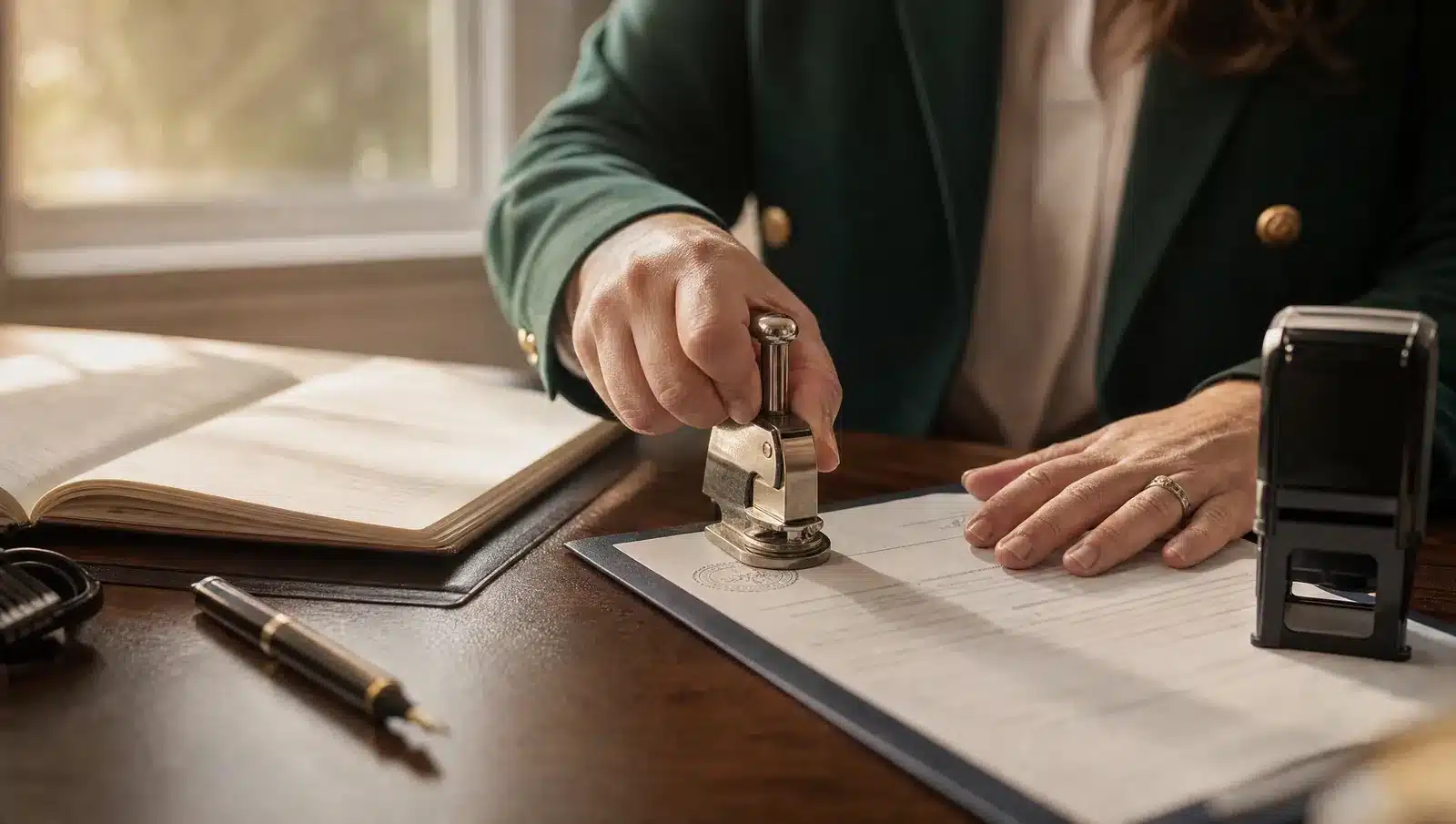
Massachusetts prescribes the wording. The certificate Hanson attaches to or stamps on the copy reads: “On this ____ day of ____________, 20__, I certify that the (preceding) (following) (attached) document is a true, exact, complete and unaltered copy made by me of ______________________ (description of the document), presented to me by ______________________.” It is dated, signed with the notary’s name exactly as commissioned, sealed, and marked with the commission expiration date.
A few details in that wording matter when the copy is going somewhere strict:
- “Made by me.” The notary made or supervised the copy. A copy you made at home last week cannot be certified, no matter how good it looks.
- “Presented to me by.” The certificate names the person who brought the original. It does not say that person owns the document or is the person it describes. For an ID copy, the notary will typically also note that the person presenting it appeared to be the person pictured, but the statutory act is the copy comparison, not an identity verification.
- “Description of the document.” We describe the original precisely: “United States passport number ending 4821 issued to Jane Q. Doe,” or “Bachelor of Science diploma issued by the University of Massachusetts Lowell dated May 2019.” A vague description such as “document” invites questions from the receiving party.
- Venue and date. The county and the Commonwealth appear in the venue line, and the date is the day the copy was made and compared.
Each certified copy is a separate notarial act with its own certificate, signature and seal. If you need five certified copies of a trust for five different banks, that is five acts. At the office, each act is $45. On a mobile visit, the first seal is included in the zone fee and additional seals are quoted before we start.
Journal entry
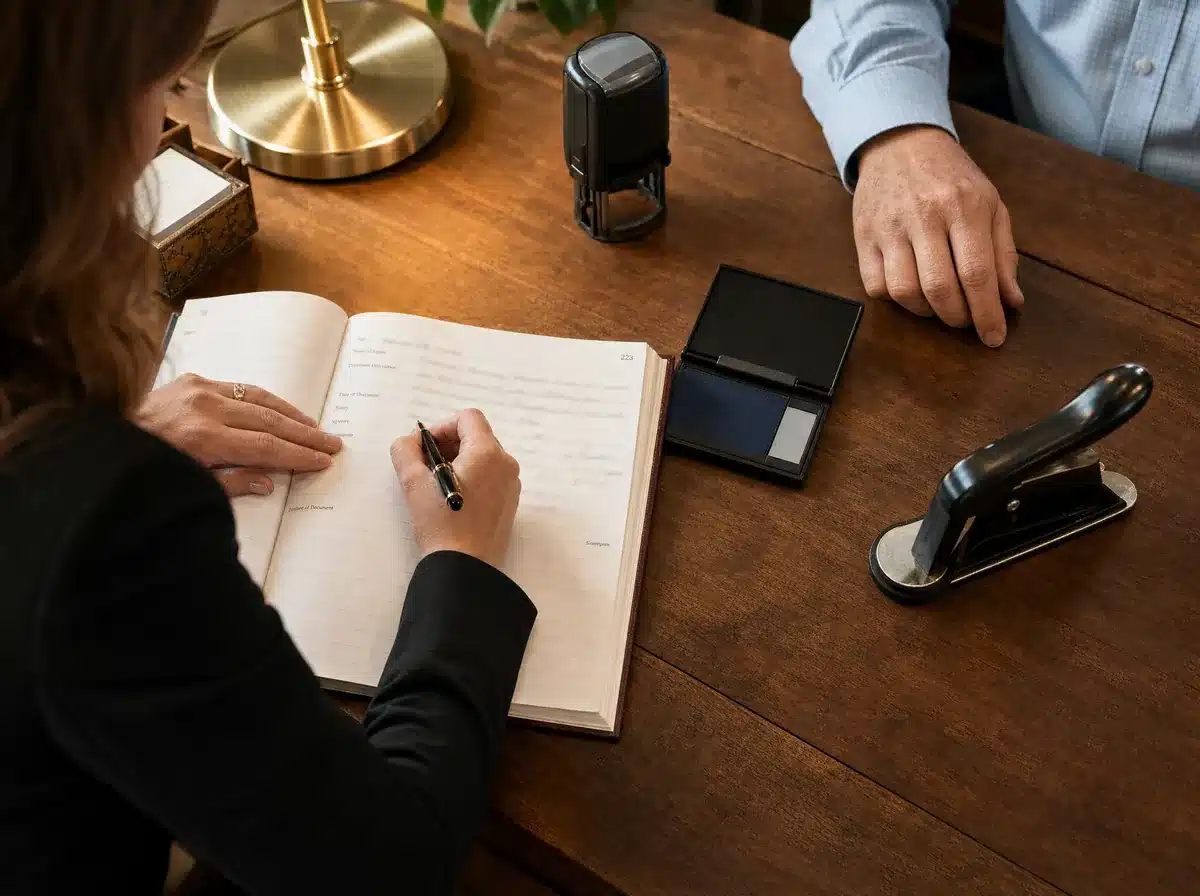
Hanson records every copy certification in his notary journal: the date, the type of act, a description of the document, and the name and identification of the person who presented it. Massachusetts requires notaries to keep a journal under M.G.L. c.222, and the entry is what allows the act to be verified years later if a bank, court or consulate asks.
Who asks for notary-certified copies, and why?
Immigration attorneys, universities, employers, licensing boards, banks and foreign institutions all ask for notary-certified copies when they need a faithful reproduction of a private document without taking custody of the original. The common thread is that the requester wants assurance the copy has not been altered, and the owner wants to keep the original.
Immigration and visa files
Immigration attorneys assembling petitions often want certified copies of passports, visas, I-94 records and foreign diplomas for the client’s file and for supporting evidence. Foreign consulates in Boston and New York frequently require certified copies of U.S. passports and green cards for visa and residency applications. One caution: USCIS itself usually asks for plain photocopies and reserves the right to request originals, so check the specific form instructions. When USCIS asks for a translation of a foreign document, it wants a translator’s certification, which is a different document from a copy certification.
Universities and credential evaluation
Foreign universities, World Education Services and similar evaluators, and overseas employers routinely ask for certified copies of diplomas and transcripts so the applicant does not have to mail an irreplaceable original. If the destination country also requires an apostille, the receiving party will usually want the registrar’s certification notarized rather than a plain copy certification; we explain the sequence before you book so you only do it once.
Employers, HR and licensing boards
Hospitals credentialing nurses and physicians, school districts verifying teaching licenses, trade boards, and employers completing background check packets ask for certified copies of licenses, certifications and identity documents. For I-9 purposes specifically, see our I-9 form notary service; that is an employer-authorized representative role, not a copy certification.
Banks, brokerages and trustees
Financial institutions opening trust accounts, honoring a power of attorney or recognizing a corporate officer’s authority ask for certified copies of the trust, the POA or the resolution. Trustees and agents who manage several accounts keep the original in a safe and carry certified copies. We often certify these during the same visit in which the underlying document is signed; see notary services for trusts and wills and power of attorney notarization.
Attorneys and real estate professionals
Law offices need multiple certified copies of key instruments for distribution to parties in a transaction. Closing attorneys and title companies ask for certified copies of trust agreements, resolutions and powers of attorney before a closing so authority can be verified. Massachusetts is an attorney-closing state; we provide the notarial acts the attorney needs and do not conduct closings.
Apostille preparation
When a document that cannot leave the country, such as a passport, must be authenticated abroad, the Secretary of the Commonwealth apostilles the notary’s copy certification. The Secretary authenticates Hanson’s signature and seal on the certificate, which is why the certificate must be complete and the name must match the commission exactly.
How does copy certification work at our Tewksbury office?
You bring the original to 1215 Main St, Suite 115, Tewksbury, MA 01876; Hanson makes the copy on the office copier, compares it page by page to the original, completes the statutory certificate, signs, seals and records the act. Each certified copy is $45, and most appointments take 10 to 15 minutes.
- Book. In-office appointments are scheduled Monday through Friday. Tell us how many copies you need and what the documents are so we can confirm they are eligible.
- Bring the original and your ID. Although copy certification is not an identity act, we identify the person presenting the document for the journal entry. Bring a current government-issued photo ID; our guide to what ID is accepted for notarization in Massachusetts lists what works.
- The copy is made in front of you. Every page of a multi-page document is copied, including blank backs if the receiving party wants them. We do not certify a partial copy unless the certificate says so.
- Comparison. Hanson compares the copy to the original: text, seals, stamps, photographs, signatures, page count.
- Certificate, seal and journal. The certificate is completed with the document description and your name as presenter, signed and sealed. The act is entered in the journal.
- You leave with the original and the certified copies. We keep nothing except the journal entry.
Payment is by card, cash or check. If you need the copy to go on to the Secretary of the Commonwealth for an apostille, we can take it from there as a separate service.
Mobile copy certification notary Massachusetts pricing and how a visit works
We come to your home, office, school, hospital room or attorney’s conference room anywhere in our 177-town service area, make the copy on site, compare it to the original and complete the certificate. The mobile fee includes travel, one notary seal and 15 minutes of service; additional seals and time are quoted before we leave the office.
- Zone 1, from $125 per visit: Tewksbury, Gardner, Ashby and Athol.
- Zone 2, from $179 per visit: Lowell, Billerica, Andover, Chelmsford, Dracut, Lawrence, Worcester, Fitchburg, Leominster, Concord, Burlington, Woburn and more than 40 other towns. This is our most-booked zone.
- Zone 3, from $250 per visit: Boston, Cambridge, Newton, Lexington, Wellesley, Weston, Lynn, Gloucester, North Andover and more than 110 others. Hospital and nursing-home visits are included.
On a mobile visit the copy must still be made in Hanson’s presence. He brings a portable scanner-printer, or uses your office copier under his supervision. If you are at a hospital or care facility and the document belongs to a patient, the patient or the patient’s representative presents it; a nurse or administrator can be the presenter if the facility holds the record. Mobile appointments run 7 days a week, with same-day and after-hours visits by confirmation.
For a 20-document corporate due diligence binder or a batch of licenses for a hospital credentialing office, call for a multi-document quote. We price by the number of acts and the time on site rather than by page.
Notary copy certification vs. certified copy vs. apostille: what is the difference?
A notary copy certification certifies that a photocopy matches an original you presented. A certified copy is issued by the government office that holds the original record and carries that office’s authority. An apostille is a certificate from the Secretary of the Commonwealth authenticating the signature of a public official or a notary for use in another country. They are three different things, issued by three different authorities, and receiving institutions are specific about which one they want.
| Notary copy certification | Agency certified copy | Apostille | |
|---|---|---|---|
| Who issues it | Massachusetts notary public | Registry, court clerk, city or town clerk, Corporations Division | Secretary of the Commonwealth, Commissions Section |
| What it attests | The copy matches the original presented | The copy matches the official record on file | The signature, capacity and seal of the official or notary are genuine |
| Typical documents | Passports, diplomas, licenses, contracts, trusts, POAs | Birth, marriage, death, divorce, court orders, deeds, corporate filings | Any of the above, once properly certified or notarized |
| Where it is accepted | Employers, schools, banks, attorneys, many consulates | Everywhere the record itself is required | Hague Convention countries |
| Cost | $45 per act in office; mobile from $125 by zone | Set by the agency | $6 state fee plus our service fee |
If someone tells you “get it notarized” for a birth certificate, what they almost always mean is “get a certified copy, then get it apostilled.” Call us and we will sort out which it is before you spend money on the wrong step.
What should you check before your copy certification appointment?
Confirm three things with the receiving institution: that a notary-certified copy is acceptable (rather than an agency certified copy), whether every page is required, and whether the copy must be in color. Then bring the original document and a current photo ID, and tell us how many copies you need.
- Is the original actually an original? A certified copy from a registry is an original for our purposes; a photocopy or a phone photo is not. A document you printed yourself from an online portal is treated as the original you present, and the certificate says only that the copy matches it.
- Is the document eligible? Check the table above. If it is a vital record, court record or recorded deed, go to the issuing agency first.
- Laminated documents. We can copy them, but some receiving parties reject copies of laminated originals because security features cannot be seen. Ask.
- Foreign-language documents. We certify copies of documents in any language, since the act is a visual comparison. Hanson reads English, Arabic and French, which helps with describing the document accurately in the certificate.
- Color or black and white. Many consulates want color copies of passports and IDs. Tell us in advance so the right equipment is on hand for a mobile visit.
- How many copies. Each is a separate act. Order them all at once to avoid a second trip.
A notary cannot give legal advice, draft documents or tell you whether a certified copy will satisfy a particular legal requirement. For that, ask the receiving institution or an attorney. What we can do is make sure the copy and the certificate are correct, complete and ready to be relied on.
Frequently asked questions
Can a Massachusetts notary certify a copy of my birth certificate?
No. Birth certificates are vital records, and certified copies come only from the Massachusetts Registry of Vital Records and Statistics or the clerk of the city or town where the birth was recorded. A notary seal on a photocopy does not create a certified copy. If you need the birth certificate for use abroad, order a certified copy and have it apostilled by the Secretary of the Commonwealth.
What is the difference between a notary copy certification and a certified copy?
A notary copy certification under M.G.L. c.222 s.15 states that the photocopy the notary made matches the original presented. A certified copy is issued by the government agency that holds the record (vital records, court clerk, Registry of Deeds, Corporations Division) and carries that agency’s authority. Many institutions require the agency copy and will not accept a notary copy certification in its place, so confirm before your appointment.
Does the original have to be present?
Yes. The notary must have the original in hand to make or supervise the copy and to compare the two. A copy cannot be certified from a photocopy, a scan, a fax or a photo on your phone. The original must be physically present at the appointment, whether at our office or at your location.
Can you certify a copy of my passport?
Yes. A U.S. or foreign passport is a document in your possession, and we certify copies of the photo page or the full book. Certified passport copies are commonly used for consulate visa applications, bank and brokerage account opening, immigration file copies and employer records. The copy does not replace the passport for travel or for passport agency purposes.
How much does a copy certification notary Massachusetts appointment cost?
At our Tewksbury office, each certified copy is $45 per notarial act. As a mobile service, the visit is from $125 in Zone 1 (Tewksbury, Gardner, Ashby, Athol), from $179 in Zone 2 (Lowell, Billerica, Andover, Worcester, Burlington, Woburn and more) and from $250 in Zone 3 (Boston, Cambridge, Newton, Lexington, Wellesley, Weston, Lynn, Gloucester and more). The mobile fee includes travel, one seal and 15 minutes; additional copies are quoted.
Can a notary-certified copy be apostilled?
Yes, for private documents. The Secretary of the Commonwealth authenticates the notary’s signature and seal on the copy certification, which is how passports, licenses and similar documents are authenticated for use abroad. For diplomas and transcripts going overseas, the receiving party often wants the registrar’s certification notarized instead, so tell us the destination and we will confirm the correct sequence.
Will USCIS accept a notary-certified copy?
USCIS form instructions generally ask for plain photocopies of documents and reserve the right to request originals, so a copy certification is usually unnecessary for the filing itself. Immigration attorneys often want certified copies for their files and for consular processes. Follow the specific form instructions, and do not confuse a copy certification with the translator’s certification USCIS requires for foreign-language documents.
Can you come to my home or office for copy certification?
Yes. Copy certification is available as a mobile service anywhere in our 177-town Massachusetts service area, including hospitals and care facilities, 7 days a week with same-day and after-hours visits by confirmation. You present the original, Hanson makes the copy on site in your presence, and the certificate is completed before he leaves.
Do you provide witnesses for documents that need them?
No. Copy certification never requires witnesses. If a different document you are signing at the same appointment, such as a will, requires witnesses under Massachusetts law, you arrange your own witnesses and bring them; we do not supply, coordinate or act as witnesses.

1,190+ signings across Greater Boston and the Merrimack Valley. Fluent in English, Arabic and French. About Hanson