
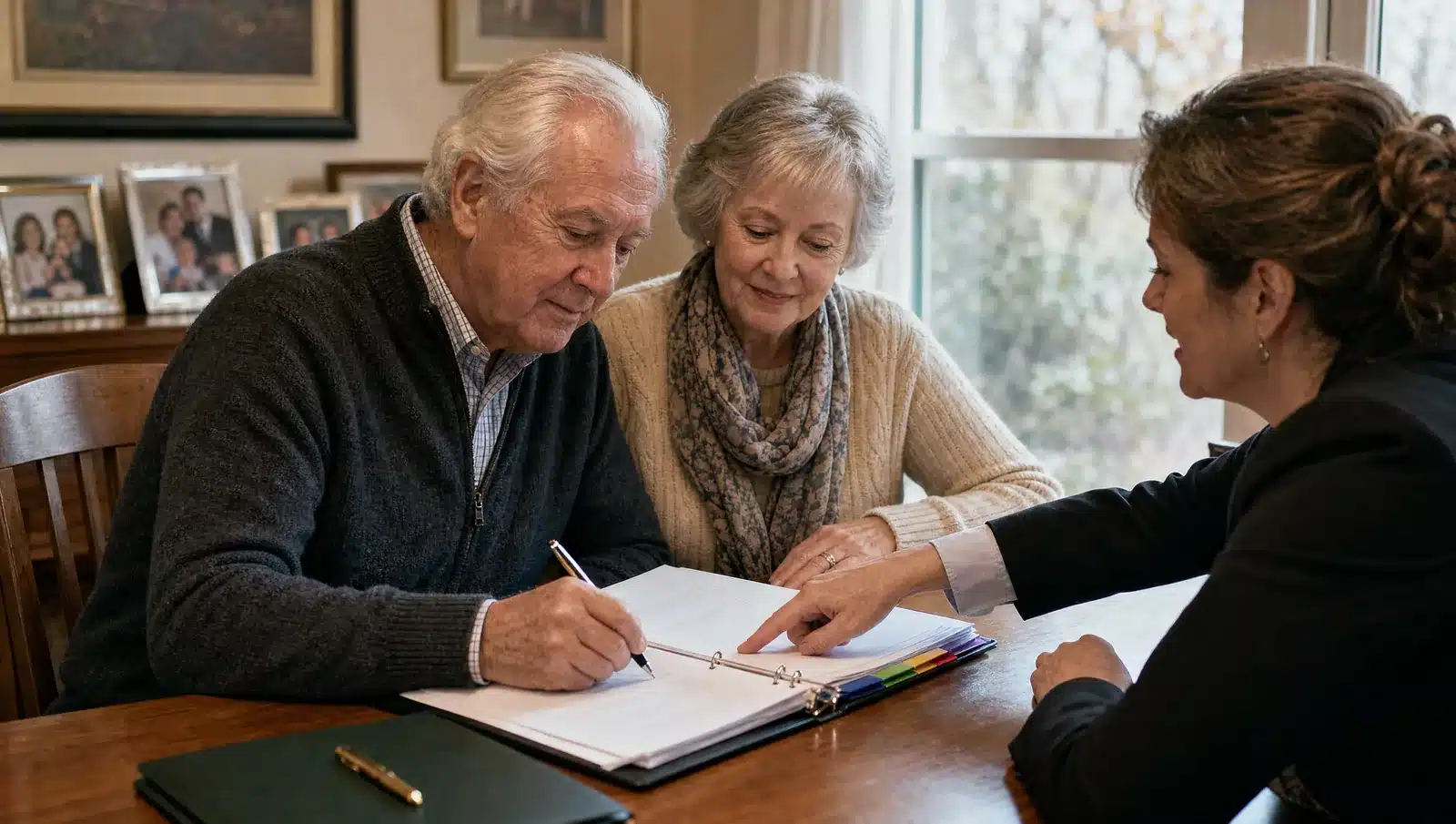
Trust and Will Notary Services in Massachusetts
Licensed mobile notary for trusts and wills across Massachusetts. Self-proving will affidavits under M.G.L. c.190B §2-504. Revocable and irrevocable trust notarization. We come to your home, attorney's office, or care facility. Reviewed by lead editor James Lumas. Call (978) 424-4629.
A Massachusetts will is made valid by two witnesses, not by a notary; a trust is made usable by a notary’s acknowledgment, which banks, brokerages and the Registry of Deeds require before they will honor the trustee. Our trust and will notary Massachusetts service comes to your home, your attorney’s conference room, a hospital room or a care facility, or meets you at 1215 Main St, Suite 115, Tewksbury, MA 01876, to notarize the self-proving will affidavit under M.G.L. c.190B s.2-504, acknowledge trust agreements, trustee certifications and amendments, and handle the power of attorney and heirship affidavits that round out an estate plan. Mobile visits follow our zone fees, from $125, $179 or $250 with travel included; in-office acts are $45 each.
Hanson Webb has been a Massachusetts Notary Public since 2007, is NNA certified, BBB A+ accredited and has completed more than 1,190 signings in English, Arabic and French. Call (978) 424-4629 or (978) 851-0199, or book an estate document signing online. One rule applies to every will signing: the two witnesses are the family’s own. We do not provide, supply, bring, coordinate or serve as witnesses.
Does a will need to be notarized in Massachusetts?
No. Under M.G.L. c.190B s.2-502, a Massachusetts will is valid when it is in writing, signed by the testator (or by someone in the testator’s presence and at the testator’s direction), and signed by at least two individuals who each witnessed the testator sign or acknowledge the will. Notarization is not part of that formula, and a notary seal does not replace the two witnesses.
Getting this right matters because the mistake runs in both directions. Some families have a will notarized and skip the witnesses, which produces an invalid will. Others assume the notary adds nothing and skip the one thing a notary can do: the self-proving affidavit under M.G.L. c.190B s.2-504, which saves the estate from tracking down witnesses years later.
A self-proved will is one in which the testator’s acknowledgment and the witnesses’ affidavits are made before an officer authorized to administer oaths, such as a notary public, and attached to the will. When the Probate and Family Court receives a self-proved will, it can admit it to probate without calling the witnesses to testify or submit affidavits. That is the practical reason estate planning attorneys in Boston, Newton, Andover and Worcester schedule a notary for a will signing.
Massachusetts does not recognize holographic (handwritten, unwitnessed) wills written in the Commonwealth. A will executed in another state or country according to that place’s law is generally recognized here under c.190B, but the probate court may still need witness evidence if it is not self-proved.
How does a self-proving will affidavit work in Massachusetts?
The testator and the two witnesses sign the will, then all three swear to a short affidavit before the notary stating that the testator signed willingly, was at least 18 and of sound mind, and that the witnesses signed in the testator’s presence. The notary notarizes the affidavit, not the will, and the affidavit is attached to the will.
- The attorney drafts the will and the affidavit language. M.G.L. c.190B s.2-504 sets out the substance of the self-proving affidavit. Your attorney prepares it as part of the will package. We do not draft either document.
- Everyone gathers in one place. The testator, the two witnesses the family has arranged, and the notary, all together at the same time. Witnesses bring their own valid photo ID. The testator must not have pre-signed the will or the affidavit.
- The notary verifies identity. Hanson checks the testator’s and both witnesses’ government photo IDs and records them in the notarial journal under M.G.L. c.222 s.22.
- The testator signs the will. In the presence of both witnesses and the notary. If the testator cannot sign a full signature, a mark or a directed signature under s.2-502 may be used; the attorney should plan for that in advance.
- The witnesses sign the will. Each witness signs the attestation clause after watching the testator sign or acknowledge the signature.
- All three swear to the affidavit. Hanson administers the oath or affirmation to the testator and both witnesses together. Each signs the affidavit.
- The notary completes the jurat. Venue, date, names, how each person was identified, “subscribed and sworn to before me,” signature, printed name, commission expiration and seal. The affidavit is attached to the will and stays with it.
Who can be a witness to a Massachusetts will
Any person generally competent to be a witness may witness a will under c.190B. Massachusetts does not void a will because a beneficiary witnessed it, but a gift to a witness can be challenged, so attorneys tell families to use two adults who inherit nothing: a neighbor, a colleague, a friend, the attorney’s staff. The family brings them. The notary performs the oath and jurat and does not serve as one of the two witnesses.
Why the affidavit matters later
| At probate | Will without self-proving affidavit | Self-proved will |
|---|---|---|
| Proof of due execution | Court may require testimony or affidavits from the original witnesses | Affidavit attached to the will is accepted as proof |
| If a witness has moved or died | Delay while the personal representative searches, or alternative proof is assembled | No search needed |
| Timeline | Longer when witnesses are hard to locate | Standard |
| Cost to the estate | Attorney time locating and deposing witnesses | Minimal |
| Validity of the will | Same; the affidavit does not make an invalid will valid | Same |
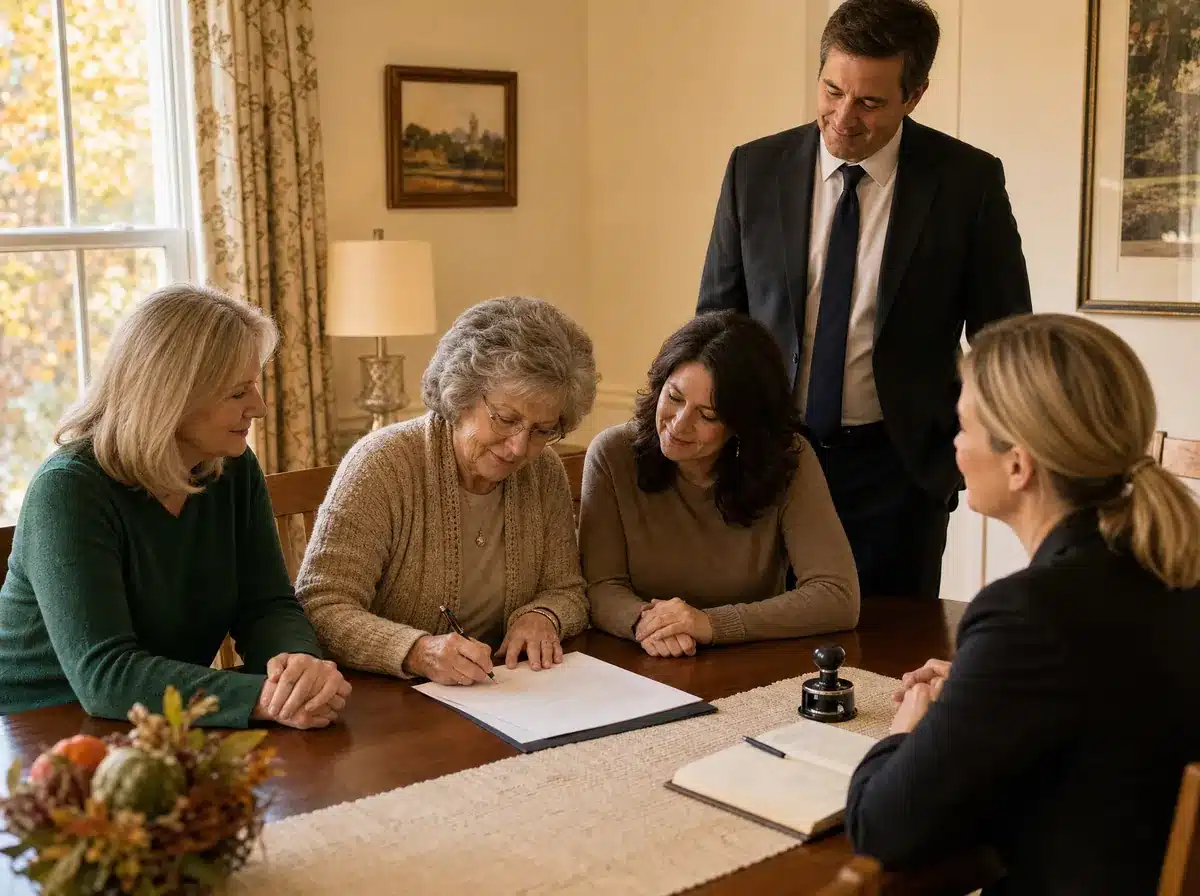
Does a trust need to be notarized in Massachusetts?
Massachusetts does not require a trust agreement to be notarized to exist, but a trust that will hold real estate must be acknowledged before a notary so the deed into the trust and the trustee’s certificate can be recorded at the Registry of Deeds, and banks and brokerages routinely require a notarized trust or trustee certification before retitling accounts. In practice, every trust prepared by a Massachusetts attorney is signed before a notary.
The notarial act on a trust is an acknowledgment: the settlor (the person creating the trust) and the trustees appear, are identified, and acknowledge that they signed voluntarily. No oath is involved unless the document includes a sworn certification. Trusts do not require witnesses under Massachusetts law, though some attorneys add witness lines by habit; if your trust has them, you arrange the witnesses.
Trust documents we notarize
- Revocable living trust. The settlor and initial trustee, often the same person, acknowledge the trust agreement. Spouses acknowledge a joint trust together.
- Irrevocable trust. Including Medicaid planning, life insurance and special needs trusts. The settlor and trustee acknowledge; a deed into the trust follows and must also be acknowledged for recording.
- Trustee’s certificate under M.G.L. c.184 s.35. A recordable certificate stating who the trustees are and what they may do, so the full trust stays private. Registries require it to be acknowledged.
- Certification of trust for financial institutions. A summary document banks and brokerages accept in place of the whole trust. Usually acknowledged; some institutions ask for a jurat.
- Trust amendment or restatement. Executed with the same formality as the original.
- Deed into trust. Prepared by the attorney; the grantor acknowledges before the notary and the deed is recorded. Massachusetts is an attorney-closing state, and the attorney handles the recording.
- Acceptance or resignation of trustee, appointment of successor trustee. Acknowledged so the successor’s authority can be shown to institutions and registries.
- Pour-over will. A will that leaves assets to the trust; executed with two witnesses and a self-proving affidavit like any other will.
Which estate planning documents need a notary, witnesses or both?
Use this table as a planning aid for the signing. It reflects Massachusetts law and ordinary practice; your attorney’s instructions control. Wherever witnesses appear, they are people you bring.
| Document | Massachusetts requirement | Notarial act we perform | Witnesses (arranged by you) |
|---|---|---|---|
| Last will and testament | Writing, testator’s signature, two witnesses (c.190B s.2-502) | None on the will itself | Two adults |
| Self-proving will affidavit | Optional; sworn by testator and witnesses before a notary (s.2-504) | Jurat | The same two witnesses sign and swear |
| Codicil | Same as a will | Jurat on its self-proving affidavit | Two adults |
| Holographic will | Not valid if made in Massachusetts | Not applicable | Not applicable |
| Revocable or irrevocable trust | No statutory notarization; required in practice and for recording | Acknowledgment | None unless the form has lines |
| Trustee’s certificate (c.184 s.35) | Acknowledged for recording | Acknowledgment | None |
| Deed into trust | Acknowledged for recording | Acknowledgment | None |
| Durable power of attorney | No statutory notarization (c.190B s.5-501); required by registries and institutions | Acknowledgment | None unless the form has lines |
| Health care proxy | Two adult witnesses, not the agent (c.201D); notarization optional | Acknowledgment on request | Two adults |
| HIPAA authorization | Varies by institution | Acknowledgment or signature witnessing if requested | None |
| Affidavit of heirship | Sworn statement | Jurat | None |
| Disclaimer of inheritance, receipt and release | Often acknowledged for the court or trustee | Acknowledgment or jurat as drafted | None |
Powers of attorney have their own page: power of attorney notarization in Massachusetts. Sworn estate documents such as heirship affidavits are covered under affidavit and sworn statement notarization.
How does a trust and will signing appointment work?
The attorney sends the final documents; you gather the signers and your two witnesses; the notary arrives, checks every ID, walks through the signing order the attorney specified, administers the oath for the self-proving affidavit, acknowledges the trust and POA signatures, seals each certificate and records every act. A full estate plan signing takes 30 to 60 minutes.
- Book with the document list. Call (978) 424-4629 or book online and tell us: will with self-proving affidavit, trust, trustee’s certificate, deed, POA, health care proxy, HIPAA. The count sets the quote. Tell us whether the attorney will attend in person or by phone.
- Confirm the witnesses. Two adults who are not beneficiaries, not the health care agent and, ideally, not family. You invite them. They bring photo ID.
- Set the signing order. Most attorneys sign the will first while everyone is fresh, then the proxy with the same witnesses, then the trust, POA and HIPAA, which need only the notary.
- Identity and awareness. Hanson checks each signer’s and each witness’s ID, then speaks briefly with the testator or settlor: what are these documents, who is named, are you signing freely.
- Execution. Signatures in the order the attorney set, initials where the documents call for them, witnesses signing where directed.
- Notarial acts. Jurat on the self-proving affidavit, acknowledgments on the trust, certificate, deed and POA, acknowledgment on the proxy if requested. Each certificate is completed in full under M.G.L. c.222 s.15 and sealed.
- Journal and delivery. Every act is journaled. Originals go to the attorney or the family as instructed; we can scan the set for the attorney the same day.
Signing abroad or for property abroad
A Massachusetts trust or will affidavit that will be used in another country usually needs an apostille from the Secretary of the Commonwealth after the notarization, and some countries also require a certified translation. Tell us the destination at booking so the certificate is prepared to pass the Commissions Section review the first time. Hanson reads Arabic and French documents directly, which shortens the review for Lebanese, Moroccan, Egyptian and French matters.
What to bring
- All documents, complete, unsigned, with the attorney’s signing instructions
- Valid, unexpired government photo ID for the testator, each settlor and trustee, and each witness
- Your two witnesses, present for the whole will signing
- Payment: card, Apple Pay, Zelle, PayPal, cash or attorney billing
Testamentary capacity and the notary’s role
A testator must have testamentary capacity: understand the nature of the act, know in general what property they own and who their natural heirs are, and be free of delusion affecting the will. Capacity is a legal question for the attorney and, if contested, the Probate and Family Court. The notary’s narrower duty under M.G.L. c.222 s.16 is to confirm identity, willingness and awareness of the document before performing any notarial act.
At the table we ask the testator to tell us what the documents are and who is named in them, and to confirm they are signing freely. If the testator cannot do that, appears sedated or looks to a family member before answering, we decline the notarial acts and say so plainly. The witnesses’ affidavit also states the testator appeared of sound mind, so witnesses should be comfortable swearing to it.
For signings at a hospital or nursing home, we prefer the testator’s most alert hours, a quiet room, and the attorney reachable by phone. A declined signing at a facility still carries the travel fee quoted at booking, so talk with the care team about alertness before scheduling.
Will and trust signings at hospitals and care facilities
We notarize estate documents at the bedside at Massachusetts General, Brigham and Women’s, Beth Israel Deaconess, Tufts Medical Center, Lahey Hospital in Burlington, Lowell General, and at skilled nursing, rehabilitation, assisted living, memory care and hospice facilities across Middlesex, Essex and Suffolk counties.
- We call the floor or the facility first to confirm visiting rules, room number and whether a private space is available for a signing with several people in it.
- A will signing at a bedside still needs the family’s two witnesses in the room with the testator. Facility staff may be restricted from witnessing; ask the charge nurse ahead of time rather than assuming.
- We bring pens, journal and loose certificates and keep the visit brief.
- Hospital and facility visits are quoted at booking and confirmed in advance.
Details on bedside procedure, Boston hospitals and family roles are on our hospital notary service page.
How much does a trust and will notary Massachusetts visit cost?
In our Tewksbury office each notarial act is $45. A mobile visit is priced by zone with travel, one notary seal and 15 minutes included: from $125 in Zone 1 (Tewksbury, Gardner, Ashby, Athol), from $179 in Zone 2 (Lowell, Billerica, Andover, Chelmsford, Dracut, Lawrence, Worcester, Fitchburg, Leominster, Concord, Burlington, Woburn and 40 more towns) and from $250 in Zone 3 (Boston, Cambridge, Newton, Lexington, Wellesley, Weston, Lynn, Gloucester, North Andover and 110 more). Estate plan packets are quoted by the number of seals.
| Service | Fee | Notes |
|---|---|---|
| In-office, Tewksbury | $45 per notarial act | Self-proving affidavit jurat, trust acknowledgment, POA acknowledgment each count as one act |
| Mobile visit, Zone 1 | From $125 | Travel, one seal, 15 minutes |
| Mobile visit, Zone 2 | From $179 | Travel, one seal, 15 minutes |
| Mobile visit, Zone 3 | From $250 | Travel, one seal, 15 minutes |
| Full estate plan packet | Quoted by document count | Additional seals and time quoted before the visit |
| Hospital or care facility visit | Quoted at booking | Zone fee plus coordination the visit requires |
| Attorney and firm engagements | Quoted | Direct billing available |
A typical couple’s plan (two wills with affidavits, a joint trust, a trustee’s certificate, two POAs and two proxies) involves several separate notarial acts; we count them with you from the attorney’s document list and confirm the total before we arrive. For a general picture of mobile pricing, see what a notary does versus what an attorney does in Massachusetts, which also explains why the attorney, not the notary, drafts and advises.

Which mistakes undermine a will or trust signing?
Missing or unqualified witnesses, pre-signed documents, notarizing the will instead of the affidavit, and unrecorded trust documents are the errors that surface at probate or at the registry. Each is avoidable at the signing.
- Only one witness, or a witness who leaves early. Both witnesses must see the testator sign or acknowledge the will. Plan for two people who can stay for the whole signing.
- Beneficiary as witness. Not fatal to the will in Massachusetts, but an invitation to a challenge. Use disinterested adults.
- Expecting the notary to witness. We perform the notarial acts only. The two witnesses are yours to bring.
- Notarizing the will itself with no affidavit. Adds nothing. The self-proving affidavit is the document that gets notarized.
- Pre-signed will or affidavit. The affidavit swears everyone signed in each other’s presence. Sign at the appointment.
- Trust signed but never funded. A trust that owns nothing does nothing. Deeds, account retitling and trustee’s certificates are the follow-through; we notarize those too.
- Names inconsistent across documents. The trust says “Robert,” the deed says “Bob.” Fix before the signing.
- Expired ID at a bedside. Massachusetts does not allow expired ID. Check the dates the day before.
- Loose certificate not attached. When a document lacks a notary block, the loose certificate must be stapled to it and identify the document. We do this every time.
Common trust and will signing scenarios
Most estate signings fall into a few patterns, and the preparation for each is slightly different.
- Couple finalizing a plan at home in Lexington. The attorney emails final drafts; the couple invites two neighbors as witnesses; we arrive at 6 p.m., run the signing in the attorney’s order and leave the originals in the attorney’s folder.
- Attorney’s office in Boston, client cannot travel. The attorney sends us to the client’s apartment in Back Bay with the documents and joins by phone. The client’s friends serve as witnesses.
- Hospital bedside at Beth Israel. Adult children fly in; the elder law attorney drafts a will, trust, POA and proxy in two days; two family friends come as witnesses; we schedule the morning when the patient is sharpest.
- Successor trustee after a death. The new trustee signs an acceptance and an updated trustee’s certificate so the bank and the registry recognize the change.
- Heirs without a will. Siblings in Lowell each swear an affidavit of heirship to release a parent’s bank account; three affiants, three jurats, one visit.
- Trust for property in Morocco or Lebanon. Bilingual trust or POA acknowledged before Hanson in Arabic or French, then apostilled for use abroad.
A notary cannot draft a will or trust, advise on who should be trustee or beneficiary, explain what a clause means or judge capacity. Hire Mobile Notary and Neighborhood Parcel are not a law firm. For legal guidance, consult a licensed Massachusetts estate planning attorney. Our office is at 1215 Main St, Suite 115, Tewksbury, MA 01876, and we serve 177 Massachusetts cities and towns.
Frequently asked questions
Does a will need to be notarized in Massachusetts?
No. Under M.G.L. c.190B s.2-502, a will is valid when it is in writing, signed by the testator and signed by two witnesses. Notarization is not required for validity. A self-proving affidavit under s.2-504, sworn by the testator and both witnesses before a notary, is recommended because it lets the probate court admit the will without contacting the witnesses.
What does a notary actually do at a will signing?
The notary verifies the identity of the testator and the two witnesses, administers an oath to all three, and notarizes the self-proving affidavit with a jurat. The affidavit is attached to the will. The notary does not notarize the will itself and does not serve as one of the two witnesses; those are people the family brings.
Does a living trust need to be notarized in Massachusetts?
Not by statute, but in practice yes. Banks and brokerages require a notarized trust or trustee certification before retitling accounts, and a trust holding real estate needs an acknowledged trustee’s certificate and deed to be recorded at the Registry of Deeds. Every attorney-prepared Massachusetts trust we see is signed before a notary.
Can the notary be one of the witnesses to my will?
Whatever Massachusetts law may allow in general, we do not serve as a witness to any document, and we do not provide, supply, bring or coordinate witnesses. Arrange two disinterested adults and bring them to the signing with photo ID. Hanson performs the notarial acts: the oath and jurat on the self-proving affidavit and the acknowledgments on the trust and related documents.
Can a notary come to a hospital or nursing home for a will signing?
Yes. We notarize estate documents at hospitals, nursing homes, assisted living, memory care and hospice facilities across Greater Boston and the Merrimack Valley. The testator must be awake, understand the documents and have valid photo ID, and the family’s two witnesses must be present for the will. Facility visits are quoted at booking and confirmed in advance.
How much does a trust and will notary Massachusetts appointment cost?
A trust and will notary Massachusetts visit is priced by zone: from $125 in Zone 1, $179 in Zone 2 and $250 in Zone 3, with travel, one seal and 15 minutes included, plus additional seals quoted by the number of documents. In our Tewksbury office each notarial act is $45. Hospital visits are quoted at booking. We confirm the total from the attorney’s document list before we arrive.
Do I need to notarize a codicil or a trust amendment?
A codicil follows the same rules as a will: two witnesses, with a self-proving affidavit notarized if you want the probate benefit. A trust amendment is executed with the same formality as the trust, which in practice means an acknowledgment before a notary so institutions will accept it.
What is a trustee's certificate and why does it need a notary?
A trustee’s certificate under M.G.L. c.184 s.35 is a short recordable document stating who the trustees are and what powers they have, so the full trust stays private. Registries of Deeds require it to be acknowledged before a notary before they will record it or a deed signed by the trustee.
Can you notarize estate documents in Arabic or French?
Yes. Hanson Webb is fluent in English, Arabic and French and reads the document with the signer before any oath or acknowledgment. The notarial certificate is completed in English. Documents for use abroad can then be apostilled through the Massachusetts Secretary of the Commonwealth.
Can the notary tell me whether my will or trust is drafted correctly?
No. A notary cannot review legal sufficiency, suggest changes, explain clauses or advise on who should be trustee or beneficiary. We confirm identity, willingness and awareness and perform the notarial acts. For drafting and advice, consult a licensed Massachusetts estate planning attorney.

1,190+ signings across Greater Boston and the Merrimack Valley. Fluent in English, Arabic and French. About Hanson