
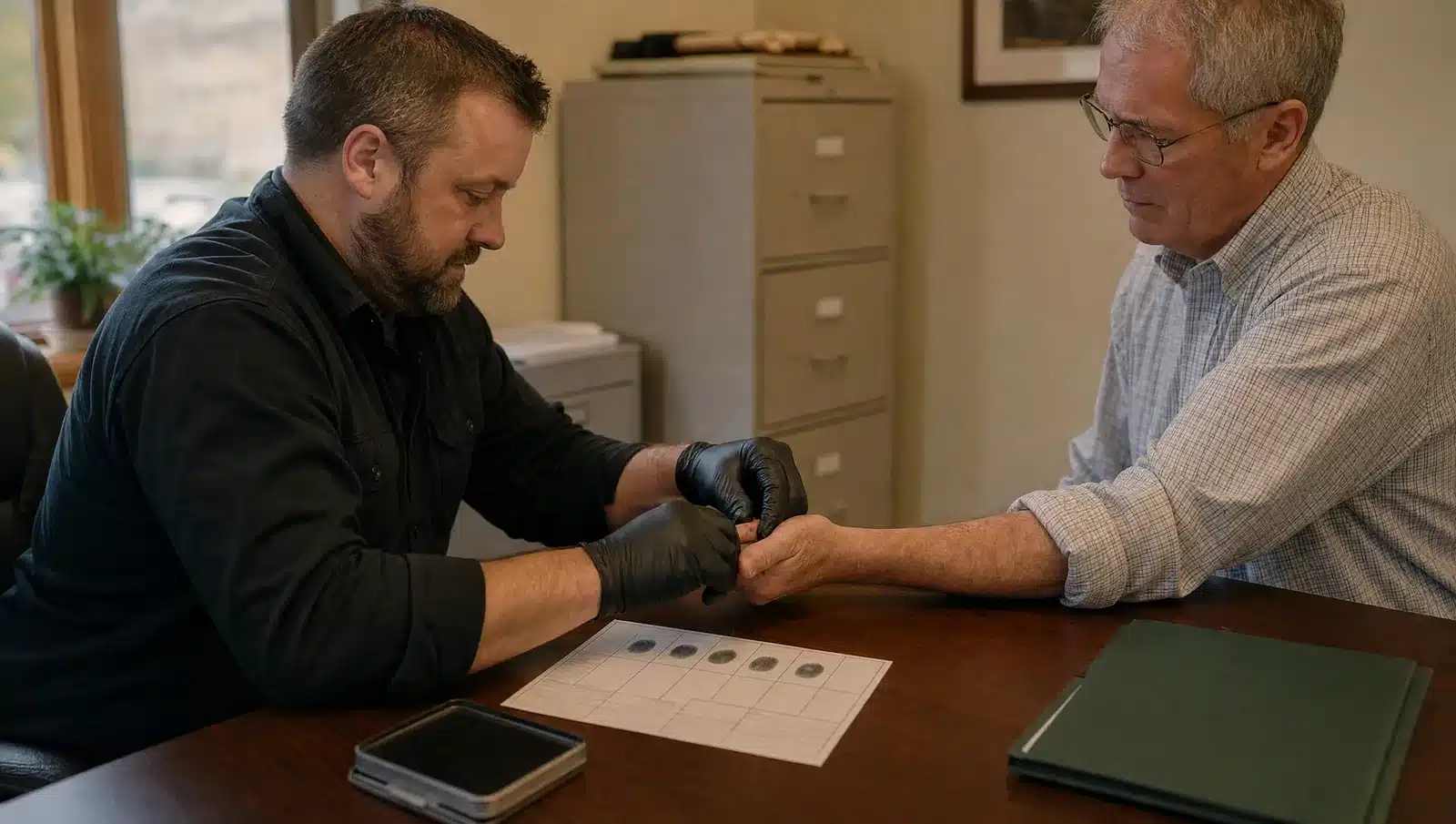
Mobile Fingerprinting Service in Massachusetts
The people who call a mobile notary are rarely dealing with one document. They are dealing with a situation: an estate getting organized, a parent entering care, a family filing for citizenship, an adoption moving forward, a business clearing new staff before a contract.
Situations generate paperwork in clusters. Somewhere in the cluster, with remarkable frequency, sits a line requiring fingerprints. The pension office wants prints with the notarized claim. The adoption agency wants prints from every adult alongside the witnessed affidavits. The foreign consulate wants an FBI background check to accompany the notarized application package.
One Visit Covers
Live Scan$65
Ink Card (FD-258)$49.95
FBI Background Check$125
Mobile Notaryfrom $129.95
Mobile Print Visitfrom $199.95
Mobile visits from $199.95 plus service fees, group discounts available. Homes, offices, hospitals and facilities across Metro Boston, Lowell and Worcester. Operated by Neighborhood Parcel Business Center since 2007.
The traditional answer sends people on two errands with two providers, hard enough for a busy household and genuinely impossible for the homebound clients mobile services exist to serve. Our answer is one visit. A certified fingerprint technician travels to your home, office, hospital room or facility anywhere in our Massachusetts coverage area, captures prints to federal standards on professional equipment and, where your paperwork calls for it, a commissioned notary handles the signatures in the same sitting. One appointment, one accountable provider, a situation moved forward instead of a to-do list grown longer.
This page explains the whole service: what mobile fingerprinting is and who it serves, why fingerprints and notarizations travel together so often, how a visit runs minute by minute, what everything costs and what happens to your documents after we leave. Both this service and the fingerprinting operation behind it, Fingerprint Boston, are owned and operated by Neighborhood Parcel Business Center in Tewksbury, the same family of document services since 2007, which is why the coordination between them works the way separate vendors never quite manage.
What Mobile Fingerprinting Is
Mobile fingerprinting brings professional print capture to your location instead of bringing you to an office. The technician arrives with portable equipment covering both capture methods: electronic Live Scan, where a scanner reads your prints digitally and grades every image in real time, plus traditional FD-258 ink cards, rolled by hand to FBI specifications for the agencies still requiring paper. The capture standard matches an office appointment exactly, including the part deciding outcomes, a quality review of every print before anything is submitted or handed over.
The service exists because print quality and access both matter. On quality, national systems reject a percentage of fingerprint submissions for image problems, smudges, weak ridges, incomplete rolls. Every rejection costs the applicant weeks while the paperwork behind it stalls. Professional capture with real-time checking prevents nearly all of it, which is why who takes your prints matters more than where. On access, a meaningful share of the people who need fingerprints cannot easily reach an office: elders managing foreign pensions, patients with licensing deadlines, families coordinating prints for every adult in a household, night-shift workers whose employers need them cleared. The mobile model serves exactly the people the office model quietly excludes, at the same federal capture standard. Access is not a niche concern. Between elders, patients, caregivers who cannot leave the house, workers without weekday flexibility and households needing four people printed at once, the excluded population is enormous, largely invisible to office-based providers and precisely who this service was built around from the first house call.
Three submission types cover nearly every request. Live Scan handles electronic submissions to agencies accepting digital intake. FD-258 cards handle out-of-state boards, foreign governments and any agency wanting mail. FBI background checks, formally the Identity History Summary, run through an FBI-approved channeler for the national record employers, consulates and adoption programs request. Your paperwork decides which one you need. Reading it with you before the visit is part of the service, at no charge, because the wrong submission wastes everyone’s time and your money.
Why Fingerprints and Signatures Travel Together
The pairing is not a marketing convenience. It reflects how regulated paperwork works. Agencies verifying identity at the highest level want two proofs: biometric proof of who you are through the fingerprints plus witnessed proof of what you signed through the notarization. The document packages built around life’s bigger events demand both, which is why the same visit so often needs both professionals. Walk through the situations and the pattern shows itself.
Estate Planning and Elder Care
An elder law attorney organizing a client’s affairs generates notarization demand by the folder: powers of attorney, health care proxies, deeds, trust documents. The same season of life generates fingerprint demand nobody anticipates: the foreign pension the client earned decades ago wanting periodic proof of identity, the record request a benefits program requires, the background check a guardianship or fiduciary appointment triggers. For a client in assisted living or recovering at home, each requirement is a separate mountain. A combined bedside visit levels all of them in an hour: prints captured gently and patiently, documents signed and witnessed, family spared the second and third appointment they were dreading. The families who discover this option describe it the same way every time: we did not know anyone did this.
Immigration, Citizenship and International Packages
International filings are the densest overlap of all. A citizenship application, a family visa petition, a dual citizenship claim or an overseas property matter assembles a package of FBI background checks, notarized affidavits, translated civil records and authenticated documents, all pointed at the same consulate deadline. The fingerprints anchor the FBI report. The notary witnesses the affidavits and declarations. The same household frequently needs both for multiple people, which is exactly the shape of work a combined home visit handles in one sitting: three adults printed, four documents notarized, one timeline instead of seven errands. The full document sequence from fingerprints through apostille and translation is mapped in the guide to FBI background checks and apostilles for visas and citizenship, and the later steps run through the same Tewksbury operation, covered below.
Adoption and Family Matters
Adoption programs fingerprint every adult in the household and bury the home study in notarized documents, references, statements, agreements. International adoptions layer FBI checks and apostilles on top. Guardianship and custody matters mix background checks with witnessed filings in the same folder. These are households coordinating work schedules, childcare and court dates simultaneously, for whom one evening visit capturing everyone’s prints and witnessing every signature replaces a week of logistics. Children print with lighter pressure and patience, a parent or guardian present throughout. The whole family finishes together at their own kitchen table.
Hospitals, Facilities and Homebound Clients
Mobile notaries know facility work: hospital rooms, rehab centers, skilled nursing, memory care, the signings where mobility ended the office option long ago. Fingerprint demand follows the same population. The patient with a professional license renewal mid-recovery. The resident with a foreign benefit claim wanting prints with the notarized forms. The record request an attorney needs from a client who no longer travels. Facility visits run on the facility’s rhythm, coordinated with nursing staff, scheduled around care and unhurried at the bedside, because a capture done gently and correctly the first time spares a fragile person a repeat nobody wants.
Employers and Group Clearances
Businesses clearing staff cohorts book the same traveling model at commercial scale: a scheduled visit printing an entire roster at the workplace, five to fifty people, one invoice, no errand coordination. Staffing agencies, healthcare employers, schools, camps and security firms run these as standing arrangements, some weekly through hiring surges, most monthly as an operations fixture, each clearing cohorts at a fraction of the coordination cost of individual errands. The employer playbook, including the paid-hours math against individual trips, lives in the Massachusetts mobile fingerprinting guide, and combined visits add on-site I-9 and employment document notarization where HR wants the paperwork closed in the same pass.

How a Combined Visit Works
The Scoping Call
Every visit starts with five minutes on the phone at (978) 424-4629. You describe the situation, not the service alone, because the situation reveals the full document picture: who needs prints, for which program, which documents need witnessing, where everything is headed afterward. Photograph any requirement letters and send them over, in whatever language and condition they arrived. We decode the codes, confirm the right submission type for each person and quote the visit as one itemized number before anything is booked. When the paperwork points abroad, we flag the apostille and translation steps now, at the start, when planning for them is cheap.
Scheduling Around Your Situation
Visits schedule around households, facilities and shifts rather than office hours: evenings for working families, coordinated windows for facility care schedules, single blocks for employer rosters. A typical home visit books within the week, faster when a deadline demands it. You prepare almost nothing: valid government photo ID for each person being printed or signing, the requirement letters and documents themselves and a table with decent light. The equipment, cards, supplies and witnessing standards travel with us.
The Visit Itself
A single-person capture runs about fifteen minutes. A household of three with notarizations runs under an hour. The technician checks each ID against each requirement, captures prints with real-time quality grading on electronic work or careful nail-to-nail rolls on ink cards and reviews every image before packing up. The notary work follows its own discipline in the same sitting: identity verified, willingness confirmed, documents signed, witnessed and sealed. Worn hands, common on the working and elderly hands this service sees most, get the adjusted pressure and patience they need, since rushing a difficult capture is how rejections happen.
After We Leave
Electronic submissions transmit to their receiving agencies. Ink cards leave with you or mail with tracking, finished and checked. Notarized documents stay in your hands, executed and sealed. You receive an itemized receipt covering everything, useful for the reimbursements employers and programs frequently offer. And if any agency ever rejects a print we captured for quality, we return and recapture, which almost never happens for the same reason it almost never needs saying: the quality review before we leave is the product.
Services and Pricing
Transparent numbers, quoted before booking, itemized on one invoice. Fingerprinting services anchor to the published office pricing: Live Scan electronic capture at $65 per person, FD-258 ink cards at $49.95 with additional cards at $25 each and FBI background check submissions at $125 including channeler routing, with the complete menu on the Fingerprint Boston pricing page. Mobile print scan visits start at $199.95 plus applicable service fees, covering the technician’s travel and on-location capture, with the per-person service rates above applying to each set of prints. Mobile notary service starts at $125 per visit by zone. Combined visits price as one trip rather than two, which is the entire economic point: the travel component is shared, so adding fingerprinting to a notary visit costs far less than booking the services separately, exactly as adding signatures to a fingerprint visit does. Group and facility visits quote per trip by headcount and distance, with discounts for larger groups bringing the per-person figure down as the roster grows. Recurring arrangements price better than one-off calls. Certain submissions carry government or agency processing fees on top, named in the quote, never discovered on the invoice.
One honest boundary, stated plainly because trust is the product here. A single mobile-capable person near Tewksbury with easy transportation should book the office instead and skip the trip fee entirely: in-office fingerprinting runs by appointment Monday through Friday at 1215 Main Street with free parking. Mobile pricing exists for groups, distance, access barriers and combined document work. Part of quoting fairly is saying when the cheaper option fits.
Get one number for the whole visit.
Describe the situation, send a photo of any requirement letters and receive an itemized quote before booking anything. Five minutes on the phone replaces a week of vendor calls.
The Notary Side, Briefly
Since this page lives on a notary site, the signing half of the visit deserves its own clear paragraph. The traveling notary handles the full range of witnessed work: powers of attorney, health care proxies, real estate documents, affidavits and declarations, loan signings, I-9 employment verifications, trust and estate documents and the general acknowledgments and jurats everyday life produces. Standard notarial rules travel with the seal: the signer appears in person, presents valid ID, demonstrates willingness and awareness and signs before the notary, requirements we confirm during scoping so no visit ends with an unsignable document. What the notary witnesses and what the technician captures are separate professional acts held to separate standards, delivered in one coordinated appointment, which is the whole product in a sentence.
Timing, Deadlines and When to Book
Book against the deadline chain, not the calendar’s convenience. Fingerprint results return on each receiving agency’s clock, days for channeled electronic work, weeks for mailed cards and longer where apostilles follow, so the fingerprint visit belongs at the front of any timeline, the week the requirement lands. Notarizations execute same-day at the visit, making them the flexible half of the pairing. For consulate deadlines, work backward from the appointment date through the freshness window the consulate publishes, commonly three to six months for background checks, then land the visit early inside the window. Same-week visits are the norm, urgent slots exist for genuine deadlines and the seasonal rushes, school-year starts, summer program clearances, holiday hiring, reward anyone booking two weeks ahead of the crowd.
Where We Travel
Coverage runs across eastern and central Massachusetts from our Tewksbury base at the junction of I-495 and I-93. Metro Boston and the inner ring: Boston, Cambridge, Somerville, Quincy, Newton, Brookline, Waltham, Medford. The Merrimack Valley at our doorstep: Lowell, Chelmsford, Billerica, Dracut, Andover, Lawrence, Methuen, Haverhill. Central Massachusetts: Worcester, Shrewsbury, Marlborough, Westborough, Fitchburg, Leominster. Southern New Hampshire border towns join by arrangement. Trip components scale with distance and spread across headcount, which keeps per-person figures sensible on group visits anywhere in the map. City-side fingerprinting details also live on the Fingerprint Boston local pages for Cambridge, Lowell and the full service area list.
One Family of Services, One Accountable Provider
Here is the structural advantage worth understanding before you book anyone. This mobile notary service, the Fingerprint Boston fingerprinting operation and the document services behind both are owned and operated by Neighborhood Parcel Business Center, a Tewksbury institution serving the Merrimack Valley since 2007. The shared ownership is why the combined visit exists at all. It matters most after the visit, when documents keep moving.
An FBI report headed to a foreign government needs an apostille, the federal authentication consulates require, then frequently certified translation after it. Documents notarized for international use often need state-level apostilles of their own. Under separate vendors, each step is a new provider, a new intake and a new chance for the chain to break. Under one roof, the prints captured at your kitchen table flow into the FBI request, the returned report flows into apostille processing, the authenticated package flows into translation and one provider answers for the whole chain, with one phone number when you have a question. Families who have run international paperwork both ways describe the difference in months, not days.
Three Visits, Told Plainly
Abstract services become real through specific mornings, so here are three, details changed, shapes true. A Dracut kitchen on a Tuesday evening: a Cambodian family assembling a citizenship petition for a grandmother abroad, three adults needing FBI checks, two affidavits of support needing witness, a stack of civil records headed for translation. One visit prints all three at the table where the family eats, witnesses both affidavits and leaves with the destination country named, so the reports come back in the format the apostille office accepts. Total time, seventy minutes. Errands replaced, roughly six.
A Newton memory care facility on a Thursday: an elder law attorney finalizing a client’s affairs, a power of attorney and health proxy needing witness, a foreign pension renewal wanting fresh prints from a man who worked thirty years in Portugal before his hands earned their rest. The visit runs on the facility’s schedule, coordinated with the charge nurse, unhurried at the bedside. Worn ridges get the patient, adjusted capture they need and pass quality review on the first pass. The attorney closes the file. The family thanks the nurse. The pension continues.
A Marlborough staffing office on a Monday at seven: fourteen new warehouse hires needing clearance before a contract start, plus I-9 documents wanting notarized completion while everyone stands in one room for once. By nine-forty the roster is printed, checked, submitted and signed, one invoice on its way to accounting. The contract starts on the date the sales team promised, which, the branch manager admits, has not always been the tradition.

Choosing a Mobile Fingerprinting Provider: Five Questions Worth Asking
This section serves you even if you never call us, because the mobile fingerprinting field is unregulated enough for quality to vary wildly. Ask any provider these five questions and the answers sort the field fast. First, who captures the prints and what happens when an image reads weak? The answer should feature a trained technician and real-time quality review, since capture skill is the entire difference between accepted and rejected submissions. Second, which services travel, electronic, ink cards or both? Requirements differ by agency, so a one-method provider covers only part of the map. Third, what does the quote include and what appears later? Insist on one itemized number naming any government fees up front. Fourth, what happens after a rejection? The right answer is a return visit and recapture, stated plainly, not a shrug toward the agency. Fifth, what happens to the documents afterward, when the report needs an apostille or the package needs translation? A provider connected to the downstream steps saves you from vendor-hunting mid-process. Any provider answering all five confidently deserves your consideration. We publish our answers across this page precisely because confident answers are the point.
Preparing for Your Visit
Small preparations raise first-pass success. They cost nothing. Hands first: moisturize for two days before the visit and skip harsh cleaning chemicals the morning of, since dry, cracked fingertips are the leading cause of weak prints, advice doubly relevant for the elders, clinicians and hands-on workers this service visits most. Names second: the name on each ID should match the name on each application, so gather the marriage certificates or court orders connecting any name changes before the visit rather than during it. Paper third: every requirement letter, code sheet and document in one folder on the table when we arrive. Facility visits add one call to the nursing station confirming timing, which we handle with you during scheduling. Households finish faster than they expect. The most common closing remark calls the visit the easiest part of the whole process, which is the goal.
Common Questions About Mobile Fingerprinting
Quick Answers Before You Book
Is mobile capture accepted the same as office capture?
Yes. Receiving agencies evaluate the submission and the print quality, not the room where capture happened. The equipment, technique and quality review travel intact. Electronic images grade in real time at your table exactly as they would at the office counter.
How much does a combined fingerprint and notary visit cost?
The visit quotes as one itemized number: mobile print scan visits from $199.95 plus service fees, per-person fingerprinting at the published service rates, notary work with mobile visits from $125 by zone and group discounts for larger rosters. Combining services in one trip costs meaningfully less than booking two separate providers. The quote arrives before you commit to anything.
Who in my family needs to be present and with what ID?
Everyone being printed or signing, each with a valid unexpired government photo ID. Minors being printed need a parent or guardian present with their own ID. For signings, the signer must be present, alert and willing, the standard notarial requirements, which we confirm during scoping so nobody is surprised at the table.
Do you fingerprint people in hospitals and nursing facilities?
Yes, this is core work for us. We coordinate timing with the facility, work around care schedules and capture patiently at the bedside. Combined visits handling the facility signing and the prints together are common for pension, guardianship and estate matters, sparing families a second appointment.
What happens if a print gets rejected for quality after the visit?
We return and recapture. Rejections are rare precisely because every print is quality-checked before we leave, but the guarantee stands: one provider, accountable end to end. Keep the rejection notice, since agencies waive their processing fee on resubmission in most programs.
My documents are going to another country. Do you handle the rest?
Yes, through the same family of services: FBI report, apostille authentication and certified translation all run through the Neighborhood Parcel operation in Tewksbury. Name the destination country during the scoping call and the whole chain gets planned from the first step, in the right order.
Book the Visit
Whatever situation generated the paperwork, the paperwork is the easy part now. Call (978) 424-4629 and describe what you are dealing with. Or start with the fingerprinting side online at fingerprintboston.com/contact and mention the documents needing witness. Five minutes of scoping, one scheduled visit, prints captured to federal standards and signatures witnessed at your own table. Situations move forward one completed step at a time. This service exists to complete several of them in a single hour, wherever you are.

1,190+ signings across Greater Boston and the Merrimack Valley. Fluent in English, Arabic and French. About Hanson