
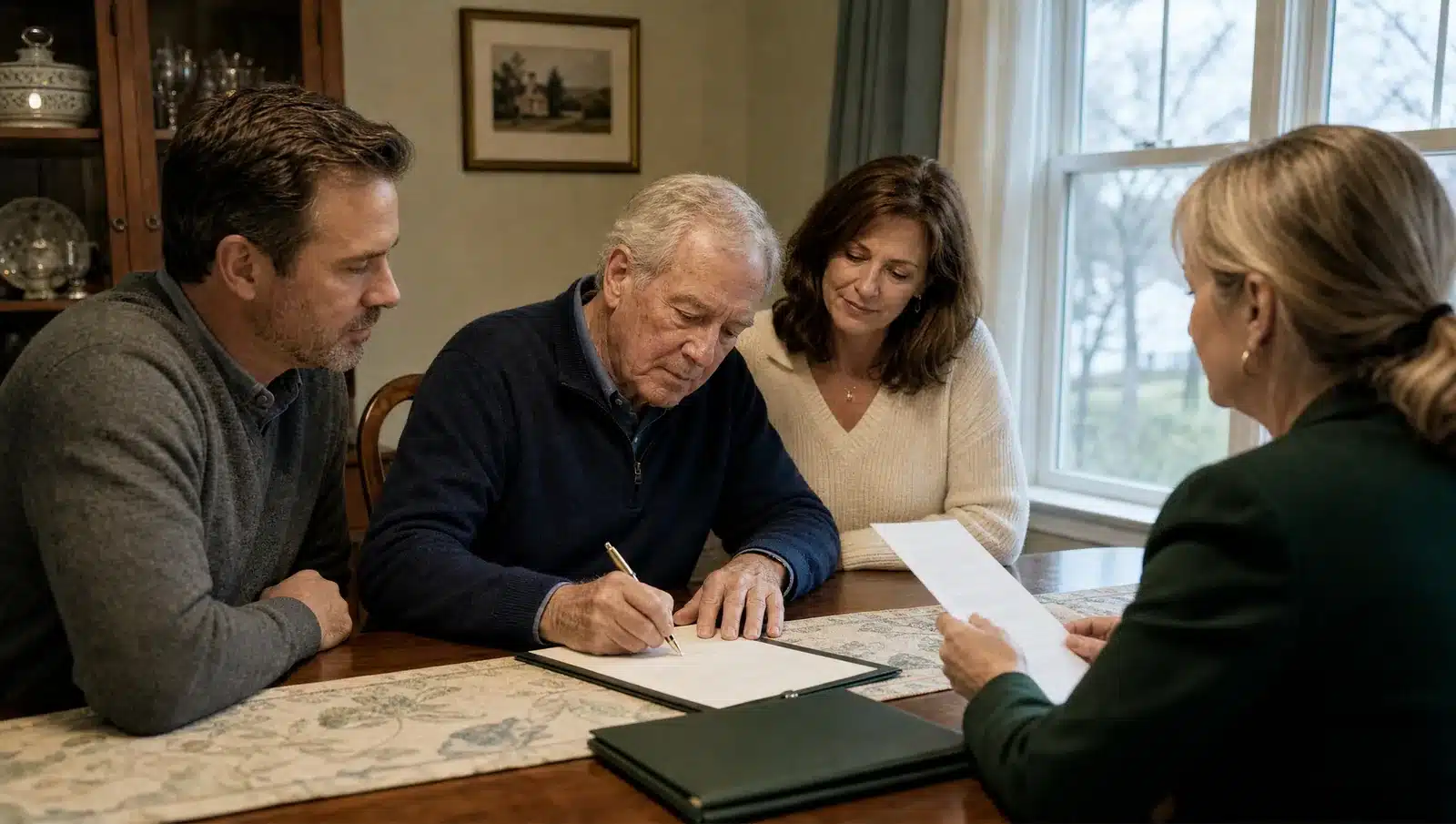
Does a Will Need to Be Notarized in Massachusetts? Witnesses, the Self-Proving Affidavit, and Why the Notary Cannot Be a Witness
No. A Massachusetts will does not need to be notarized to be valid. A valid will is a written document signed by the testator and by two witnesses. The notary comes in for one optional page, the self-proving affidavit, which saves your family a court step later. Here is how the signing works.
What does Massachusetts law actually require for a valid will?
Massachusetts requires three things for a valid will: it must be in writing, it must be signed by the person making it (or by someone else in that person’s conscious presence and at their direction), and it must be signed by at least two individuals who watched the testator sign or heard the testator acknowledge the signature or the will. That is the full list under M.G.L. c.190B s.2-502, the Massachusetts Uniform Probate Code.
Notice what is missing from that list. There is no requirement for a notary seal, no requirement that the signing happen at a law office, and no requirement that the witnesses know what the will says. The witnesses are confirming that the person in front of them signed the document voluntarily and appeared to understand what they were doing. They are not approving the contents.
A one-sentence definition for the record: in Massachusetts, a will is valid when it is written, signed by the testator, and signed by two competent witnesses; notarization is optional and serves only to make the will self-proving.
How many witnesses does a will need in Massachusetts, and who can be one?
Two witnesses, and almost any adult can serve. Under M.G.L. c.190B s.2-505, anyone who is generally competent to testify in court may witness a will. There is no requirement that the witness be a Massachusetts resident, a stranger, or a notary.
The careful choice is still a disinterested witness. The same section says that a gift to a witness, or to the witness’s spouse, is void unless two other witnesses who do not benefit also signed, or the interested witness can prove the gift was not the product of fraud or undue influence. In plain terms: if your daughter inherits the house and also signs as a witness, the will survives but her inheritance may not. Use two people who are not named in the document.
Choices our Merrimack Valley clients make work well: two neighbors, two adult friends, a coworker and a cousin who is not a beneficiary, or two staff members at a law office. In a hospital, no employee is obligated to serve, and many facilities bar staff from witnessing legal documents. Ask before you count on it.
Each witness needs valid photo identification to sign the self-proving affidavit, because the notary identifies them and takes their oath. A witness who forgets ID can still witness the will itself but cannot complete the affidavit that day.
What is a self-proving affidavit, and why is that the part the notary signs?
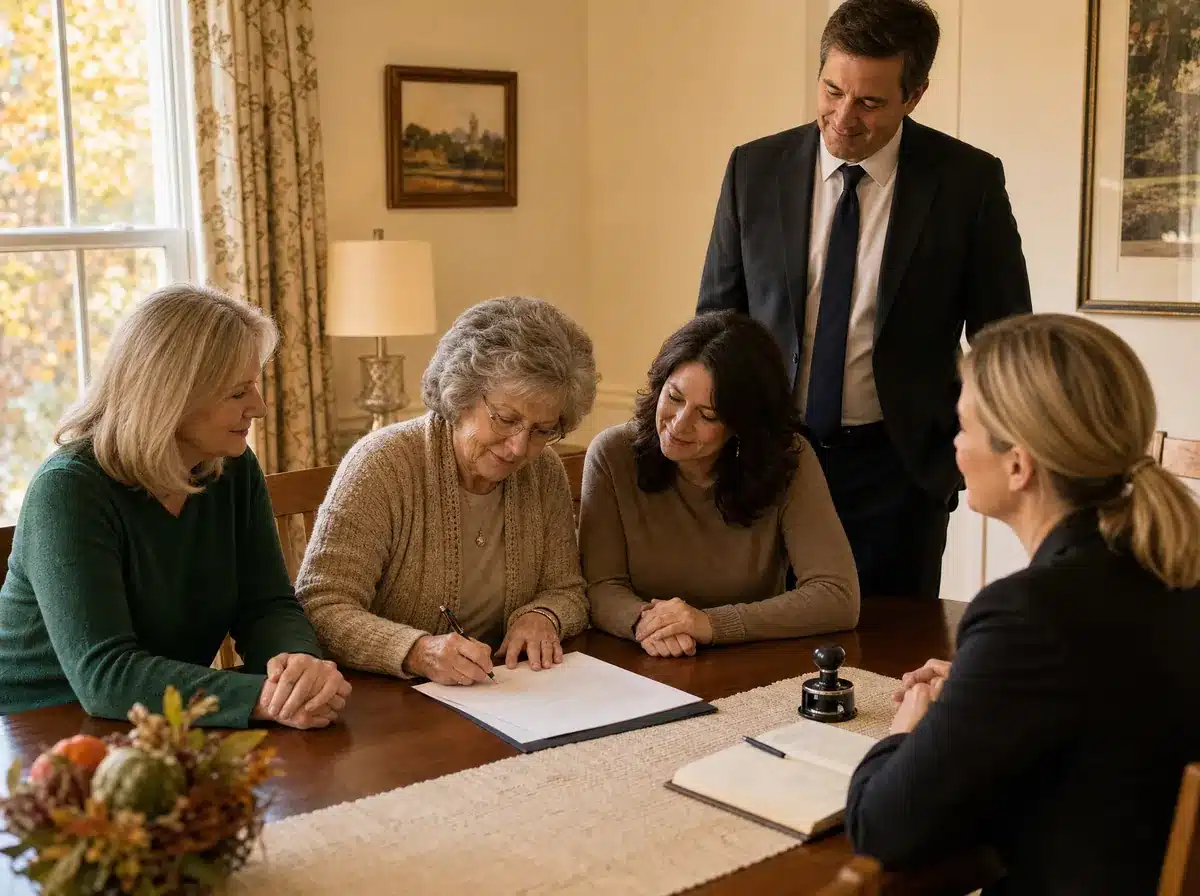
A self-proving affidavit is a sworn statement, attached to the will, in which the testator and both witnesses swear before a notary that the will was signed properly. Massachusetts authorizes it under M.G.L. c.190B s.2-504. This is the only part of a will signing where a notary has any role at all.
The affidavit does two things. First, the testator declares under oath that they signed the will willingly, as a free and voluntary act, that they are at least 18, of sound mind, and under no constraint or undue influence. Second, the witnesses declare under oath that the testator signed the will as their will in the witnesses’ presence and hearing, that each witness signed in the testator’s presence, and that to the best of their knowledge the testator met those same conditions. The notary administers the oaths, signs, and seals the certificate.
Why bother? Because when the will is later filed at a Probate and Family Court, the court normally needs proof that the signing was done correctly. Without an affidavit, the personal representative may have to locate the witnesses and obtain their testimony or sworn statements, years after the fact, when one witness may have moved to Florida and the other may have died. With the affidavit, the statute lets the sworn signatures stand in for that testimony. The Middlesex Probate and Family Court in Woburn and the Essex Probate and Family Court in Salem see both kinds of wills every week; the self-proved ones move faster.
The statute also answers a common timing question. Section 2-504(b) allows a will to be made self-proved “at any time after its execution.” So a will that was witnessed in 2015 without a notary can be made self-proving today, as long as the same testator and the same two witnesses can sit down together before a notary. If a witness is no longer available, that route is closed, and the will simply remains a validly witnessed will that will need witness proof at probate.
Can the notary also be one of the two witnesses?
Not in any way that works. A notary administers an oath to the witnesses and certifies their signatures on the self-proving affidavit. A Massachusetts notary cannot notarize their own signature or take their own oath, and M.G.L. c.222 s.16 bars a notary from performing a notarial act in which the notary is a party or has a financial interest. The notary who signed as a witness would need a second notary to complete the affidavit, which defeats the purpose of having one notary in the room.
There is a practical reason too. A notary’s value at a will signing is independence. Doubling as a witness pulls the notary into the transaction and invites the exact challenge the affidavit is meant to prevent.
Our policy follows from this. Hire Mobile Notary does not provide, supply, bring, coordinate or serve as witnesses for a will or any other document. You arrange your own two witnesses, and we notarize the affidavit. We say this on the phone when you book, and we repeat it here so no family arrives at the kitchen table with one witness short.
If you cannot think of two people, the estate planning attorney who drafted your will can usually host the signing with staff witnesses, and our signature witnessing page explains what a notary’s signature witnessing act is and is not, since the two are often confused.
Are handwritten or unwitnessed wills valid in Massachusetts?
A handwritten will is valid only if it meets the same three requirements: written, signed by the testator, and signed by two witnesses. A handwritten will with no witnesses, often called a holographic will, is not valid in Massachusetts. The Massachusetts version of the Uniform Probate Code deliberately left out the holographic will provision that some other states adopted, and Massachusetts courts have declined to rescue unwitnessed documents under a harmless-error theory.
This catches people who move here. Several states accept a will written entirely in the testator’s handwriting with no witnesses. A will validly made in another state under that state’s law generally remains valid when the person moves to Massachusetts, but a new will written at a kitchen table in Lowell without witnesses will not be.
Notarizing an unwitnessed will does not fix it. We are asked this regularly: “Can you just notarize it so it counts?” A notary seal on a signature does not substitute for the two witnesses the statute requires. If anything, a notarized but unwitnessed will creates false confidence. The honest answer is to gather two witnesses and sign again.
What happens at a kitchen-table will signing with a mobile notary?
A typical in-home will signing takes 20 to 30 minutes once everyone is seated, and it follows a fixed order so nothing is signed out of sequence. Here is how it runs when we come to a home in Tewksbury, Andover or Chelmsford.
- Everyone shows photo ID. The notary checks the testator’s ID and both witnesses’ IDs against the names typed in the will and the affidavit.
- The notary confirms the testator knows what the document is and is signing willingly. This is a short, plain conversation, not a quiz. Family members are asked to let the testator answer.
- The testator signs the will where indicated, with both witnesses watching.
- The two witnesses sign the attestation clause of the will.
- The notary administers the oath to the testator and to both witnesses for the self-proving affidavit.
- The testator and the witnesses sign the affidavit.
- The notary completes the certificate, signs, applies the seal, and records the act in the notary journal.
- The notary hands the original back. Nothing is kept by the notary, and nothing is filed anywhere that day.
Bring the will as drafted, unsigned. Do not sign ahead of time. If the will came from an attorney, it will already have the attestation clause and the affidavit page; if you drafted it yourself or used a form, make sure both pages are present, because we cannot draft or add legal language for you. A notary is not an attorney and cannot explain what a clause means or whether the will does what you want.
A kitchen-table signing in a Zone 1 town such as Tewksbury starts at $125, including travel, one notary seal and 15 minutes of service. Zone 2 towns like Lowell, Billerica and Andover start at $179. Zone 3, which includes Boston, Cambridge, Newton and Lexington, starts at $250. A will signing uses one seal for the affidavit, so most families pay the base visit fee. If you are also signing a health care proxy, durable power of attorney and HIPAA release the same evening, tell us when you book so the extra seals are quoted up front. Our trusts and wills notary page lists what we commonly see in one estate-planning packet.
How does a will signing work in a hospital or nursing home?
The same legal rules apply at a bedside, with three added realities: the patient must be alert and willing at the moment of signing, the family must bring two witnesses, and the facility’s visiting rules control when it can happen. We handle bedside signings across Greater Boston, from Lowell General and Lawrence General to Mass General, Beth Israel Deaconess and Boston Medical Center, and at nursing homes and rehab centers from Tewksbury to Newton.
Capacity is the issue that stops a bedside will signing most often. A notary does not diagnose anyone, but a Massachusetts notary must refuse if the signer appears not to understand what is happening or seems unwilling. Pain medication, sedation after surgery and late-day confusion are the usual causes. Ask the nurse when your parent is most alert, and schedule for that window. Mornings are usually better than evenings.
Witnesses at a hospital are the family’s job. Do not assume a nurse, aide or social worker will sign. Some Boston hospitals have offered a volunteer or staff notary on limited weekday hours, but staff notaries generally do not serve as witnesses and are often unavailable on weekends or evenings. Bring two adults who are not beneficiaries, each with photo ID. Two cousins or two family friends from the waiting room is the most common arrangement we see.
If the patient cannot hold a pen, Massachusetts law allows a signature by mark and, in limited cases, allows another person to sign at the patient’s direction in the notary’s presence, but that is a conversation to have with the drafting attorney before the appointment, not at the bedside. Our hospital notary service page covers scheduling, parking and what to tell the nursing station.
Zone 3 pricing, from $250, includes hospital and nursing home visits in Boston and the surrounding cities. Same-day and after-hours bedside visits are available by confirmation, seven days a week.
Can a will be notarized online or remotely in Massachusetts?
No, and that is true on two separate grounds as of October 2026. First, the Massachusetts remote online notarization law, Chapter 2 of the Acts of 2023, specifically excludes wills and codicils from remote notarization. Second, the Secretary of the Commonwealth has not yet opened the training and registration process that the law requires before any notary may perform a remote act, so no Massachusetts notary is lawfully performing remote notarizations for any document at this time.
Out-of-state online platforms do not solve this. A will signed in Massachusetts has to meet Massachusetts execution rules, and an online notary in another state cannot administer an in-person oath to your two witnesses in your living room. Our mobile notary service exists for exactly this gap: the signing has to happen in person, and we come to where the testator is.
Which estate documents need a notary, and which need witnesses?
Each estate document in a Massachusetts packet has its own signing rule, and families mix them up constantly. The table below is the short version. The drafting attorney’s instructions always control; this is a guide to what to expect at the table.
| Document | Witnesses required? | Notary required? | Notes |
|---|---|---|---|
| Last will and testament | Yes, two (M.G.L. c.190B s.2-502) | No; optional for the self-proving affidavit (s.2-504) | Notary cannot double as a witness. Wills excluded from remote notarization. |
| Self-proving affidavit | Signed by the same two witnesses | Yes, oath and seal | Can be done at signing or any time later with the same witnesses. |
| Health care proxy | Yes, two adults; the named agent cannot be a witness (M.G.L. c.201D) | No | Many families notarize anyway for out-of-state use; not required. |
| Durable power of attorney | Not required by statute; attorneys often add two | Yes in practice, and required if it will be recorded for real estate | Banks and the Registry of Deeds expect an acknowledgment. |
| Revocable living trust | Not required | Usually, because financial institutions ask for it | Trustee certificates for real estate are notarized and recorded. |
| HIPAA release | No | No, often notarized for convenience | One seal if included. |
Two takeaways. The health care proxy, like the will, runs on witnesses, not a notary, and the person you are naming as your agent cannot be one of them; our health care proxy page walks through it. And if your attorney built your plan around a trust rather than a will, the signing will involve more notary seals and fewer witnesses; the living trust vs. will guide explains the difference from the signing-table point of view.
What should I bring to a will signing, and how do I book one?
Bring the unsigned will with its attestation clause and self-proving affidavit, valid photo ID for the testator and both witnesses, and the two witnesses themselves. That is the complete list. A pen and a table are helpful but we carry pens.
Valid ID means a current government-issued photo ID: a Massachusetts driver’s license or ID card, a U.S. or foreign passport, or a military ID. If the testator’s license lapsed during a long hospital stay, call us before the appointment and we will talk through what Massachusetts law allows.
To book, call Hanson Webb directly at (978) 424-4629, seven days a week, or the office at (978) 851-0199, or reserve a time at https://hiremobilenotary.com/booking/. Tell us the town, whether the signing is at a home, hospital or nursing home, how many documents are in the packet, and confirm that your two witnesses are lined up. Hanson has been a Massachusetts notary since 2007, is NNA certified, has completed more than 1,190 signings, and works in English, Arabic and French, which matters when a parent is more comfortable confirming their wishes in their first language. In-office signings at 1215 Main St, Suite 115, Tewksbury are $45 per notarial act if you would rather bring your witnesses to us.
Need this notarized this week?
Same-day and weekend mobile appointments across Greater Boston and the Merrimack Valley. Flat zone pricing, travel included.
Frequently asked questions
Does my will have to be notarized in Massachusetts?
Short answer: no. A Massachusetts will is valid when it is in writing, signed by you, and signed by two witnesses under M.G.L. c.190B s.2-502. A notary is used only for the optional self-proving affidavit, which lets the court accept the will without tracking down the witnesses later.
How many witnesses does a will need in Massachusetts?
Short answer: two. Each must have watched you sign or heard you acknowledge your signature or the will. Any adult competent to testify may serve, but choose people who are not beneficiaries, because a gift to a witness or the witness's spouse can be voided under s.2-505.
What is a self-proving affidavit and why does it save my executor time?
Short answer: it is a sworn statement by you and your two witnesses, notarized, confirming the will was signed correctly. At probate, the affidavit stands in for witness testimony, so your personal representative does not have to locate witnesses years later. It is authorized by M.G.L. c.190B s.2-504.
Can a notary also be a witness to my last will and testament in Massachusetts?
Short answer: not in practice. The notary takes the witnesses' oaths and certifies their signatures on the affidavit, and a notary cannot notarize their own signature. Our policy is firm: we do not serve as, supply or coordinate witnesses. You bring your own two.
Can a Massachusetts will be notarized at a different time than it was witnessed?
Short answer: yes. Section 2-504(b) allows a will to be made self-proved at any time after execution, as long as the testator and the same two witnesses appear together before a notary and swear to the affidavit. If a witness is unavailable, the will remains valid but will need witness proof at probate.
Is a handwritten will valid in Massachusetts?
Short answer: only if two witnesses signed it. Massachusetts does not recognize unwitnessed holographic wills, and notarizing an unwitnessed will does not cure the defect. Gather two witnesses and sign again.
Can a will be notarized online in Massachusetts?
Short answer: no. Chapter 2 of the Acts of 2023 excludes wills and codicils from remote online notarization, and as of October 2026 the Secretary of the Commonwealth has not yet opened the registration process for any remote notarization. Will signings in Massachusetts happen in person.
What do I need to bring to a will signing at home or in a hospital?
Short answer: the unsigned will with its affidavit page, photo ID for you and both witnesses, and the two witnesses. At a hospital, schedule for the hour when the patient is most alert, and confirm that the facility allows the visit. We do not provide witnesses.
Who supplies the witnesses for a will signing?
Short answer: you do. Hire Mobile Notary does not provide, supply, bring or coordinate witnesses. Neighbors, adult friends, coworkers or relatives who are not named in the will are the usual choices. Each witness needs valid photo ID for the self-proving affidavit.
How much does a mobile notary charge for a will signing in Massachusetts?
Short answer: from $125 in Zone 1 (Tewksbury area), $179 in Zone 2 (Lowell, Andover, Worcester and 40 more towns) and $250 in Zone 3 (Boston, Cambridge and 110 more), with travel and one seal included. In-office at Tewksbury is $45 per notarial act. Extra seals for a POA or proxy are quoted when you book.


