Massachusetts Is an Attorney Closing State: What a Notary Signing Agent Can and Cannot Do
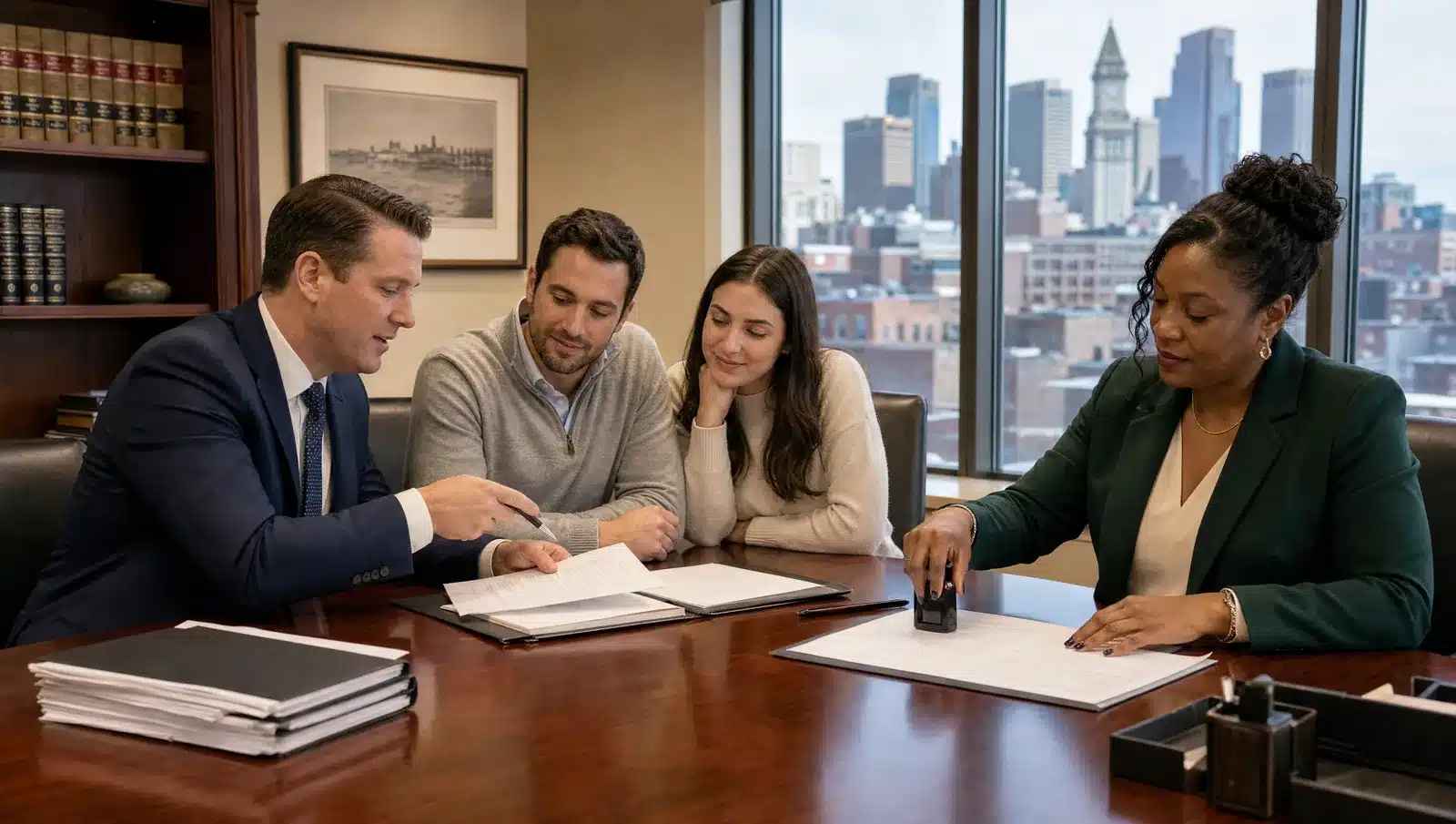
Massachusetts is an attorney closing state: a licensed Massachusetts attorney must conduct every residential real estate closing, and a notary who is not an attorney may not run one. A notary signing agent notarizes signatures at the closing attorney's direction. Here is what that means for lenders, title companies and signing services booking Massachusetts work.
Why is Massachusetts called an attorney closing state?
Because Massachusetts law treats the core steps of a real estate closing as the practice of law, and only a licensed Massachusetts attorney may practice law here. Two sources make that concrete: the Supreme Judicial Court’s 2011 decision in Real Estate Bar Association for Massachusetts v. National Real Estate Information Services, 459 Mass. 512, and M.G.L. c.222 s.17(e), which says a notary public who is not a Massachusetts attorney “shall not conduct a real estate closing and shall not act as a real estate closing agent.”
In most of the country, a title company or escrow agent runs the closing and a notary signing agent sits with the borrower to collect signatures. That model does not transfer to Massachusetts. Here the closing attorney certifies title, prepares the deed, oversees the signing, controls the funds and records at the Registry of Deeds. The notary’s job is one piece of that: the notarial acts.
One-sentence version: in Massachusetts the closing attorney conducts the closing; the notary signing agent performs notarizations under that attorney’s direction and nothing more.
What did REBA v. NREIS (2011) decide, in plain English?
The SJC held that the heart of a Massachusetts real estate closing is legal work that only an attorney may perform, and that the attorney must “substantially participate” in the transaction rather than show up to watch signatures. The case is Real Estate Bar Association for Massachusetts v. National Real Estate Information Services, 459 Mass. 512 (2011).
NREIS, a national settlement vendor, was coordinating Massachusetts closings the way such companies do in escrow states. REBA, the Massachusetts real estate bar, sued for unauthorized practice of law, and the First Circuit certified the state-law questions to the SJC (608 F.3d 110 (1st Cir. 2010)).
The court drew lines. Drafting a deed for someone else is the practice of law in Massachusetts. Certifying good, clear and marketable title to the lender and buyer is the practice of law. Seeing the transaction through, meaning making sure the deed and mortgage are properly executed and recorded, the funds are properly exchanged, and prior mortgages and liens are paid and discharged, is the attorney’s responsibility. Some vendor tasks were found not to be the practice of law: ordering a title abstract, issuing title insurance, assembling non-legal closing paperwork and the settlement statement. On other NREIS activities the court said the record was too thin to rule.
The phrase everyone remembers is “substantial participation.” An attorney cannot satisfy Massachusetts law by appearing at the signing table while a non-attorney vendor controls the file. Massachusetts Bar Counsel reinforced this in a 2013 advisory, calling an attorney’s witness-only appearance inadequate unless other Massachusetts attorneys had handled the legal steps. Commentary is collected at massrealestatelawblog.com.
Then the Legislature wrote the rule for notaries into the statute. Chapter 289 of the Acts of 2016 codified notary standards into M.G.L. c.222, and s.17(e) says a non-attorney notary may not conduct a closing or act as a closing agent. The exceptions are narrow: a notary employed by a Massachusetts attorney may notarize for that attorney’s closings, and a notary employed by a lender may notarize for that lender’s own loan closings.

What must the Massachusetts closing attorney actually do?
The closing attorney must handle every step the SJC identified as legal work and must remain substantively involved from title through recording. On a typical purchase or refinance in Middlesex, Essex or Suffolk County, that means:
- Examine and certify title. The attorney reviews the title examination and certifies good, clear, record and marketable title to the lender and, on a purchase, to the buyer.
- Prepare or review the legal instruments: the deed on a sale, the mortgage, any power of attorney used at the closing, trustee certificates and the Registry’s affidavits.
- Resolve title issues: discharges of prior mortgages, municipal lien certificates, estate and trust questions.
- Oversee the signing. The attorney directs how, when and by whom documents are executed, answers the parties’ legal questions, and decides whether a notary signing agent may perform the notarizations at a separate time or place.
- Control and disburse funds under the Massachusetts good funds law and the lender’s instructions.
- Record at the Registry of Deeds, by paper or electronically, and report the recording back to the lender.
- Issue the title policy and final closing documentation.
None of those steps may be delegated to a notary signing agent. The notary performs the notarial acts within the signing the attorney oversees, which is why the agent has to be engaged by or at the direction of the attorney, not in place of one.
What can a notary signing agent legally do at a Massachusetts closing?
A Massachusetts notary signing agent may perform notarial acts and the clerical work around them, under the closing attorney’s direction. A non-attorney signing agent in Massachusetts can:
- Verify each signer’s identity with acceptable government photo ID and record the act in the notary journal, as M.G.L. c.222 requires.
- Take acknowledgments on the mortgage, deed, power of attorney and other instruments that will be recorded.
- Administer oaths and complete jurats on the package’s affidavits.
- Witness signatures where a signature witnessing certificate is called for.
- Confirm that every page requiring a signature, initial or date is complete, in the form the attorney and lender provided.
- Print the package if asked, scan completed documents back to the attorney the same day, and ship originals by the courier the attorney specifies.
- Meet the signer where the attorney cannot: a borrower’s home in Andover on a weeknight, a seller’s hospital room in Boston.
- Stop and call the attorney when a question comes up that is not about where to sign.
What the signing agent cannot do in Massachusetts, under c.222 s.17 and REBA:
- Conduct the closing or act as the closing or settlement agent.
- Explain the legal effect of any document, answer “what does this clause mean,” or compare the terms to what the borrower expected. The National Notary Association’s state restrictions page says a non-attorney who explains legal concepts and rights to a borrower at a Massachusetts closing has engaged in the unauthorized practice of law (nationalnotary.org).
- Draft or alter any document, including filling in blanks the attorney left empty.
- Certify title, hold or disburse funds, or handle payoffs.
- Record documents or act as the party responsible for recording.
- Provide witnesses. Massachusetts loan documents rarely need them, but when a document does, the signer arranges them; we do not supply, bring or serve as witnesses.
Hanson Webb is an NNA Certified Loan Signing Agent with more than 1,190 signings since 2007, always as the notary supporting a Massachusetts closing attorney, title company or lender. We do not conduct closings. The loan signing agent page describes the service in that frame, and how a mortgage is notarized walks through the notarial acts themselves.
What is a witness-only closing, and why is it barred in Massachusetts?
A witness-only closing is a signing in which a notary, or an attorney acting only as a notary, sits with the borrower to collect and notarize signatures while a company outside the state controls the file, the title and the money. It is the standard model in escrow states. In Massachusetts it is unlawful for a non-attorney notary under c.222 s.17(e), and inadequate for an attorney under REBA and the 2013 Bar Counsel advisory, because nobody at the table is substantively responsible for the legal work.
The term confuses people because the signing agent’s legitimate Massachusetts role looks, from across the room, like a witness-only closing: a notary and a borrower at a kitchen table with a package. The difference is upstream. In a lawful Massachusetts signing, a Massachusetts closing attorney has certified title, prepared the documents, instructed the notary, and remains responsible for funds and recording. In a witness-only closing, there is no such attorney.
REBA has sued over this more than once, including a 2012 action against a Kentucky-based closing company whose contract attorneys merely witnessed and notarized documents (massrealestatelawblog.com). When a signing service sends us an order with no Massachusetts closing attorney attached, we ask for the attorney’s name before we accept it, and if the answer is “the title company is the settlement agent,” we decline.
How should an out-of-state lender or title company book a Massachusetts signing?
Retain a Massachusetts closing attorney first, then engage the notary signing agent through or with the knowledge of that attorney. Every other step follows from that order.
- Engage Massachusetts counsel. Most national title underwriters have approved Massachusetts attorney panels; the title company’s role is described in a separate guide.
- Decide, with the attorney, whether a separate notary appointment is appropriate: a borrower who cannot reach the attorney’s office, an evening signing, a seller in a hospital.
- Send the order with the attorney’s name, firm, phone and email, the signing location, the signer names exactly as they appear on ID, and the package size. We will not accept a Massachusetts loan signing without the closing attorney’s contact information.
- Deliver the package at least 24 hours ahead when possible, with the attorney’s signing instructions, the pages requiring notarization, any POA and the attorney’s approval of its form, and the return label.
- Confirm the signer’s ID in advance. An expired license or a name mismatch stops the signing, and we would rather catch it the day before.
- Signing. We identify the signers, perform the notarial acts, confirm completeness, and refer every legal question to the closing attorney by phone during the appointment.
- Same-day scan back, originals shipped by the specified courier, and a completion report with the journal reference.
Loan signings are quoted per package, not per seal, and the quote covers notary work only: travel, the notarial acts, printing if requested, scan-back and drop-off. Fees for title, settlement, recording or legal services are the attorney’s and never appear on our invoice. The Boston mortgage notary page covers scheduling and turnaround.
How do seller-side, power of attorney and deed signings fit the rule?
The same way: the attorney prepares and directs, the notary notarizes. Seller-side signings are the most common request we get from out-of-state title companies, because the seller has often already moved and the buyer’s attorney needs a deed, a 6(d) or trustee certificate, and the Registry’s affidavits executed somewhere other than the closing table.
On a seller signing, the deed must have been drafted by an attorney; drafting a deed for another person is the practice of law under REBA. We take the seller’s acknowledgment on the deed the attorney drafted and administer oaths on the affidavits the attorney included. We do not prepare, revise or fill in a deed. The quitclaim deed notarization guide covers the acknowledgment form the Registry expects and what we check before stamping.
Powers of attorney at closings require advance approval from the closing attorney and usually from the lender and title underwriter. A Massachusetts POA used to convey or mortgage real estate must be acknowledged before a notary so it can be recorded. We can notarize the principal’s signature on a POA the attorney has prepared, and the attorney-in-fact’s signature on the closing documents when the attorney directs it. We cannot advise whether the POA is sufficient; the notary vs. attorney guide explains why.

How does the 2023 Massachusetts RON law treat residential closings?
The Massachusetts remote online notarization law, Chapter 2 of the Acts of 2023, keeps the attorney-closing rule intact and writes it into the remote context. New sections 27 through 29 of M.G.L. c.222 took effect January 1, 2024. For any remote notarial act involving a mortgage or other conveyance of residential property, the notary must be either an attorney licensed in Massachusetts or a non-attorney acting under the direct supervision of, or at the direct request of, such an attorney, and the certificate must include the attorney’s Board of Bar Overseers number, although a missing number does not invalidate the document (summarized at nationalnotary.org). Wills are excluded from remote notarization entirely.
Two points matter. First, as of October 2026 the Secretary of the Commonwealth has not opened the registration and training process the law requires; the Secretary’s own page says the training and notification form are not yet available and that notaries should not use online remote platforms at this time (sec.state.ma.us). So there are no lawful Massachusetts RON closings yet, and an out-of-state RON notary cannot stand in for the Massachusetts attorney requirement. Second, the Land Court instructed registry districts in December 2023 not to accept remotely notarized documents for registration on registered land until further instruction.
How does e-recording at the Registry of Deeds work, and who does it?
Every Massachusetts Registry of Deeds accepts electronic recording through approved vendors, and the closing attorney, not the notary signing agent, submits the documents. The Secretary of the Commonwealth maintains the vendor list by registry at sec.state.ma.us. Middlesex North in Lowell was the first Massachusetts registry to e-record, in 2007, and by 2015 all 21 registry districts offered it (alta.org).
A mortgage notarized at a borrower’s home in Chelmsford at 6 p.m. can be scanned to the closing attorney that night and e-recorded at Middlesex North the next morning. That only works if the notarial certificate is complete: venue (county), date, signer names exactly as on the document, the notary’s printed name and commission expiration, and the seal. Registries reject certificates with a missing venue or a mismatched seal.
The signing agent’s responsibility ends with a clean, complete, legible original and scan; recording is the attorney’s.
What do out-of-state lenders most often get wrong about Massachusetts?
These come from real orders we have been sent.
| What the out-of-state order assumes | Massachusetts rule |
|---|---|
| “The title company is the settlement agent; the notary closes.” | A Massachusetts attorney must conduct the closing. A non-attorney notary may not act as closing agent (c.222 s.17(e)). |
| “Any attorney can witness; we have one on contract in another state.” | The closing attorney must be licensed in Massachusetts and must substantially participate (REBA v. NREIS, 459 Mass. 512). |
| “Have the notary walk the borrower through the terms.” | Explaining legal effect is the practice of law. The notary refers questions to the closing attorney. |
| “Use a RON notary; the borrower is traveling.” | No Massachusetts RON is operational as of October 2026, and residential RON closings will require a Massachusetts attorney notary or attorney supervision with a BBO number on the certificate. |
| “The notary will bring two witnesses.” | Massachusetts notaries do not supply witnesses, and we never do. If the attorney requires witnesses, the signer arranges them. |
| “The notary records the mortgage.” | The closing attorney records, by paper or e-recording. The notary returns a complete original and scan. |
If an order fits the left column, the fix is the same every time: add a Massachusetts closing attorney to the file before anything else is scheduled.
To schedule a Massachusetts signing as the notary supporting your closing attorney, call Hanson Webb at (978) 424-4629 seven days a week or the office at (978) 851-0199, or use https://hiremobilenotary.com/booking/. Hanson has been a Massachusetts notary public since 2007, is an NNA Certified Loan Signing Agent, background screened, bonded and E&O insured, and works in English, Arabic and French. We serve 177 cities and towns across Greater Boston, the Merrimack Valley, Central Massachusetts and the North Shore from Tewksbury.
Need this notarized this week?
Same-day and weekend mobile appointments across Greater Boston and the Merrimack Valley. Flat zone pricing, travel included.
Frequently asked questions
Why is Massachusetts called an attorney closing state?
Short answer: because the core steps of a closing, certifying title, drafting the deed, overseeing execution, controlling funds and recording, are the practice of law under REBA v. NREIS, 459 Mass. 512 (2011), and M.G.L. c.222 s.17(e) bars a non-attorney notary from conducting a closing or acting as closing agent.
What did REBA v. NREIS decide?
Short answer: the SJC held that a Massachusetts attorney must substantially participate in a real estate closing, that drafting deeds and certifying title are legal work, and that the attorney is responsible for seeing the deed and mortgage recorded and funds properly handled.
What can a non-attorney notary signing agent legally do at a Massachusetts closing?
Short answer: identify signers, take acknowledgments, administer oaths, witness signatures as notarial acts, confirm the package is complete, and scan and ship it, all at the closing attorney's direction. The agent cannot explain documents, draft or complete them, handle funds, certify title, or conduct the closing.
What is a witness-only closing and why is it barred in Massachusetts?
Short answer: a signing where a notary or a contract attorney only collects signatures while an out-of-state company controls title and funds. It is unlawful for a non-attorney notary under c.222 s.17(e) and inadequate for an attorney under REBA and the 2013 Bar Counsel advisory, because no Massachusetts attorney is substantively responsible for the legal work.
Can a Massachusetts notary signing agent sign refinance packages for an out-of-state lender?
Short answer: yes, as the notary performing the notarizations under the direction of the Massachusetts closing attorney the lender has retained. The agent cannot be the closer. We ask for the closing attorney's contact information on every order and decline files that have none.
How does the 2023 RON law treat residential closings in Massachusetts?
Short answer: a remote notarization on a residential mortgage or conveyance may be performed only by a Massachusetts attorney notary or a notary under that attorney's direct supervision, with the attorney's BBO number on the certificate. As of October 2026 the Secretary has not opened RON registration, so no Massachusetts RON closings are happening yet.
What should a title company ask before hiring a Massachusetts signing agent?
Short answer: confirm a Massachusetts closing attorney is on the file, then ask the agent for current commission, NNA signing agent certification, background screening, E&O coverage, journal practice, and whether they decline orders without an attorney. An agent who offers to "close" the loan is the wrong agent.
How do seller-side and power of attorney signings fit in?
Short answer: the attorney drafts the deed or approves the POA; the notary takes the acknowledgment and oaths. We will not prepare or fill in a deed, and we cannot advise whether a POA is sufficient. A POA used to convey or mortgage Massachusetts real estate must be acknowledged so it can be recorded.
Who records the mortgage at the Registry of Deeds?
Short answer: the closing attorney, by paper or through an approved e-recording vendor. All 21 Massachusetts registry districts e-record. The signing agent's job is to return a complete, legible original with a correct notarial certificate so the attorney can record without rejection.
Does Hire Mobile Notary conduct closings in Massachusetts?
Short answer: no. We act as the notary signing agent supporting the closing attorney, title company or lender. Hanson Webb is an NNA Certified Loan Signing Agent with 1,190+ signings since 2007, and loan signings are quoted per package for notary work only.