
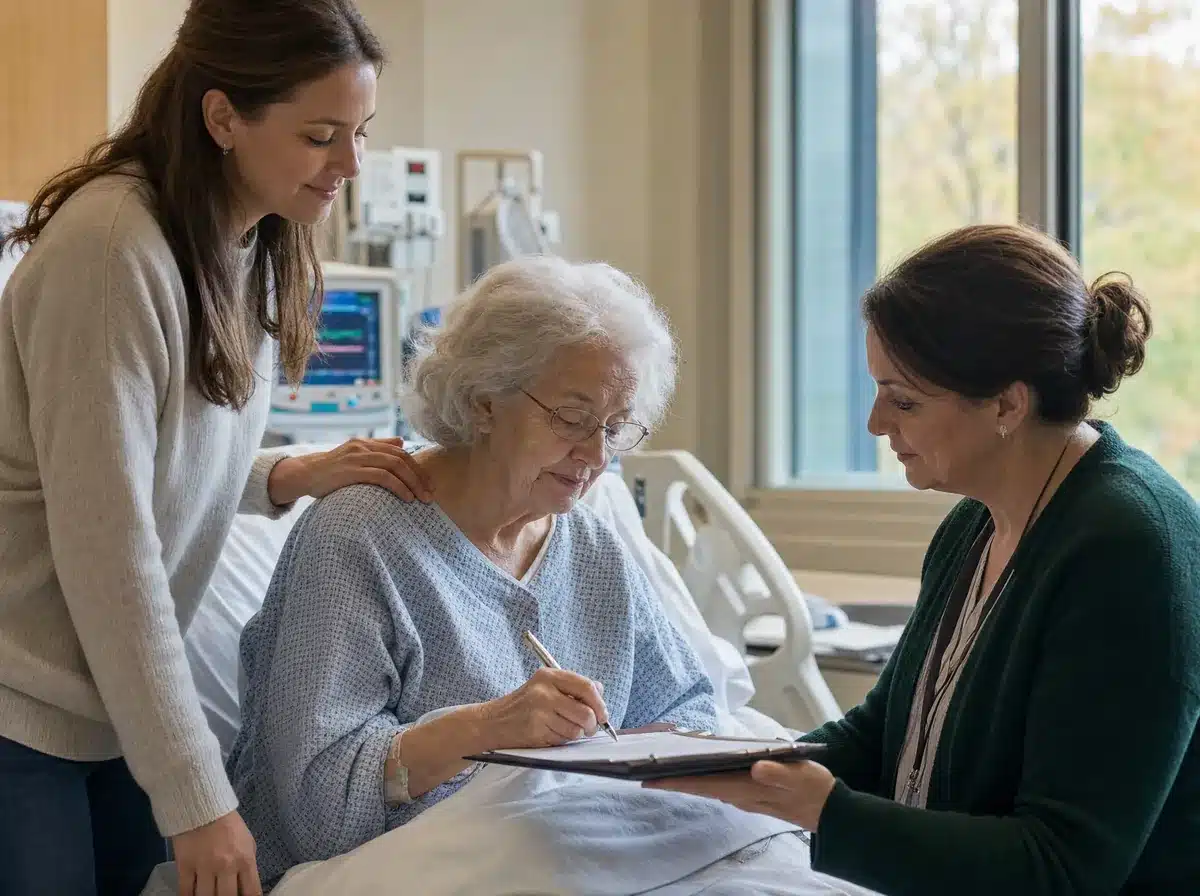
Medical Document Notary in Massachusetts
Licensed mobile notary for medical documents across Massachusetts. Hospital and nursing home bedside visits. Healthcare proxies, durable power of attorney, HIPAA releases, living wills, and more. Naleeyah specializes in hospital and elder care settings. Call (978) 424-4629.
Not every medical document needs a notary, and knowing which ones do saves a family time and money during a hard week. Our medical document notary Massachusetts service notarizes health care proxies when a facility or attorney asks for it, HIPAA authorizations, living wills and personal directives, medical affidavits for court and benefits claims, consents for a minor’s treatment and the powers of attorney that travel with them, at hospitals, nursing homes, rehabilitation centers, assisted living and hospice locations across Greater Boston and the Merrimack Valley, or in our office at 1215 Main St, Suite 115, Tewksbury, MA 01876. Mobile visits follow our zone fees, from $125, $179 or $250 with travel included; hospital and facility visits are quoted at booking; in-office acts are $45 each.
Hanson Webb has been a Massachusetts Notary Public since 2007, is NNA certified, BBB A+ accredited and has completed more than 1,190 signings in English, Arabic and French. Call (978) 424-4629 or (978) 851-0199, or book a medical document notarization online. Two rules run through this page: a MOLST or DNR is a physician’s order and is never notarized, and the two witnesses a health care proxy requires are people you bring. We do not provide, supply, bring, coordinate or serve as witnesses.
Which medical documents need a notary in Massachusetts?
A Massachusetts health care proxy is valid with two adult witnesses and does not require a notary under M.G.L. c.201D. HIPAA authorizations, living wills, medical affidavits, consents for treatment and benefit claim forms need a notary only when the institution receiving them says so. MOLST forms and DNR orders are signed by clinicians, not notarized.
| Document | Massachusetts requirement | Notary involved? | Witnesses (arranged by you) |
|---|---|---|---|
| Health care proxy | Signed by the principal before two adult witnesses, neither of whom is the agent (c.201D) | Optional; acknowledgment added when a hospital, attorney or out-of-state provider requests it | Two adults |
| HIPAA release or authorization | Federal privacy rule; execution set by the provider | Yes, when the provider or attorney requests it | None |
| Living will or personal directive | No Massachusetts statute; not binding on clinicians, but used as evidence of wishes | Yes, commonly, to strengthen acceptance | Often two, by the drafter’s design |
| Durable power of attorney | c.190B s.5-501; notarization expected by institutions | Yes, acknowledgment | None unless the form has lines |
| Consent for a minor’s medical treatment | Set by the provider, school or travel destination | Yes, usually a signature witnessing or acknowledgment | None |
| Medical affidavit for court, insurer or benefits agency | Sworn statement | Yes, jurat | None |
| Affidavits filed with a guardianship or conservatorship petition | Probate and Family Court rules | Yes, jurat, where the form calls for it | None |
| Veterans and Social Security disability statements | Agency form instructions | Only when the form includes a notary block | None |
| Nursing home and assisted living admission documents | Facility-specific | Sometimes, for the responsible party’s signature | None |
| MOLST (Medical Orders for Life-Sustaining Treatment) | Signed by patient or representative and a physician, nurse practitioner or physician assistant | No; never notarized | None |
| DNR or comfort care order | Clinician’s medical order | No | None |
If you are unsure, read the signature page. A form with a notary block and seal space needs a notary. A form with only a clinician’s signature line is a medical order; call the care team, not a notary.
Does a Massachusetts health care proxy need to be notarized?
No. Under M.G.L. c.201D, a health care proxy is valid when the principal signs it in the presence of two adult witnesses who also sign, each stating that the principal appeared to be at least 18, of sound mind and under no constraint or undue influence. Neither witness may be the person named as health care agent or alternate. Notarization is not part of the statute.
Why, then, do families call a notary for a proxy? Three reasons. Hospitals in other states, where notarized directives are the norm, accept a notarized Massachusetts proxy with less friction. Elder law attorneys often add an acknowledgment so the signature cannot later be disputed. And when the proxy is signed at the same visit as a POA and HIPAA release, adding the acknowledgment costs one extra seal.
The agent cannot witness. Under c.201D, the operator, administrator or employee of a facility where the principal is a patient or resident may serve as agent only if related to the principal by blood, marriage or adoption. Check the facility’s policy on staff serving as witnesses before you count on a nurse; many hospitals prohibit it. The two witnesses are yours to bring, and we do not provide them.
Our guide to health care proxy notarization in Massachusetts goes deeper on the statute, the form and the agent’s authority.
HIPAA authorizations
A HIPAA release lets named people receive your protected health information. The federal rule does not require a notary, but many hospital systems, insurers, attorneys and out-of-state providers do, and the authorization is usually signed alongside the proxy so the agent can actually obtain records. Most Boston hospital systems also use their own release form on top of the attorney’s version; sign both if the care team asks.
Living wills and personal directives
Massachusetts has no living will statute, so a living will is not binding on physicians the way a proxy is. It is still valuable as written evidence of your wishes for the agent and the care team. Attorneys usually have it signed before two witnesses and a notary to maximize acceptance, especially if the principal travels or winters in another state.
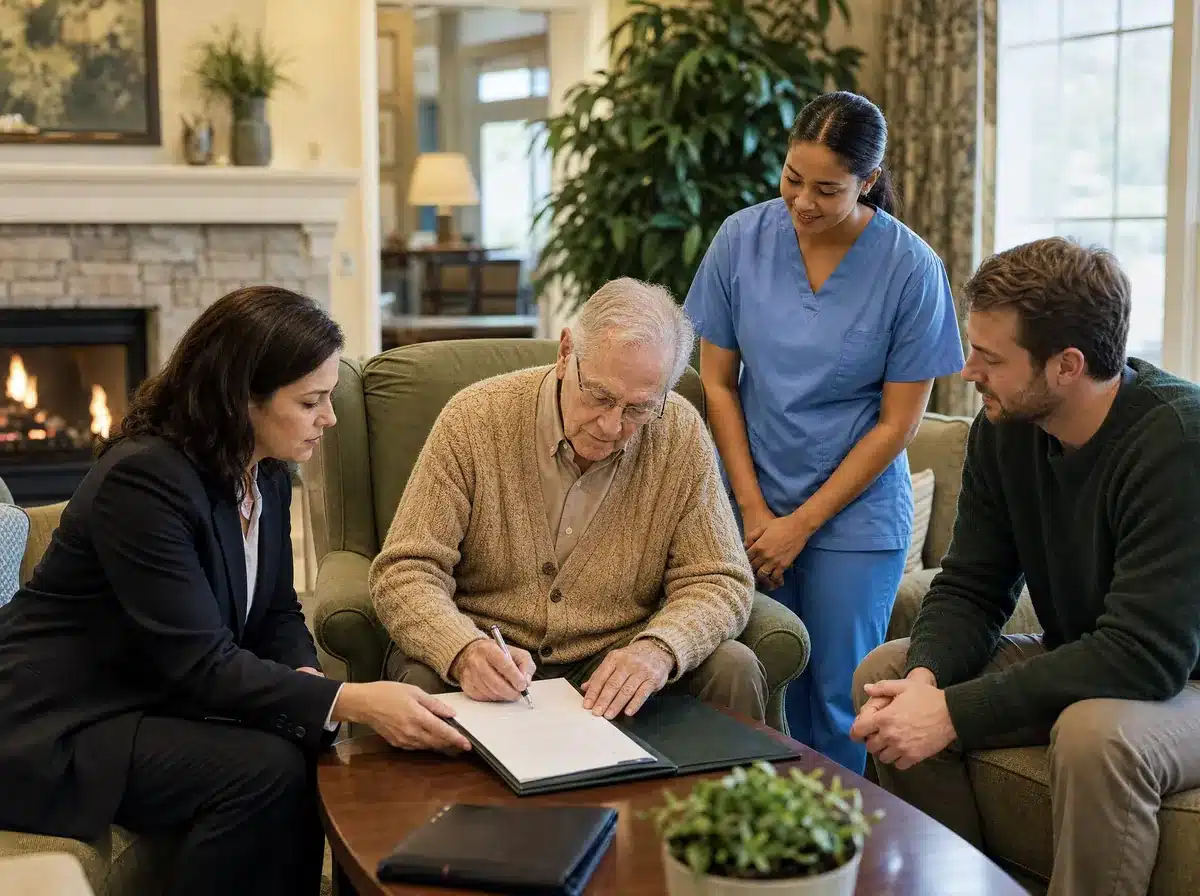
Medical affidavits, consents and benefits forms that take a notary
Sworn medical statements use a jurat; consents and authorizations use an acknowledgment or signature witnessing. Which one applies is printed on the form.
- Medical affidavits for court. Sworn statements about a person’s condition, treatment or prognosis filed in the Probate and Family Court, Housing Court or Superior Court, including affidavits that accompany guardianship and conservatorship petitions under M.G.L. c.190B. The clinician’s medical certificate for guardianship is signed by the clinician; affidavits by family members or caregivers are sworn before a notary.
- Insurance and disability claims. Sworn statements of claim, proof of loss and continuing disability declarations where the insurer’s form includes a notary block.
- Veterans benefits. Lay statements and sworn declarations supporting a VA claim when the form requires notarization.
- Consent for a minor’s treatment. Parents authorizing a grandparent, chaperone or school to consent to care; often paired with a travel consent and sometimes apostilled for travel abroad.
- Consent to release records to an attorney or agency. When the provider’s release requires notarized signature.
- Admission and responsible party agreements. Skilled nursing and assisted living facilities sometimes require the responsible party’s signature to be notarized.
- Organ donation and body disposition statements. Where the receiving institution requires a notarized statement.
A notary cannot tell you whether a document is medically or legally appropriate, cannot fill in medical information and cannot witness a clinician’s order. Sworn medical statements follow the same jurat procedure as any other affidavit: oath first, signature in the notary’s presence, certificate and seal.
Why MOLST and DNR forms are never notarized
A Massachusetts MOLST form and a do-not-resuscitate order are medical orders. They are completed with the patient or the patient’s representative and signed by a physician, nurse practitioner or physician assistant. A notary has no role in them, and a notary seal on one would add nothing and could confuse an emergency responder.
Families call us for a MOLST more often than you might expect, usually because a relative heard that “end of life paperwork needs to be notarized.” The paperwork that may be notarized is the proxy, the HIPAA release and the living will. The MOLST comes from the care team. If you need one, ask the attending clinician or the hospice nurse, and keep the pink original where responders will see it.
How does a medical document notarization work, step by step?
You book with the facility name, room, document list and timing; we confirm with the floor; the notary arrives, checks the patient’s ID, has a short conversation about the documents, watches the signing, performs the acknowledgment or jurat each document calls for, and leaves the family with originals and a scan. At the bedside a single document takes about 15 minutes once we sit down.
- Book. Call (978) 424-4629 or book online with the hospital or facility name, floor and room, the documents, the patient’s alert hours and whether the attorney will join by phone. Hospital and facility visits are quoted and confirmed at booking.
- Confirm the documents. Complete and unsigned. The proxy form from the hospital social work office, the Massachusetts Medical Society or the attorney; the HIPAA release from the attorney or provider; the POA from the attorney. We do not supply forms.
- Arrange witnesses for the proxy. Two adults who are not the agent or alternate. Ask the charge nurse whether staff may witness; if not, bring friends or relatives who are not named in the document.
- Notify the facility. Tell the nursing station or front desk a notary is coming, so visitor rules and room access are settled before we arrive. We call ahead as well.
- Identity verification. The patient’s current government photo ID, checked and recorded in the journal under M.G.L. c.222 s.22. A hospital wristband is not ID. If the ID is at home, a family member brings it before we start.
- Willingness and awareness. Hanson asks the patient to say what the document is, who is being named and whether they are signing freely, with the named agent out of the room when possible.
- Signing. The patient signs first. For a proxy, the two witnesses the family arranged sign next.
- Notarial certificate. Acknowledgment on the proxy (if requested), HIPAA release and POA; jurat on any affidavit. Each certificate is completed in full under M.G.L. c.222 s.15 and sealed.
- Delivery. Originals to the family or attorney; a clean scan to the care team or attorney the same day on request so the proxy is in the chart before the next shift.
Capacity at the bedside: what the notary confirms and where the notary stops
The notary confirms identity, willingness and awareness of the document. The notary does not assess medical capacity, diagnose confusion or judge whether a patient has legal capacity to contract; those are decisions for clinicians and, if contested, the Probate and Family Court. If the patient cannot say what the document is or who is being appointed, or signs only when prompted, we decline the notarial act.
We time visits for the patient’s best hours when the family can tell us what they are. Medication schedules, dialysis, early-morning rounds and post-operative sedation all affect alertness, and a 10 a.m. signing often succeeds where a 4 p.m. one would not. If the care team has documented that the patient lacks capacity, a notary visit is not the answer; speak with an elder law attorney about guardianship under M.G.L. c.190B.
When we decline, there is no notarial act and no seal fee, but the travel portion of the visit fee quoted at booking still applies because the trip was made. To avoid that, ask the charge nurse about alertness and ID before you book, and tell us honestly what you observe. We would rather reschedule than make a wasted trip.
Hospital and nursing home etiquette we follow
We work around clinical care, not through it. Nurses, social workers and discharge planners at Massachusetts General, Brigham and Women’s, Beth Israel Deaconess, Tufts Medical Center, Boston Medical Center, Lahey in Burlington, Lowell General and the skilled nursing and hospice facilities of Middlesex and Essex counties see us regularly, and the routine is the same each time.
- We call the floor before arriving to confirm visiting policy, room number and whether a quiet space is available.
- We check in at the nursing station, wear identification and follow any visitor list or screening the facility requires.
- We step out for clinical care and wait rather than asking staff to pause.
- We bring our own pens, journal, loose certificates and a hard writing surface; we do not borrow hospital supplies or ask staff to make copies.
- We respect HIPAA and discuss the patient only with the patient and the people the patient authorizes.
- We keep the signing short. Most bedside documents are done in 15 to 25 minutes.
- We never ask staff to serve as witnesses on the family’s behalf. If staff are permitted and willing, that is between the family and the facility.
Boston hospitals, bedside procedure and family roles are covered on our hospital notary service page for Boston and Massachusetts.
What ID does the patient need, and what if it is at home?
A current, unexpired government-issued photo ID with signature: Massachusetts or out-of-state driver’s license, Mass ID, U.S. passport or passport card, military ID, permanent resident card or foreign passport. M.G.L. c.222 does not allow an expired license, a hospital wristband, an insurance card or a Medicare card as identification.
If the wallet is at home, a family member brings the ID before the signing starts; that is the simplest fix and the one we recommend. Massachusetts law gives a notary very narrow alternatives to a government ID, and they rarely fit a hospital room, so plan on the physical document. If the license expired during a long admission, the RMV can issue a renewal or a Mass ID; some families handle this the day before the signing. Our guide to what ID is accepted for notarization in Massachusetts covers name changes and other edge cases.
How much does a medical document notary Massachusetts visit cost?
In our Tewksbury office each notarial act is $45. A mobile visit to a home is priced by zone with travel, one seal and 15 minutes included: from $125 in Zone 1 (Tewksbury, Gardner, Ashby, Athol), from $179 in Zone 2 (Lowell, Billerica, Andover, Chelmsford, Dracut, Lawrence, Worcester, Fitchburg, Leominster, Concord, Burlington, Woburn and 40 more towns) and from $250 in Zone 3 (Boston, Cambridge, Newton, Lexington, Wellesley, Weston, Lynn, Gloucester, North Andover and 110 more). Hospital, nursing home and hospice visits are quoted at booking based on the facility’s address and the coordination involved.
| Service | Fee | Notes |
|---|---|---|
| In-office, Tewksbury | $45 per notarial act | Proxy acknowledgment, HIPAA, POA and medical affidavit each count as one act |
| Home visit, Zone 1 | From $125 | Travel, one seal, 15 minutes |
| Home visit, Zone 2 | From $179 | Travel, one seal, 15 minutes |
| Home visit, Zone 3 | From $250 | Travel, one seal, 15 minutes |
| Hospital, nursing home, rehab or hospice visit | Quoted at booking | Zone determined by the facility’s address, not your home; confirmed and prepaid before we depart |
| Proxy, HIPAA and POA at one bedside visit | Quoted by document count | Additional seals and time quoted up front |
Zone is set by where the signing happens. A family in Tewksbury whose parent is at Beth Israel in Boston pays the Boston visit fee, because that is where the notary goes. Facility visits are confirmed and paid before we depart; if the signing cannot proceed after we arrive, the travel portion is not refunded, and there is no charge for a notarial act that was not performed. Powers of attorney signed at the same visit are covered on our power of attorney notarization page.

Who calls us for medical document notarization?
Families and caregivers, elder law attorneys, hospital social workers and discharge planners, and nursing home and assisted living staff make up most of our medical document work. Each calls for a slightly different reason.
- Families and caregivers. A parent in the ICU at MGH, a spouse in rehab at Spaulding, a grandparent in memory care in Andover. The family realizes the proxy and POA were never signed and needs them before a discharge or transfer.
- Elder law attorneys. Attorneys who drafted a proxy, HIPAA release, POA and living will for a client who is now inpatient, and who need a reliable notary on the floor while they join by phone.
- Hospital social workers and discharge planners. Case managers who identify a missing proxy during discharge planning and need it executed before the patient leaves for a skilled nursing facility.
- Nursing homes and assisted living. Facilities whose new residents need directives signed at intake, or whose long-term residents need updated documents after a change in family circumstances.
- Arabic- and French-speaking families. Patients who need the proxy and HIPAA release explained and acknowledged in their own language. See our Arabic notary service in Boston.
Common medical document scenarios
- Discharge planner finds no proxy. Patient at Lowell General is being discharged to a skilled nursing facility in two days. The social worker calls; the family brings two friends as witnesses; we execute the proxy and HIPAA release that afternoon and scan them to the case manager.
- Pre-surgery at Brigham and Women’s. The family wants the proxy, HIPAA release and POA signed before sedation. We coordinate with the pre-op nurse and finish before the patient is moved.
- Hospice admission. The hospice intake nurse notes the directive packet is incomplete. The attorney emails the documents; we meet the family at the hospice house with their witnesses; the MOLST is handled by the hospice physician separately.
- Out-of-state hospital wants a notarized proxy. A Massachusetts resident wintering in Florida is told the hospital prefers a notarized directive. We acknowledge the proxy and living will at the Tewksbury office for $45 per act before the trip.
- Guardianship petition. A daughter in Billerica swears an affidavit describing her mother’s condition for the Probate and Family Court; the clinician completes the medical certificate separately.
- Minor traveling with grandparents to Morocco. Parents sign a consent for medical treatment and a travel consent before Hanson in English and Arabic, then we apostille both.
A notary cannot give legal or medical advice, choose documents for you or say whether a form will achieve your goal. Hire Mobile Notary and Neighborhood Parcel are not a law firm. For which documents you need, consult a licensed Massachusetts elder law or estate planning attorney; for MOLST and DNR orders, speak with the care team. Our office is at 1215 Main St, Suite 115, Tewksbury, MA 01876, and we serve 177 Massachusetts cities and towns.
Frequently asked questions
Does a Massachusetts health care proxy need to be notarized?
No. Under M.G.L. c.201D a health care proxy is valid when signed by the principal before two adult witnesses, neither of whom is the named agent or alternate. Notarization is optional. Hospitals in other states, attorneys and some facilities ask for it, and we add an acknowledgment on request. You arrange the two witnesses; we do not provide them.
Can a notary come to a hospital or nursing home the same day?
Same-day hospital, nursing home, rehabilitation and hospice visits are available by confirmation across Greater Boston and the Merrimack Valley, seven days a week. Book online or call (978) 424-4629 with the facility, room, documents and the patient’s alert hours. Facility visits are quoted at booking and confirmed before we depart.
What if the patient cannot communicate clearly?
If the patient cannot say what the document is or who is being appointed, appears sedated or signs only when prompted, the notary must decline under M.G.L. c.222 s.16. There is no fee for a notarial act that was not performed, but the travel portion of a facility visit still applies. If capacity is in doubt, ask the care team or an elder law attorney before booking.
Does a DNR or MOLST require a notary in Massachusetts?
No. A DNR order and a MOLST form are medical orders completed with the patient or representative and signed by a physician, nurse practitioner or physician assistant. A notary has no role in them. Ask the attending clinician or hospice team. The documents that may be notarized are the health care proxy, HIPAA release, living will and power of attorney.
What does a medical document notary Massachusetts visit cost?
A medical document notary Massachusetts visit to a home follows our zone fees: from $125 in Zone 1, $179 in Zone 2 and $250 in Zone 3, with travel, one seal and 15 minutes included. Hospital, nursing home and hospice visits are quoted at booking based on the facility’s address. In our Tewksbury office each notarial act is $45. Additional documents at the same visit are quoted before we arrive.
Can you notarize Arabic or French medical documents?
Yes. Hanson Webb is fluent in English, Arabic and French and reads the proxy, HIPAA release or affidavit with the patient in that language before the signing, so no interpreter is needed. The notarial certificate is completed in English as Massachusetts requires.
Who can be a witness to a health care proxy, and do you provide them?
Any two adults who are not the named health care agent or alternate. Many hospitals restrict staff from witnessing, so ask the charge nurse before counting on a nurse. We do not provide, supply, bring, coordinate or serve as witnesses; the family brings them. We perform the notarial acts only.
Does a HIPAA release need to be notarized?
Federal law does not require it, but many hospital systems, insurers, attorneys and out-of-state providers do, and attorneys routinely have it acknowledged alongside the proxy and POA. If the form has a notary block, we complete it. Most Boston hospitals also use their own release form; sign both when the care team asks.
What ID does a hospital patient need for notarization?
A current, unexpired government-issued photo ID with signature: driver’s license, Mass ID, passport, military ID, permanent resident card or foreign passport. A hospital wristband, insurance card or expired license is not accepted under M.G.L. c.222. If the ID is at home, a family member brings it before the signing starts.
Is a living will legally binding in Massachusetts?
Massachusetts has no living will statute, so a living will does not bind clinicians the way a health care proxy does. It remains valuable written evidence of your wishes for your agent and care team. Attorneys usually have it signed before two witnesses and notarized for the widest acceptance, especially if you spend time in another state.

1,190+ signings across Greater Boston and the Merrimack Valley. Fluent in English, Arabic and French. About Hanson