
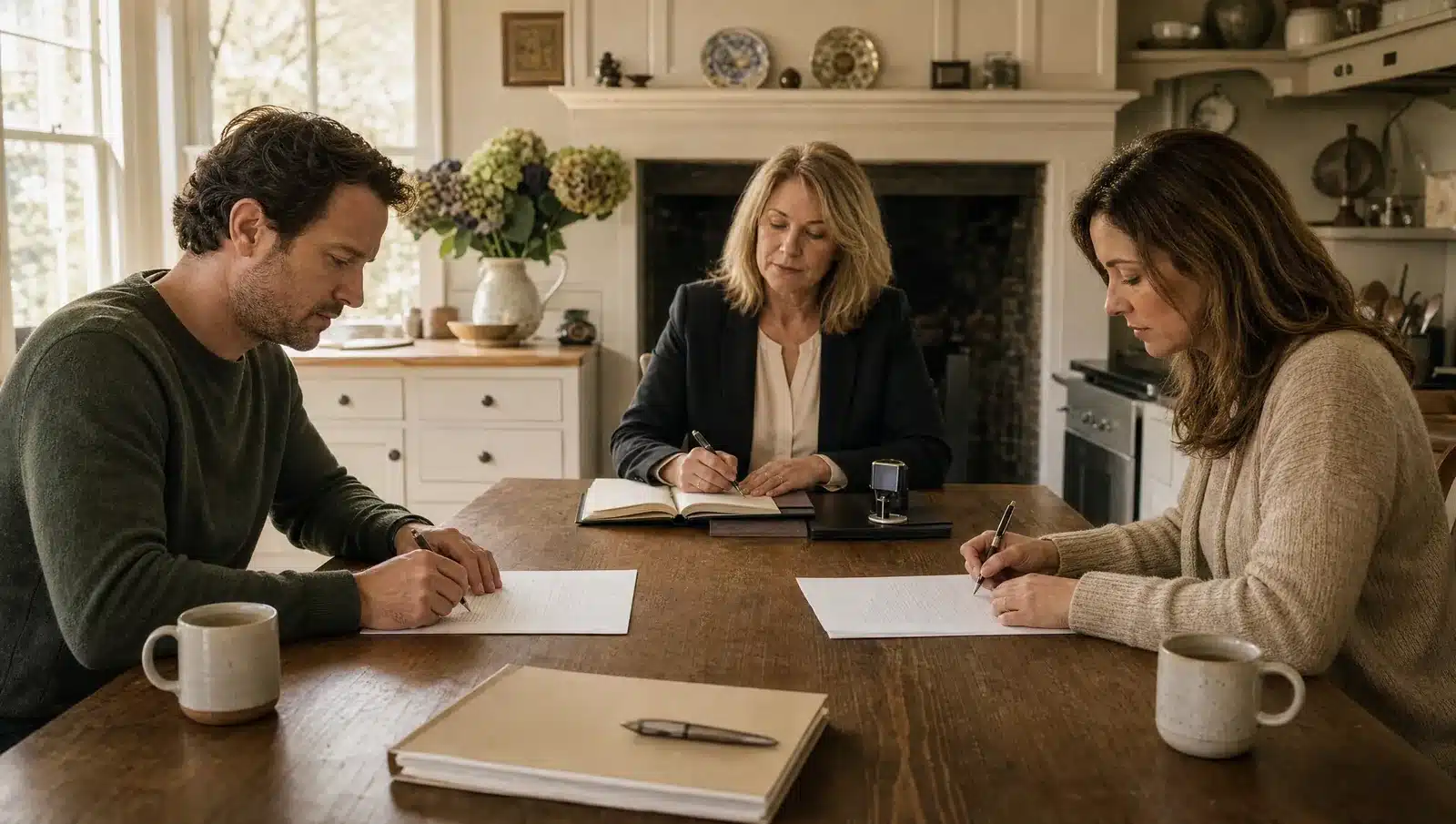
Getting a Separation Agreement Notarized in Massachusetts for a 1A Divorce: Who Signs, Where, and How a Mobile Notary Helps
Yes. To get a separation agreement notarized in Massachusetts for a 1A uncontested divorce, each spouse acknowledges their signature before a notary, and the affidavit of irretrievable breakdown is sworn as well. Spouses can sign separately, in different towns, on different days. Here is what gets notarized, what ID to bring and where to file.
Does a separation agreement have to be notarized in Massachusetts?
Yes, if you are using it for a 1A divorce. M.G.L. c.208 s.1A says the joint petition must be filed with a sworn affidavit that the marriage has irretrievably broken down and “a notarized separation agreement executed by the parties.” A separation agreement that is signed but not notarized does not meet the statute, and the Probate and Family Court registry will send it back.
The reason is simple. The agreement is the document the judge turns into a court order. It decides who gets the house in Billerica, who keeps the retirement account, how parenting time is split and whether alimony is paid. Before a judge approves something that serious, the court wants an independent official to confirm that the people who signed it were really the two spouses and that each signed willingly.
That is all the notary confirms. The notary does not read the agreement for fairness, check the math or tell you whether to sign; a notary who answers “does this clause look right?” is practicing law without a license.
What is the 1A uncontested divorce path?
A 1A divorce is the joint, no-fault route under M.G.L. c.208 s.1A for spouses who agree on everything. You file one joint petition together, there is no summons and no answer, and you both attend one short hearing. It is the path most Massachusetts couples who have already worked out their terms end up taking, with or without lawyers.
The alternative, a 1B divorce, is for spouses who agree the marriage is over but not on the terms, and it can take a year or more. If you need a separation agreement notarized, you are almost certainly on the 1A path. Here is the sequence the statute lays out:
- Both spouses sign the Joint Petition for Divorce (court form CJD-101A).
- Each spouse swears to an affidavit of irretrievable breakdown, jointly or separately, before a notary.
- Both spouses sign the separation agreement and each signature is notarized.
- Each spouse completes a financial statement under Supplemental Probate and Family Court Rule 401.
- The packet is filed in the Probate and Family Court for the county where either spouse lives, with the filing fee.
- The court schedules a hearing. Under s.1A, the judge must make a finding within 30 days of that hearing on whether the marriage has broken down and whether the agreement makes proper provision for custody, support, alimony and property.
- If the finding is yes, the judge approves the agreement and a judgment of divorce nisi enters. Under M.G.L. c.208 s.21, the judgment becomes absolute 90 days later unless the court orders otherwise.
A smooth 1A divorce therefore runs roughly 120 days from the hearing to the final decree. The notarization happens at the very start, so a delay there pushes everything else.
Which documents in the 1A packet are notarized?
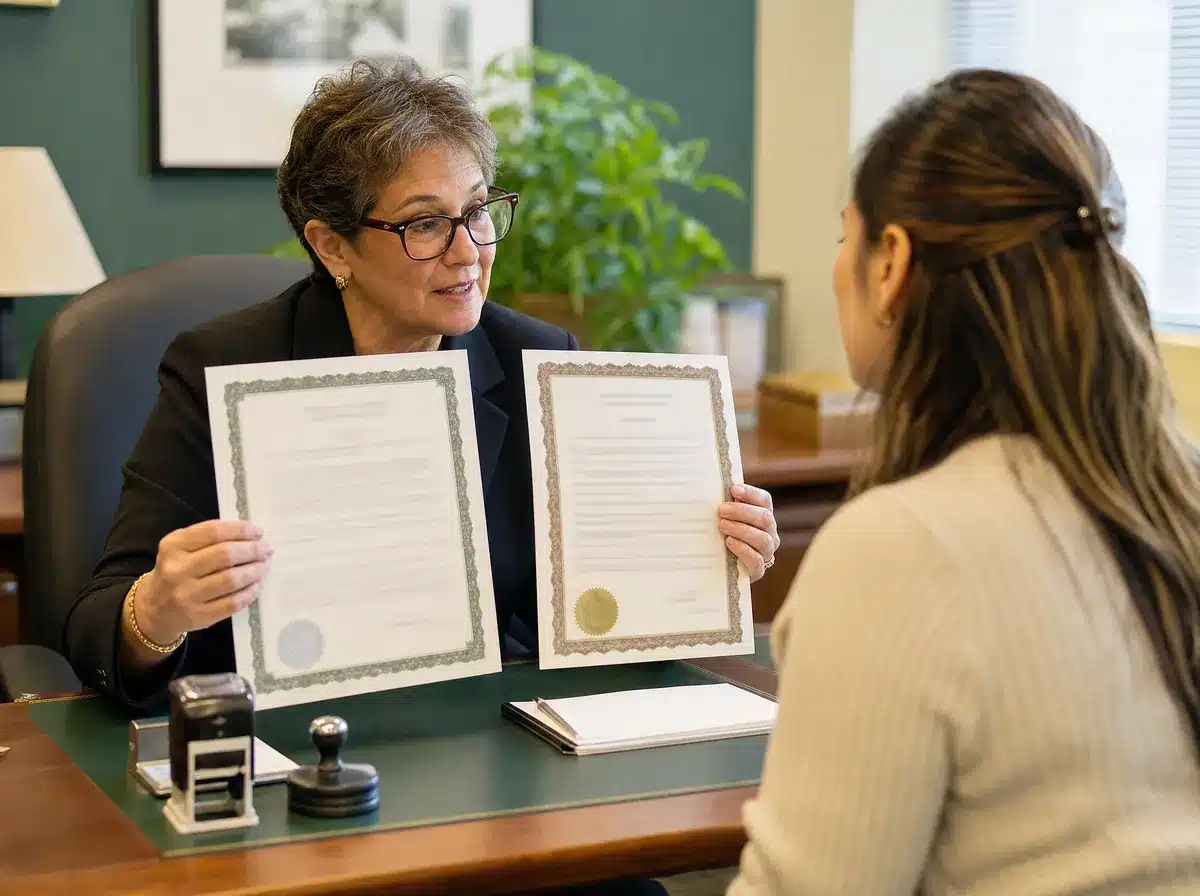
Two documents in a standard 1A packet go in front of a notary: the separation agreement and the affidavit of irretrievable breakdown. The rest of the packet is signed by you, by your attorney or under the penalties of perjury, but not notarized. The table below is the version we hand clients so they know what to have ready when the notary arrives.
| Document | Who signs | Notarized? | Type of notarial act |
|---|---|---|---|
| Joint Petition for Divorce (CJD-101A) | Both spouses, or their attorneys | No | None |
| Affidavit of irretrievable breakdown | Both spouses, jointly or separately | Yes | Jurat (oath or affirmation) |
| Separation agreement | Both spouses | Yes | Acknowledgment, one per spouse |
| Financial statement (CJD-301S short or CJD-301L long) | Each spouse separately | Generally no | Signed under the penalties of perjury |
| Certificate of Absolute Divorce or Annulment (R-408) | One spouse | No | None |
| Certified copy of the marriage certificate | Issued by the city or town clerk, or the Registry of Vital Records | No | None |
| Child support guidelines worksheet and parent education certificate (if minor children) | Spouses; the court program issues the certificate | No | None |
Some attorneys draft the affidavit of irretrievable breakdown as one page both spouses swear to together; others draft two separate affidavits so each spouse can sign on their own schedule. The statute allows either. Bring every page to the signing, because the notary needs to see the whole document, not a loose signature page.
Acknowledgment or jurat: which certificate goes on which document?
The separation agreement gets an acknowledgment and the affidavit gets a jurat. The difference matters because the court registry checks the wording, and a certificate of the wrong type can get a filing rejected even though a notary stamped it.
An acknowledgment, under M.G.L. c.222 s.15, is the notary’s certificate that the signer personally appeared, proved identity with satisfactory evidence, and acknowledged signing the document voluntarily for its stated purpose. You can sign a separation agreement before the notary arrives and then acknowledge the signature in person, although most people sign on the spot.
A jurat is different. The signer signs in the notary’s presence and swears or affirms that the contents are true. For the affidavit of irretrievable breakdown, you raise your hand, or affirm if you prefer not to swear, and state that the marriage has in fact broken down. If you signed the affidavit the night before, the notary will have you sign again on a fresh line. Our guide to acknowledgment versus jurat in Massachusetts covers the distinction in depth.
Massachusetts certificates must also show the notary’s name as commissioned, the commission expiration date, the county where the notarization happened and the date. A missing county line is the most common defect we see on agreements notarized by someone who does this once a year.
Do both spouses have to sign in front of the same notary at the same time?
No. Each spouse’s signature is notarized separately, so you can sign in the same room on the same afternoon, or in different towns a week apart, or in different states. Nothing in c.208 s.1A requires one joint signing, and the statute itself says the affidavit may be “jointly or separately executed.”
In practice we see three patterns. The single sitting: both spouses, often with a mediator, sign everything in one appointment at a home in Andover or a conference room in Cambridge, with two acknowledgments and two jurats in one visit. The staggered signing: one spouse signs in Lowell on Tuesday and the other in Newton on Saturday, and each gets a certificate dated the day they signed. The split state: one spouse has already moved to New Hampshire or Florida and signs before a notary there, which Massachusetts courts accept as long as the certificate is complete under that state’s law.
Two warnings for the staggered approach. The pages must not change between signings; if the agreement is edited after the first spouse signs, that signature is on a different document and has to be redone. And the document needs a separate acknowledgment certificate for each spouse. A single certificate naming both spouses when only one appeared is a false certificate, which M.G.L. c.222 s.16 forbids a notary to sign.
What ID do we bring?
Each spouse brings one current government-issued photo ID that shows your signature, such as a Massachusetts driver’s license, a Massachusetts ID card, a U.S. passport or passport card, or a foreign passport. The name on the ID should match the name typed under your signature line on the agreement. Expired licenses, Social Security cards, work badges and phone photos of a license are not accepted.
Divorce paperwork raises one ID problem more than any other document we notarize: the name. A spouse who took a married name but still carries a license in her birth name, or the reverse, needs the agreement to use the name on the ID, or a line such as “Jane Smith, also known as Jane Doe,” so the notary can match the person in the room to the signer on the page. Sort that out with whoever drafted the agreement before the signing. Our page on what ID is accepted for notarization in Massachusetts has the full list and the alternatives when a license has lapsed; usually the fastest fix is a trip to the RMV first.
What about the financial statements?
Each spouse files a sworn financial statement under Supplemental Probate and Family Court Rule 401, and the form depends on income. Under the rule, a party whose gross annual income is less than $75,000 completes the short form (CJD-301S), and a party whose income is $75,000 or more completes the long form (CJD-301L), unless the court orders otherwise. Self-employed spouses attach Schedule A.
The financial statement is the document couples underestimate. It lists every source of income, every weekly expense, every asset and every debt, signed under the penalties of perjury, and the judge uses it to decide whether the agreement is fair. A $400,000 house in Westford missing from a financial statement is a problem even if the agreement mentions it. Rule 401 impounds the statements, keeping them out of the public file, but the judge reads them closely.
As notaries we do not review, complete or comment on the financial statement. The court form carries a penalties-of-perjury block rather than a notary certificate, but some attorneys ask for a notarized signature out of caution. If yours does, tell us at booking, and fill the form in completely first; a notary cannot notarize a document with blanks in it.
Where do you file? Probate and Family Court by county
You file the 1A packet with the Probate and Family Court in the county where either spouse lives. The filing fee is $200 plus a $15 surcharge, payable by bank check, money order, cash or card at the registry. If the separation agreement is not ready when the petition is filed, c.208 s.1A gives you 90 days after the action is commenced to file it, but in our experience couples who file the complete packet at once get a hearing date faster.
| County | Probate and Family Court location | Covers (examples) |
|---|---|---|
| Suffolk | 24 New Chardon Street, Boston | Boston neighborhoods, Chelsea, Revere, Winthrop |
| Middlesex | South division, 10-U Commerce Way, Woburn; North division, 370 Jackson Street, Lowell | Cambridge, Newton, Lexington, Waltham (South); Lowell, Billerica, Tewksbury, Chelmsford (North) |
| Essex | 36 Federal Street, Salem; 2 Appleton Street, Lawrence | Lynn, Gloucester, Andover, Lawrence, North Andover |
| Norfolk | 35 Shawmut Road, Canton | Quincy, Brookline, Wellesley, Needham, Weymouth |
| Worcester | 225 Main Street, Worcester | All Worcester County towns, including Fitchburg, Leominster and Gardner |
Confirm hours and the current fee schedule on mass.gov before you go. The signing comes first, the filing second.
Mobile signing when spouses live apart
A mobile notary solves the problem a divorcing couple rarely wants to say out loud: you do not want to drive to each other’s homes, and you may not want to sit in a bank lobby together. We come to each of you, or to one neutral place, with the certificates ready. Every mobile notary visit is priced by zone with travel, one seal and 15 minutes included: from $125 in Zone 1 (Tewksbury, Gardner, Ashby, Athol), from $179 in Zone 2 (Lowell, Billerica, Andover, Chelmsford, Worcester, Concord, Burlington, Woburn and 40 more towns) and from $250 in Zone 3 (Boston, Cambridge, Newton, Lexington, Wellesley, Lynn and 110 more). Extra seals are quoted when you book.
A separation agreement signing usually needs two seals per spouse: an acknowledgment on the agreement and a jurat on the affidavit. If both spouses sign at the same visit, that is four seals in one trip, which costs less than two visits. If you sign apart, each visit is priced on its own zone. Common arrangements we handle:
- One spouse at home in Dracut on a weekday evening, the other at an apartment in Somerville the next morning, with the agreement carried between them in a sealed envelope.
- Both spouses at a mediator’s office in Concord or an attorney’s conference room in Woburn, with the notary arriving for the last 30 minutes.
- A spouse in a Boston hospital or rehabilitation facility who cannot travel; Zone 3 covers hospital and nursing home visits.
- A spouse who prefers to come to us: our Tewksbury office at 1215 Main Street, Suite 115, charges $45 per notarial act for an in-office notarization, by appointment.
Hanson Webb has been a Massachusetts notary public since 2007, is NNA certified and has completed more than 1,190 signings in English, Arabic and French. If one spouse is more comfortable in Arabic or French, the oath and the conversation can happen in that language, although the documents are filed in English.

Can the separation agreement be notarized online in Massachusetts right now?
Not yet in a way we recommend relying on. Chapter 2 of the Acts of 2023 authorized remote online notarization in Massachusetts, but as of October 2026 the Secretary of the Commonwealth has not released the required training or notification form and tells Massachusetts notaries not to use online platforms until that is complete. For a 1A filing, paper and ink remain the safe route. If a spouse is out of state, an in-person notarization where they live is accepted and avoids the question entirely.
What the notary will not do
A Massachusetts notary who is not an attorney cannot give legal advice, and that rule bites hardest in family law. We will not tell you whether the alimony term is reasonable, whether you should waive a share of a pension, whether the parenting schedule will satisfy the judge, or whether to sign at all. M.G.L. c.222 s.16 bars a non-attorney notary from influencing a person to enter or avoid a transaction, and the Massachusetts “notario” rules exist precisely because people have been hurt by notaries who crossed that line.
What we do is narrower and still essential: confirm identity, confirm the signer is acting freely and knows they are signing a separation agreement, take the oath on the affidavit, complete accurate certificates and record the act in the notary journal. If one spouse seems pressured by the other, the notary will ask to speak with that spouse alone and will decline if the answer is not a clear, voluntary yes. An agreement signed under pressure is the kind a judge later sets aside.
We also do not provide witnesses. A separation agreement does not normally require them, but if your attorney has added witness lines, you arrange your own witnesses and have them present.
What happens after the notarization
Once both signatures are notarized, the agreement is filed with the petition, the affidavit, the financial statements, the marriage certificate and the R-408, and the registry assigns a docket number and a hearing date. At the hearing the judge asks both spouses a short series of questions, confirms each read and understood the agreement and signed it voluntarily, and reviews whether it provides properly for the children and the finances. If so, the judgment nisi enters, and 90 days later it becomes absolute under c.208 s.21. Until that day you are still legally married.
Many agreements also require follow-up documents: a quitclaim deed transferring the marital home to one spouse, which must be notarized and recorded at the Registry of Deeds, a qualified domestic relations order for a retirement plan, or car title transfers. The deed is the one we are called for most often, usually within a month of the judgment. Our page on quitclaim deed notarization in Massachusetts explains that step.
To schedule a separation agreement signing at home, at a mediator’s office or at our Tewksbury office, call (978) 424-4629 seven days a week or book online. Tell us how many spouses are signing, where each one is, and whether the affidavit is joint or separate, and we will quote the visit before we come.
Need this notarized this week?
Same-day and weekend mobile appointments across Greater Boston and the Merrimack Valley. Flat zone pricing, travel included.
Frequently asked questions
Does a Massachusetts separation agreement have to be notarized?
Short answer: yes, for a 1A divorce. M.G.L. c.208 s.1A requires the joint petition to be filed with a notarized separation agreement executed by both parties and a sworn affidavit of irretrievable breakdown. The Probate and Family Court registry will not accept an agreement without the notarial certificates.
Do both spouses sign in front of the same notary at the same time?
Short answer: no. Each spouse's signature is acknowledged separately, so you can sign together at one sitting or apart on different days, in different towns or even different states. Each spouse gets their own notarial certificate dated the day they actually signed.
What is the affidavit of irretrievable breakdown and is it notarized too?
Short answer: it is the sworn statement that the marriage has irretrievably broken down, and yes, it is notarized with a jurat. You sign it in the notary's presence and swear or affirm that it is true. The statute allows one joint affidavit or two separate ones.
Can we sign in different towns on different days?
Short answer: yes. One spouse can sign in Lowell on Tuesday and the other in Newton on Saturday. The agreement must not be edited between the two signings, and each signing gets its own acknowledgment certificate showing the date and county where it happened.
Can we sign at a mediator's office or at home?
Short answer: either one. A mobile notary comes to a home, an attorney's or mediator's office, a hospital or any other agreed location in our 177-town service area. Visits run from $125, $179 or $250 by zone with travel and one seal included, or $45 per act at our Tewksbury office.
What ID do we bring to the signing?
Short answer: one current government-issued photo ID with your signature for each spouse, such as a driver's license, state ID card or passport. The name on the ID must match the name under your signature line. Expired IDs, Social Security cards and phone photos are not accepted.
Can the separation agreement be notarized online in Massachusetts right now?
Short answer: not reliably, as of October 2026. Remote online notarization was authorized by Chapter 2 of the Acts of 2023, but the Secretary of the Commonwealth has not finished the rollout and tells Massachusetts notaries not to use online platforms yet. Sign on paper in person to be safe.
What happens after the agreement is notarized?
Short answer: you file the packet at the Probate and Family Court for your county, pay the $200 fee plus $15 surcharge, and attend a hearing. The judge must make a finding within 30 days of the hearing, a judgment nisi enters, and it becomes absolute 90 days later under c.208 s.21.
Will the notary tell us if the agreement is fair?
Short answer: no. A non-attorney notary cannot give legal advice, explain legal effect or recommend whether to sign. Fairness is decided by the judge at the hearing, and the people to ask beforehand are a family law attorney or your mediator.


