Can Someone With Dementia Sign Before a Notary in Massachusetts? Capacity, Willingness and What Happens at the Bedside
A dementia diagnosis does not by itself stop a notarization in Massachusetts. The notary must be satisfied, in a private conversation, that the signer knows what the document is and is signing willingly; under M.G.L. c.222 s.16, a compelling doubt on either point means the notary declines. Good days count, and preparation matters.
Can someone with dementia sign before a notary in Massachusetts?
Yes, on a day when they can tell the notary, in their own words, what they are signing and that they want to sign it. No, on a day when they cannot. The diagnosis in the chart is not the test; the person in the room is. Every “notary dementia Massachusetts” search we see comes from a family trying to find out which of those two days they are facing.
Massachusetts puts the rule in the statute rather than leaving it to custom. M.G.L. c.222 s.16(a) says a notary shall not perform a notarial act if the principal’s demeanor causes the notary to have a compelling doubt about whether the principal knows the consequences of the transaction, or if, in the notary’s judgment, the principal is not acting of their own free will. Understanding and willingness: that is the whole standard at a Boston bedside.
Notice what the statute does not say. It does not require the notary to confirm legal competence, does not require a medical opinion, and does not mention any diagnosis. A notary is not a physician. The notary makes a commonsense judgment about a short conversation, records it in the journal, and either completes the certificate or does not. We have notarized powers of attorney for people with early Alzheimer’s who explained their wishes more clearly than their adult children did, and declined for people with no diagnosis who could not say what the paper in front of them was.
Capacity for a notarization versus capacity for a will or power of attorney
The notary’s standard is narrower than the legal standard a court applies later. A notarization confirms identity, awareness and willingness at the moment of signing. Whether the signer had legal capacity to make a valid will or power of attorney is a separate question decided, if ever raised, by a judge with medical evidence and testimony.
One-sentence definitions help. Notarial awareness means the signer understands, in general terms, what the document is and does. Testamentary capacity, the standard for a will, means the signer understands the nature of the act, the property they own and the people who would naturally inherit. Contractual capacity, applied to a power of attorney or deed, means the signer understands the nature and consequences of the transaction. The legal standards are higher and more specific than the notary’s.
| Question | Notary at the signing | Court, if the document is challenged |
|---|---|---|
| Who decides | The notary, alone, in the room | A Probate and Family Court judge |
| Standard | No compelling doubt that the signer knows the consequences and acts freely (c.222 s.16) | Testamentary or contractual capacity under Massachusetts law |
| Evidence used | A private conversation, the signer’s demeanor, the ID | Medical records, physician testimony, witnesses, the notary’s journal |
| Timing | The moment of signing | Months or years later |
| Result | Certificate completed or notarization declined | Document upheld or set aside |
The practical point: a completed notarization does not guarantee the document will survive a challenge, and a declined notarization is not a finding that your parent is incompetent. The notary’s journal entry, recording the date, the document, the ID and what the notary observed, often becomes the most useful evidence a family has later.

The conversation the notary has with the signer alone
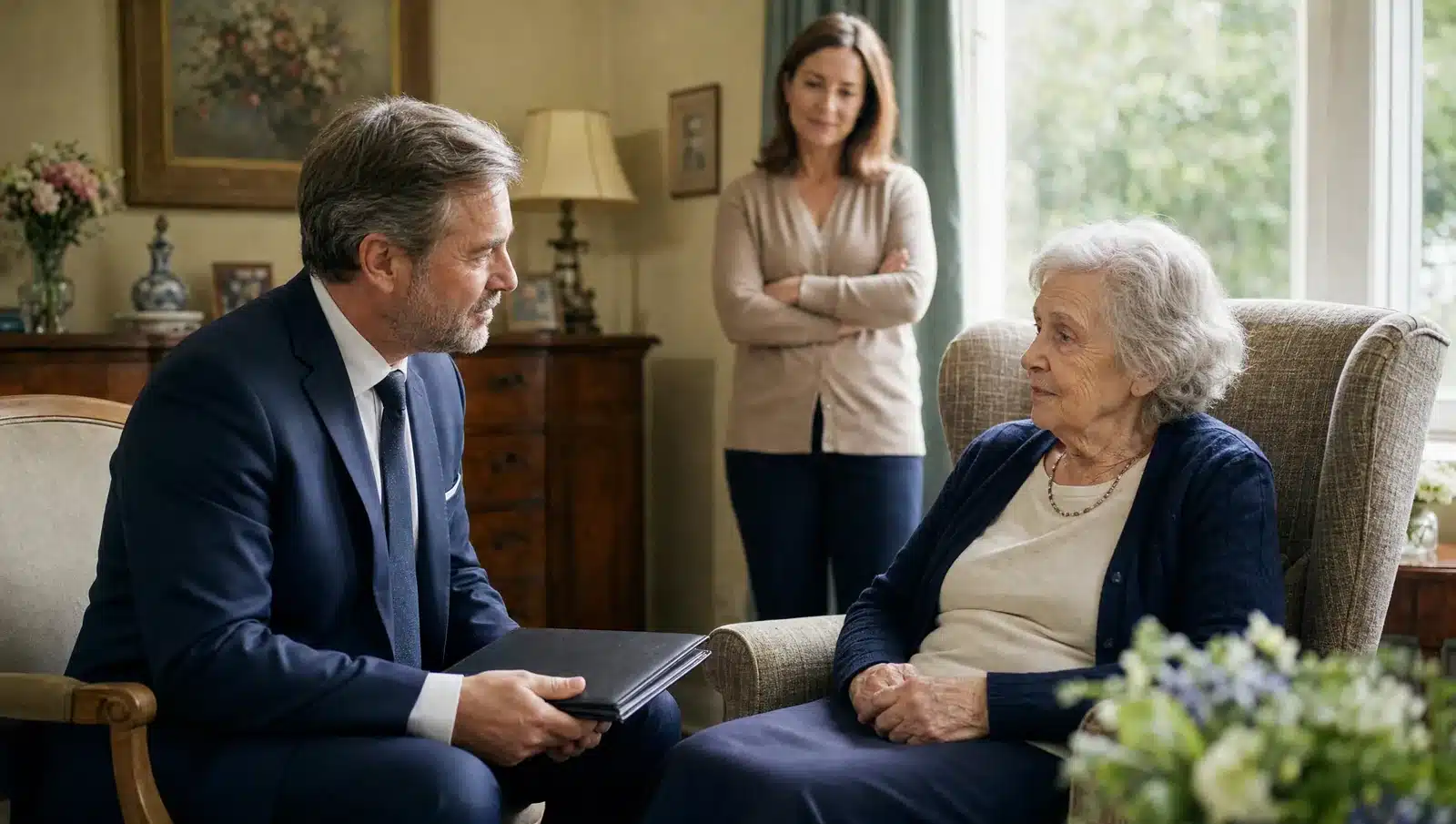
Before anything is signed, the notary asks the family to step out and spends a few minutes with the signer, one on one. This is not a suspicion of anyone. It is the only way the notary can honestly certify that the signer is acting on their own, and it is what gives the certificate its value if a sibling or a bank questions it later.
The questions are open-ended and about the document, not a memory quiz. We do not ask who the governor is or what day it is; a person with dementia can miss the date and still know exactly what a power of attorney does. We ask things like these:
- “Can you tell me what this document is?” A good answer sounds like “it lets my daughter handle my bills” or “it says who decides if I can’t.” Legal words are not needed.
- “Who is the person you are naming, and why them?” The signer should know the agent or proxy by name and relationship.
- “Is this what you want to do today?” The answer has to be the signer’s, not a glance at the doorway.
- “Did anyone tell you that you had to sign this?”
- “Do you have any questions before you sign?” If the questions are legal ones, the notary stops and the family calls the attorney.
Yes-or-no questions are avoided because a confused person will often agree with whatever is asked. A signer who only nods, or turns to a daughter and says “whatever she thinks,” has not shown the notary enough. A signer who says “it’s the paper so Michael can deal with the bank, and I’ve wanted to do it since the diagnosis” has. Hanson Webb holds this conversation in English, Arabic or French, which matters for an elderly signer whose English has faded while their first language has not.
Good days and bad days
Dementia fluctuates, and the law only cares about the moment of signing. A parent who is sharp at 10 in the morning and lost by 4 in the afternoon can sign at 10. Families already know the pattern; the job is to schedule the notary inside the good window rather than around everyone else’s calendar.
Mornings are usually better than evenings. Late-afternoon confusion, often called sundowning, is common enough that we rarely book a first bedside visit after 3 p.m. unless the family says that is the signer’s best time. New medications, a hospital transfer, an infection or a poor night’s sleep can turn a good day bad, so if the morning of the visit is clearly off, call and reschedule. There is no charge for a notarial act that was not performed; if a prepaid facility visit is cancelled after the notary has departed, the travel portion is not refunded, so the earlier the call the better.
Do not try to rush a bad day. “She was fine yesterday, just let her sign” asks the notary to certify something that is not true today, and that certificate is the one a court later sets aside. Rescheduling costs a few days; a voided power of attorney costs a guardianship petition.
What families should do before the visit
The most useful step is to act early. A durable power of attorney and a health care proxy signed in the months after a diagnosis, while understanding is intact, are worth far more than the same documents signed under pressure two years later. Beyond timing, five things make a bedside signing succeed:
- Have an attorney prepare the documents. Elder law attorneys draft powers of attorney, proxies, wills and trusts for exactly this situation. A notary cannot draft, explain or advise on any of it.
- Ask the treating physician for a short, dated letter stating the patient was examined and can understand and make decisions about their affairs. It does not bind the notary, but it reassures everyone and becomes evidence later. Ask for it within days of the signing, not months before.
- Get the ID in order: a current driver’s license, Massachusetts ID card or passport. A hospital wristband is not ID. If the license expired during rehab, the family handles the renewal first.
- Arrange your witnesses. A health care proxy needs two adult witnesses under M.G.L. c.201D, and the agent cannot be one; a will needs two witnesses under M.G.L. c.190B. We do not provide, supply or coordinate witnesses. The family brings them.
- Prepare the room. Glasses on, hearing aids in, television off, documents complete with no blanks, the signer awake and comfortable. Tell the charge nurse the notary is coming so medication timing does not collide with the visit.
Our guide to how to notarize a power of attorney covers the document-side details, and our health care proxy page explains why the proxy is witnessed rather than notarized in Massachusetts and when families still ask for a notary.
What the notary will refuse, and why
The notary will refuse when the private conversation does not show understanding and willingness, and will refuse any request to make the problem disappear on paper. Refusing is not a judgment about the family; a Massachusetts notary who signs a certificate they know to be false violates c.222 s.16 and risks their commission. These situations end a visit without a notarization:
- The signer cannot say, in any words, what the document is or does.
- The signer does not know who the agent, proxy or beneficiary is.
- The signer says they do not want to sign, or says so and then changes their answer only after a relative speaks.
- The signer is asleep, heavily sedated, in acute distress or cannot stay engaged for the few minutes the conversation takes.
- Answers are coached from the doorway, or the signer defers every question to a family member.
- A family member asks the notary to “just stamp it” without the signer present, to backdate, to accept a photocopy of ID, or to notarize a signature someone else made for the patient.
When we decline, we say so plainly, write the reason in the journal, leave the documents unsigned for a better day, and do not charge for the act. Families are sometimes frustrated in the moment and grateful a year later. Our page on when a Massachusetts notary can refuse to notarize lists every lawful ground.
Signature by mark, and when the signer cannot hold a pen
Massachusetts allows a signer who understands the document but cannot physically sign to sign by mark, or to direct the notary to sign for them, and both paths require two witnesses the family provides. These rules are for physical inability such as a stroke or tremor. They do not lower the awareness standard.
Under M.G.L. c.222 s.15(f), a principal may sign by mark if the mark is made in the presence of the notary and two witnesses unaffected by the document, both witnesses sign beside the mark, and the notary completes an acknowledgment, jurat or signature witnessing. Under s.15(g), a principal who cannot make even a mark may direct the notary to sign for them before two unaffected witnesses; the notary writes “Signature affixed by notary public in the presence of” with the names and addresses of the principal and both witnesses, who also sign.
Tell us in advance if either is needed, because the two witnesses must be in the room and cannot benefit from the document; a daughter named as agent cannot witness her father’s mark on the power of attorney. Hospital staff sometimes agree to witness and sometimes are barred by facility policy, so ask the unit beforehand and bring your own people if the answer is no.
Guardianship and conservatorship: the alternative when signing is no longer possible
When a person with dementia can no longer understand a power of attorney, the family’s route runs through the Probate and Family Court rather than a notary. Under Article V of M.G.L. c.190B, the court can appoint a guardian to make personal and medical decisions for an incapacitated person and a conservator to manage property and finances. It is slower, public and more expensive than a notarized power of attorney, which is why attorneys push families to sign early, but it exists for exactly this moment.
In outline, a petitioner files in the Probate and Family Court for the county where the person lives, attaches a medical certificate completed by a clinician after a recent examination, gives notice, and attends a hearing. The person has the right to counsel, and the court must find incapacity by clear and convincing evidence and use the least restrictive arrangement that works. An attorney handles the filing; the notary’s only role is notarizing any affidavits the attorney prepares.
For most of our service area, that means the Suffolk Probate and Family Court at 24 New Chardon Street in Boston, Middlesex in Woburn (with a northern division in Lowell), Essex in Salem and Lawrence, Norfolk in Canton, or Worcester at 225 Main Street.
Hospital and nursing home logistics in Boston
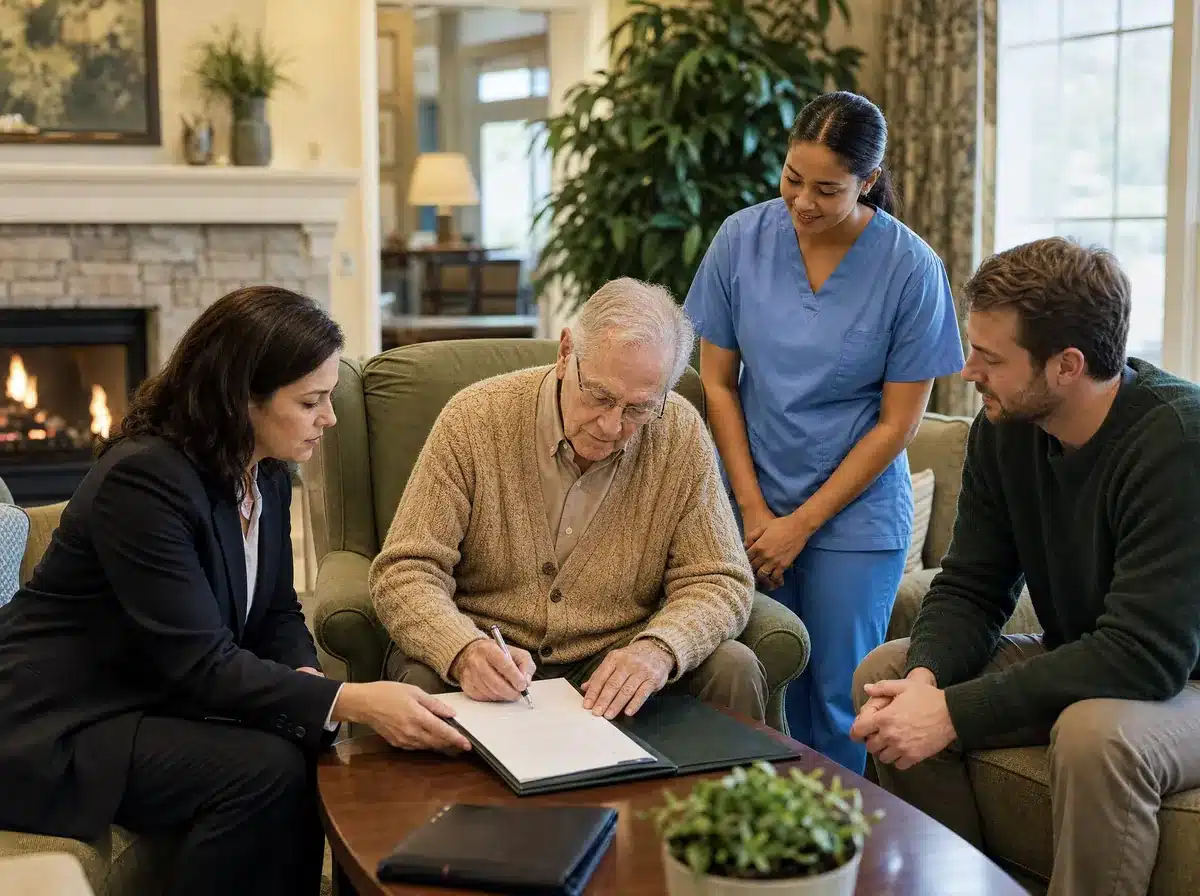
A bedside signing in Boston works best when the family handles the facility and the notary handles the law. Our Zone 3 mobile notary rate, from $250 with travel, one seal and 15 minutes included, covers hospital and nursing home visits in Boston, Cambridge, Newton, Brookline and surrounding cities; extra seals and bedside time are quoted at booking. Zone 2 towns such as Lowell, Burlington and Woburn start at $179.
Some hospitals have their own notaries, so ask before you hire anyone. Brigham and Women’s lists notary service on weekdays from 9 to 3 and on Saturdays at the Bretholtz Center, by phone at 617-732-6636, according to brighamandwomens.org; evenings, weekends on patient floors and short notice are when families call us. At Massachusetts General, Beth Israel Deaconess, Boston Medical Center, Tufts Medical Center, Spaulding and the nursing homes in Dorchester, West Roxbury and Brighton, the pattern is the same: tell the unit a notary is coming, confirm visiting hours, and make sure the signer’s ID is at the bedside rather than home in a drawer.
Nurses and social workers cannot legally veto a notarization, but the notary will listen if one raises a concern about the patient’s state that day; they have spent far more time with the patient than we have. Memory care units may limit visitors to two at a time, which affects where your witnesses stand.
Our hospital notary service in Boston and nursing home notary service pages cover facility access, after-hours visits and the documents we see most at the bedside: durable powers of attorney, health care proxies, deeds moving a home into a trust, and MassHealth affidavits.
We do not provide witnesses
Hire Mobile Notary does not provide, supply, bring, coordinate or serve as witnesses, at the bedside or anywhere else. This matters most in dementia cases, because the documents involved are the ones Massachusetts law requires witnesses for: two for a health care proxy under c.201D, two for a will under c.190B, and two unaffected witnesses for a signature by mark under c.222 s.15.
The notary is also not one of your witnesses. Bring two adults who are not named in the document and do not inherit under it: neighbors, friends, coworkers. The agent, the proxy and the beneficiaries do not qualify.
How to schedule a bedside signing
Call (978) 424-4629 seven days a week, or the office at (978) 851-0199, and tell us five things: where the signer is, which documents and who prepared them, whether dementia or a recent hospitalization is involved, the signer’s best time of day, and whether witnesses are needed and arranged. We will quote the visit by zone and tell you what ID to have at the bedside.
Hanson Webb has been a Massachusetts notary public since 2007, is NNA certified and has completed more than 1,190 signings, many of them at bedsides across Greater Boston and the Merrimack Valley. He cannot tell you whether your mother has capacity to make a will; her attorney and her doctor can. What he can do is arrive on a good morning, talk with her alone, and give you a certificate and a journal entry that hold up.
Need this notarized this week?
Same-day and weekend mobile appointments across Greater Boston and the Merrimack Valley. Flat zone pricing, travel included.
Frequently asked questions
Does a dementia diagnosis automatically prevent notarization?
Short answer: no. Massachusetts law looks at the signer's understanding and willingness at the moment of signing, not the diagnosis. A person with dementia who can explain what the document is and that they want to sign it can be notarized on a good day, and must be declined on a day when they cannot.
What does "aware and willing" mean in Massachusetts?
Short answer: it comes from M.G.L. c.222 s.16, which bars a notarial act when the signer's demeanor creates a compelling doubt about whether they know the consequences of the transaction, or when the notary judges they are not acting of their own free will. Awareness is knowing what the document does; willingness is wanting to sign it without pressure.
What questions will the notary ask my parent?
Short answer: open-ended questions about the document, not a memory test. Expect "can you tell me what this document is," "who are you naming and why," "is this what you want to do today," and "did anyone tell you that you had to sign." Dates and current events are not asked.
Can family stay in the room?
Short answer: for the signing, yes; for the first few minutes, no. The notary speaks with the signer alone to confirm the decision is the signer's own, then invites the family back in for the signature. That private conversation is what protects the document if anyone questions it later.
Can a social worker or nurse stop the notarization?
Short answer: not legally, but the notary will listen. Facility staff have no veto over a notarial act, yet a nurse or social worker who says the patient is having a bad day has spent far more time with them than the notary has. In practice a serious concern from staff usually leads to rescheduling.
What if the notary refuses? What are the alternatives?
Short answer: try again on a better day if the signer has them, and call an elder law attorney if not. When understanding is gone, the family petitions the Probate and Family Court for guardianship or conservatorship under M.G.L. c.190B. A second notary signing where the first declined does not fix a capacity problem.
Can my parent sign by mark or have the notary sign for them?
Short answer: yes, if the problem is physical rather than mental. Under M.G.L. c.222 s.15(f) and (g), a signer who understands the document may make a mark, or direct the notary to sign, in the presence of two witnesses unaffected by the document who also sign. The family provides those witnesses.
How do I schedule a bedside signing at a Boston hospital or nursing home?
Short answer: call (978) 424-4629 with the signer's location, the documents, the best time of day and your witness plan. Zone 3 visits from $250 include hospital and nursing home travel in Boston and surrounding cities. Tell the unit a notary is coming and have the signer's photo ID at the bedside.
Does the notary provide witnesses for a health care proxy or will?
Short answer: no. We never provide, supply, coordinate or serve as witnesses. A health care proxy needs two adult witnesses, the agent cannot be one, and a will needs two witnesses under Massachusetts law. The family brings two adults who are not named in and do not benefit from the document.