Does a USCIS Translation Need to Be Notarized? Certified vs Notarized Translation, and When Massachusetts Still Needs the Notary
No. USCIS does not require translations to be notarized. Under 8 CFR 103.2(b)(3), a foreign-language document needs a full English translation and a signed certification from the translator stating that it is complete and accurate and that the translator is competent. Notarization is a separate step that consulates, universities, courts and apostille chains sometimes add.
Does USCIS require translations to be notarized?
USCIS requires a certified translation, not a notarized one. The certification is the translator’s own signed statement; a notary’s seal adds nothing that the regulation asks for, and USCIS officers at the Boston Field Office and the lockbox facilities accept translations every day with no notary stamp on them.
The confusion comes from other countries. In Egypt, Lebanon, Morocco, France, Haiti, Brazil and most of Latin America, an official translation is a “sworn” translation done by a translator appointed by a court or ministry. People who grew up with that system assume the United States works the same way. It does not. The United States has no sworn-translator registry, and federal immigration law asks only for a competent translator’s certification.
So for a green card, naturalization, asylum, work permit or family petition: a certified translation is required, a notarized translation is optional, and adding the notary will not hurt you with USCIS but will not help you either. Where it does help is everywhere else your documents might go, which we cover below. We handle both through our certified translation service, which covers Arabic and French in-house and other languages through professional translators who sign the same certification.
What does 8 CFR 103.2(b)(3) actually say?
The regulation is one paragraph. It says any document containing a foreign language submitted to USCIS must be accompanied by a full English language translation that the translator has certified as complete and accurate, together with the translator’s certification that he or she is competent to translate from the foreign language into English.
Three words carry the weight. “Full” means every word on the page, including stamps, seals, handwritten notes, margin annotations and the back of the document if anything is printed there. A summary is not a full translation. “Complete and accurate” is what the translator attests to. “Competent” is the translator’s own representation of their ability; the regulation does not require a degree, a license, ATA membership or any government approval.
Notice what the paragraph does not say. It does not say notarized or sworn, and it does not say the translator must be a professional or unrelated to the applicant. Everything beyond the regulation is USCIS practice, adjudicator discretion or the preference of a different agency.
What must the translator’s certification statement contain?
A compliant certification states that the translation is complete and accurate, states that the translator is competent to translate from the named language into English, and is signed and dated by the translator with their printed name and contact information. Everything else is good practice rather than law.
Here is what we put on every certification page, which tracks the regulation and the way USCIS officers read it:
- A one-sentence identification of the document: “the attached document, a birth certificate issued by the Civil Registry of Casablanca, Morocco, dated 14 March 1992.”
- The source and target languages: “from Arabic into English.”
- The certification of completeness and accuracy: “I certify that the attached English translation is a complete and accurate translation of the original document to the best of my ability.”
- The certification of competence: “I am competent to translate from Arabic into English.”
- The translator’s full printed name, signature, date, mailing address, telephone number and email address, plus any credentials. Credentials are not required, but they answer the officer’s competence question before it is asked.
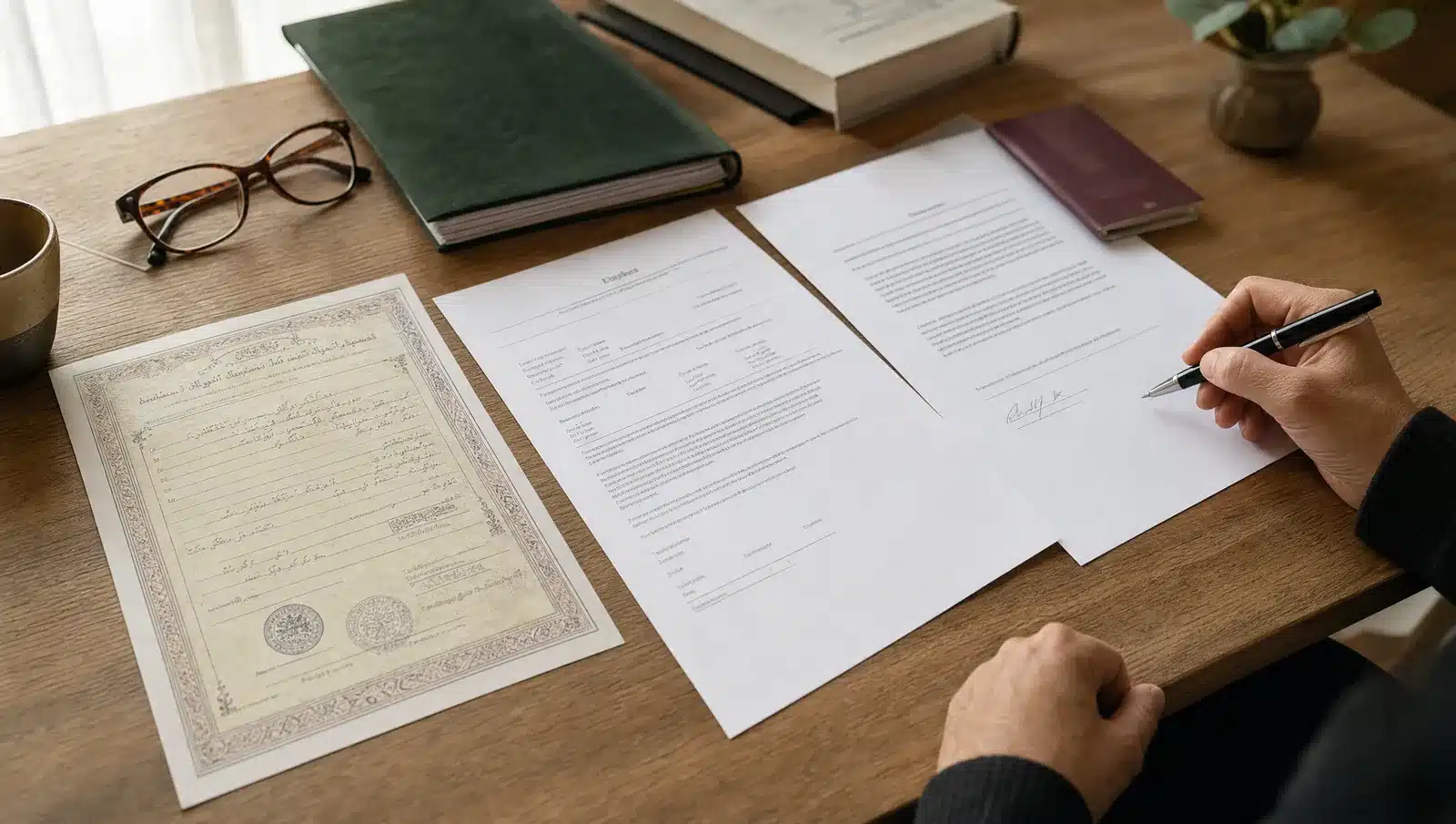
The packet is assembled in a fixed order: a copy of the original foreign-language document, the English translation laid out to mirror the original, and the signed certification. USCIS wants to hold the two documents side by side and see that the seal in the bottom right of the Arabic original is described in the bottom right of the English page.
Who can translate a document for USCIS?
Any person who is competent in both languages and willing to sign the certification can translate for USCIS, with one practical exception: the applicant should not translate their own documents. The regulation does not forbid self-translation in so many words, but officers routinely issue Requests for Evidence when the translator is the applicant, the beneficiary or the petitioner, because a person certifying the accuracy of their own evidence is not independent.
Beyond that, the field is open. A bilingual friend, a coworker, a professional translator or a translation company can all sign. There is no USCIS list of approved translators and no federal exam for immigration translations. ATA certification is a credential, not a legal requirement.
We still tell clients to avoid three translators the law allows: the spouse or parent whose relationship is the subject of the petition, a relative who is not fluent in formal written English, and anyone who will not put a phone number and address on the certification. One Massachusetts wrinkle: a notary may not notarize a document in which they have a beneficial interest, so a notary who translated the document does not notarize their own translator statement; a second notary signs that certificate.
Certified translation vs notarized translation: what is the difference?
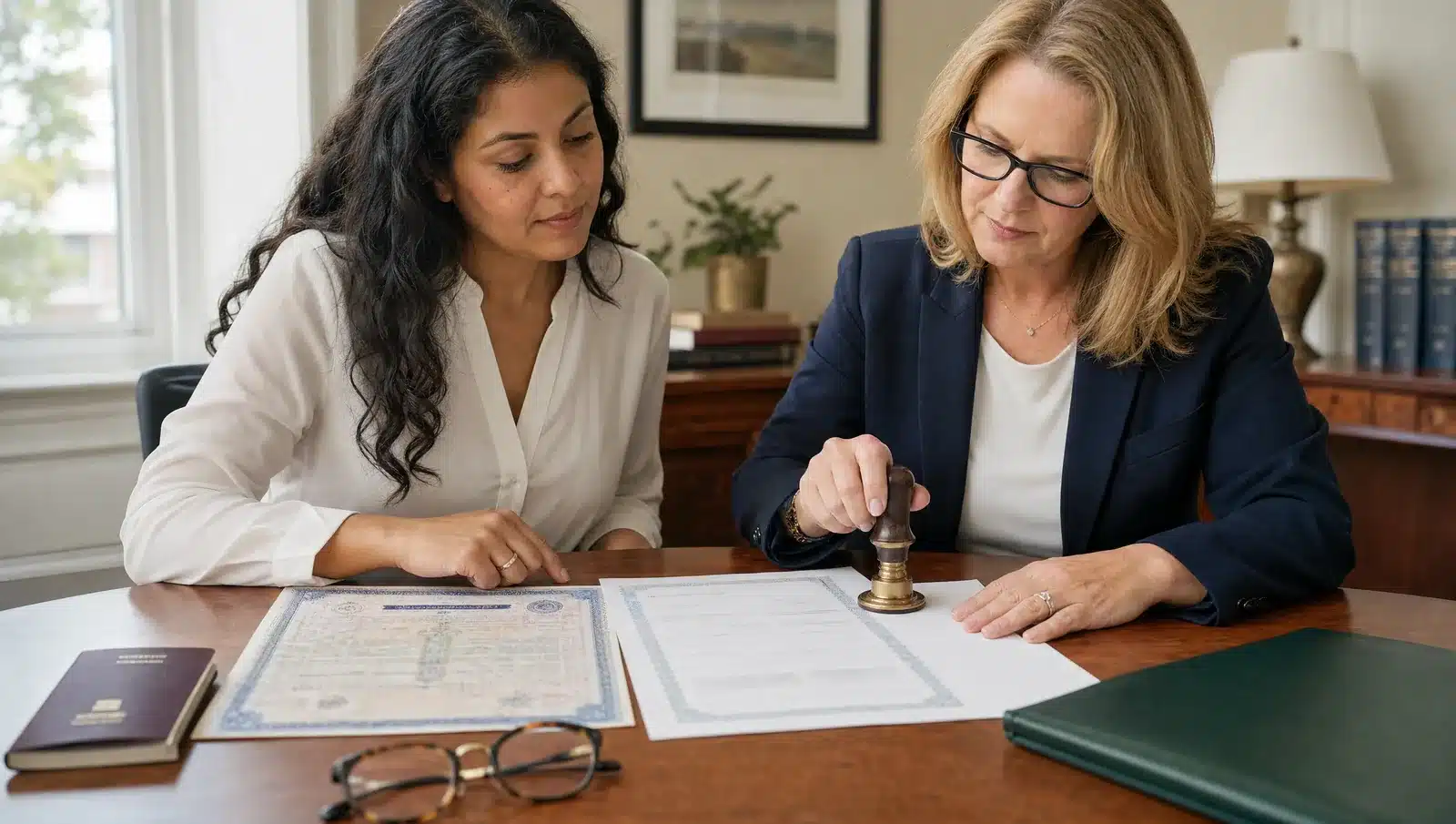
A certified translation is a translation plus the translator’s signed statement of accuracy and competence. A notarized translation is the same certified translation whose statement has been signed in front of a Massachusetts notary public, so the notary’s certificate confirms who signed it and when. The notary does not check the translation; the notary checks the translator’s identity and signature.
| Feature | Certified translation | Notarized translation |
|---|---|---|
| What it is | Full English translation plus the translator’s signed statement of completeness, accuracy and competence | A certified translation whose translator statement is signed before a notary public, with a jurat or acknowledgment certificate attached |
| Who vouches for accuracy | The translator | Still the translator; the notary vouches only for the signature |
| Required by USCIS | Yes, under 8 CFR 103.2(b)(3) | No |
| Commonly required by | USCIS, most US employers, many US universities | Foreign consulates, foreign universities and ministries, some courts, any document that needs a Massachusetts apostille |
| Can it be apostilled in Massachusetts | No; there is no notary or public official’s signature to authenticate | Yes; the Secretary of the Commonwealth authenticates the notary’s signature for the $6 state fee |
| Cost at our Tewksbury office | Translation quoted per document and language | Translation quote plus $45 per notarial act |
The practical rule: ask the receiving party which one they want. If the answer is USCIS alone, stop at certified. If the document will also go to a consulate, a court or abroad, add the notarization at the same time.
When is a notarized translation still asked for?
Notarization is asked for whenever the receiving party needs to verify the translator’s signature rather than trust it, which usually means a foreign government, a university registrar, a court clerk or an apostille office. The notary’s certificate turns a private statement into something a public official can authenticate.
Consulates and embassies
Consulates routinely ask for a notarized translator statement when a US document is going back into their system: a Massachusetts birth certificate for a dual-citizenship application, a divorce decree for a remarriage abroad, a police record for a residency permit. Brazilian, French, Dominican, Moroccan and Lebanese files are the ones we see most from Boston-area families.
Apostille chains
If your translated document is heading to a Hague Convention country, the chain is translation, notarized translator statement, Massachusetts apostille on the notary’s signature. The Secretary of the Commonwealth authenticates only the signatures of Massachusetts public officials and Massachusetts notaries, so without the notarization there is nothing for the state to apostille. Our guide to apostille vs notarization in Massachusetts walks through the sequence.
Universities, licensing boards and courts
Admissions offices generally accept certified translations, but credential evaluators and professional licensing boards often want the translator statement notarized. Massachusetts courts can ask for a translator’s affidavit, which is by definition sworn before a notary. Immigration court uses its own regulation, 8 CFR 1003.33, so check the certification wording before filing there.
How does Massachusetts handle a notarized translation that will be apostilled?
Massachusetts apostilles the notary’s signature on the translator’s statement, not the translation itself and not the foreign original. The translator signs before a Massachusetts notary, the notary completes a jurat or acknowledgment certificate under M.G.L. c.222 s.15, and the Secretary of the Commonwealth’s Commissions Section at One Ashburton Place, Room 1719, Boston attaches the apostille for $6 per document.
Two details decide whether the state accepts the packet. First, the notary’s name on the certificate must match the commission record exactly and the seal must be legible, because the Secretary compares the signature to the one on file. Second, the Secretary’s office states that Massachusetts does not certify out-of-state documents; a Connecticut birth certificate goes to Hartford and a federal record goes to the US Department of State. Massachusetts can, however, apostille the notarized translator statement attached to such a document, because the notarization itself is a Massachusetts act.
Destination countries also differ. Spain, Italy, France and Brazil frequently prefer an apostille on the original Massachusetts record and a sworn translation made in their own country, in which case a US notarized translation is wasted money. Morocco, the UAE, Saudi Arabia, Colombia and Mexico generally accept the US translation with the apostilled translator statement. We check the current instructions with you before notarizing anything. Because Hanson Webb works in English, Arabic and French, we read consulate instructions in those languages ourselves. See our Arabic notary service and French document notary service pages for how those files usually run.

Why does USCIS reject translations, and how do you avoid an RFE?
USCIS almost never rejects a translation because it lacks a notary stamp. It issues Requests for Evidence because the translation is incomplete, the certification is missing or incomplete, the translator appears to be the applicant, or the translation does not match the copy of the original that was filed. Each of those is avoidable.
- Partial translation. The body text is translated but the registrar’s stamp, the marginal note recording a name correction, or the handwritten annotation on the back is left out. If it is on the page, it goes into the English.
- Missing competence statement. Many home-made certifications say “this translation is accurate” and stop. The regulation requires two statements, accuracy and competence.
- No signature, date or contact information. An unsigned certification is not a certification.
- Translator is the applicant or beneficiary. Use someone outside the case.
- Machine translation with a human signature added. Officers recognize the word order. A competent human must do or review the work.
- Translation of the wrong version. The translation must match the copy filed with USCIS, page for page, not an older extract with a different registrar’s signature.
- Names transliterated inconsistently. “Mohamed” on the passport and “Muhammad” on the translation invites identity questions. We match the passport spelling and explain any variant in a translator’s note.
If a document is in a language the receiving party cannot read and you are not sure what it is, start with our guide to what to do with a foreign document that has no translation, which explains what a notary can and cannot do with a page they cannot read.
What do Boston-area immigration translations usually look like?
Most of the translations we see for USCIS are civil records and school records in the five languages that make up much of Greater Boston and the Merrimack Valley: Arabic, French, Portuguese, Spanish and Haitian Creole. The document types repeat, and so do the traps.
Arabic
Birth certificates and family books from Egypt, Lebanon, Jordan, Iraq, Syria and Morocco, marriage contracts from religious courts, and police clearance certificates. Traps: Hijri and Gregorian dates on the same page, both of which must be translated; names written in three or four parts that must be mapped to first, middle and last on the US form; and marginal stamps that carry the registration number. Hanson translates and certifies these in-house.
French
Birth extracts from France, Quebec, Senegal, Ivory Coast, Cameroon and Haiti, diplomas and transcripts from francophone universities, and criminal record extracts. Traps: the difference between a full copy and an extract, which USCIS does not care about but a consulate does; and the French practice of listing the mother’s maiden name, which must be translated as such rather than treated as a second surname. Also handled in-house.
Portuguese
Brazilian birth and marriage certificates and school transcripts, and Cape Verdean records, for families in Brockton, Dorchester and Framingham. Trap: Brazilian certificates often carry a second-page annotation recording a divorce or name change that is easy to miss.
Spanish
Dominican, Salvadoran, Guatemalan and Colombian birth and marriage certificates for families in Lawrence, East Boston, Chelsea and Lynn, plus police records. Traps: two surnames that must both appear, and legalization stamps already on the document that must be translated even though they are not part of the record.
Haitian Creole
Birth extracts and marriage certificates from Haiti, often in French with Creole elements, for families in Mattapan, Hyde Park, Randolph and Brockton. Traps: many are handwritten, and reconstructed records issued after the 2010 earthquake need a translator’s note explaining what the document is.
How does our certified translation plus notarized translator statement work?
You send a clear scan or photo of every page, we quote in writing by document and language, and we deliver a certified translation with the signed certification page. If your receiving party also needs the translator’s statement notarized, that is a $45 notarial act at our Tewksbury office, and if the packet is going abroad we add the $6 Massachusetts apostille plus our service fee.
- Send the pages. Email or text a legible scan or phone photo of every page, front and back, including stamps. For USCIS, a copy is enough; we never need your original to translate.
- Tell us where it is going. USCIS only, or also a consulate, university, court or foreign ministry. That answer decides whether notarization and apostille are added.
- Approve the quote. Pricing is by document and language and stated before work begins. Arabic and French are done by Hanson Webb, a Massachusetts notary public since 2007 and fluent in both; other languages are done by professional translators under the same certification standard.
- Translation and review. The translation mirrors the layout of the original, every stamp is rendered, names match your passport spelling, and a second reader checks it.
- Certification. The translator signs the statement of completeness, accuracy and competence. You receive a PDF by email and signed hard copies by mail or pickup at 1215 Main St, Suite 115, Tewksbury.
- Notarization if needed. The translator signs the statement before a notary at the office, $45 per act, with a jurat or acknowledgment certificate. Hanson’s own translations are notarized by a second commissioned notary.
- Apostille if needed. We submit the notarized statement to the Secretary of the Commonwealth in Boston and return the apostilled packet to you.
Most single documents are delivered within 24 to 72 hours of quote approval. Multi-page transcripts, handwritten records and rare language pairs take longer, and we say so at quote time.
A notary public cannot give immigration advice, so ask your attorney or the USCIS form instructions which records you need, then bring us the pages. For what a Massachusetts notary does and does not do, see our Massachusetts notary public page. Call (978) 424-4629 seven days a week, (978) 851-0199 at the office, or book online at hiremobilenotary.com/booking/.
Need this notarized this week?
Same-day and weekend mobile appointments across Greater Boston and the Merrimack Valley. Flat zone pricing, travel included.
Frequently asked questions
Does USCIS require translations to be notarized?
No. USCIS requires a certified translation under 8 CFR 103.2(b)(3): a full English translation plus the translator's signed statement that it is complete and accurate and that the translator is competent. A notary seal is not required and does not substitute for the certification. Notarization matters only when the document is also going to a consulate, court, university or apostille office.
What must the translator's certification say under 8 CFR 103.2(b)(3)?
Two things: that the translation is complete and accurate, and that the translator is competent to translate from the foreign language into English. It should be signed and dated with the translator's printed name and contact information. Credentials and letterhead are helpful but not required by the regulation.
Can I translate my own birth certificate for USCIS?
You should not. The regulation does not expressly forbid it, but officers regularly issue Requests for Evidence when the translator is the applicant, beneficiary or petitioner, because the certification is not independent. Use a professional translator or a fluent person outside the case who will sign with their contact details.
Does the translator need ATA certification?
No. There is no federal license, exam or approved list for USCIS translators, and ATA certification is a professional credential rather than a legal requirement. The translator must be competent in both languages and willing to certify that in writing. Listing credentials on the certification simply answers the competence question before it is asked.
When is a notarized translator affidavit still useful?
When a consulate, foreign university, licensing board or court wants to verify the translator's signature, or when the document needs a Massachusetts apostille. The Secretary of the Commonwealth can only apostille a notary's or public official's signature, so a translation headed to a Hague Convention country must have its translator statement notarized first.
What is a sworn translation and does the US have one?
A sworn translation is one made by a translator appointed by a court or ministry, common in France, Spain, Brazil, Morocco and Lebanon. The United States has no sworn-translator system. The closest equivalent is a certified translation with a notarized translator statement, and for many countries that, with an apostille, is accepted in place of a local sworn translation.
How does Massachusetts handle a notarized translation that will be apostilled?
The translator signs the statement before a Massachusetts notary, and the Secretary of the Commonwealth in Boston apostilles the notary's signature for $6 per document. The state authenticates the notarization, not the translation. Massachusetts does not certify documents issued by other states, but it can apostille the Massachusetts notarization attached to them.
What does a certified Arabic or French translation cost and how long does it take?
Quotes are given per document and language in writing before work begins, and most single documents are delivered within 24 to 72 hours of approval. Notarization of the translator's statement is $45 per notarial act at the Tewksbury office, and an apostille adds the $6 state fee plus our service fee. Multi-page transcripts and handwritten records take longer.
Why did USCIS send a Request for Evidence about my translation?
Usually because the translation left out a stamp or annotation, the certification lacked the competence statement or a signature, the translator was the applicant, or the translation did not match the copy of the original filed. A notary stamp is almost never the reason. A corrected full translation with a complete certification normally resolves it.