

The Complete Massachusetts Mobile Notary Guide (2026)
What a Massachusetts mobile notary is allowed to do, which of the five notarial acts your document calls for, which IDs pass, what a visit costs in 2026 and what you must arrange yourself. By a notary public commissioned since 2007.
What is a mobile notary under Massachusetts law?
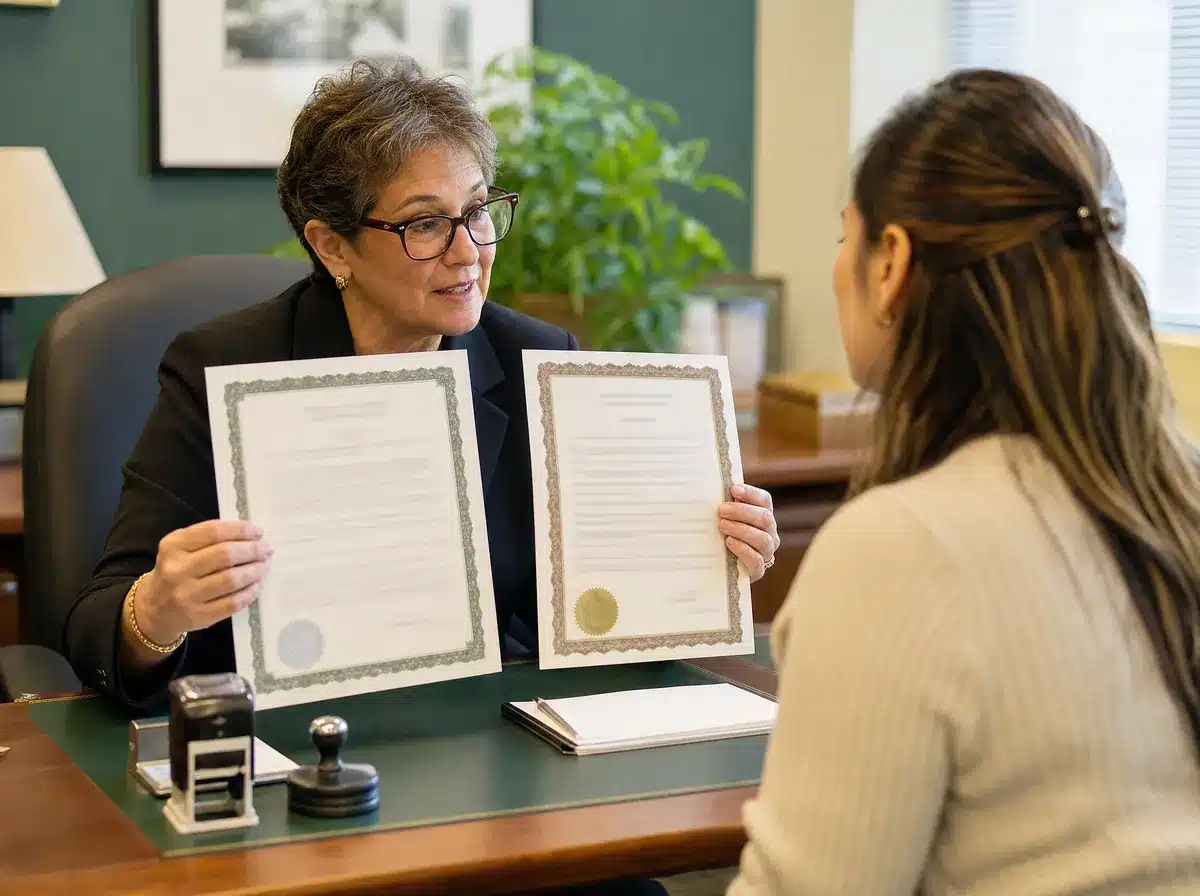
Massachusetts has no separate “mobile notary” commission. A mobile notary is an ordinary notary public, appointed by the Governor for a seven-year term under M.G.L. c.222, who travels to the signer instead of working from a fixed counter at a bank or town hall.
The notarization you get at your kitchen table in Lowell carries the same weight as one performed at a law office in Boston: same official stamp, same certificate wording, same journal entry. Our mobile notary service is simply a Massachusetts notary public who comes to you; a traveling notary is the same thing.
A Massachusetts commission is statewide. One commissioned Massachusetts notary public can act in Tewksbury in the morning, Worcester at noon and a Cambridge hospital that evening, but the commission stops at the state line.
Every notary in the Commonwealth is also bound by the standards of conduct in M.G.L. c.222 s.16: the signer must appear in person, the notary must be satisfied about identity and willingness, and the notary may not offer legal advice or pick the notarial act for you.
Which of the five notarial acts does your document need?
Massachusetts notaries perform five everyday notarial acts: the acknowledgment, the jurat, the oath or affirmation, the signature witnessing and the copy certification. The document, or the party that will receive it, decides which one applies, and the notary completes the matching certificate under M.G.L. c.222 s.15.
Acknowledgment. You declare to the notary that you signed willingly and that the signature is yours. You may have signed earlier, as long as you appear in person to acknowledge it. Deeds, mortgages, powers of attorney and trusts nearly always use an acknowledgment; the certificate begins “personally appeared before me.”
Jurat. You sign in front of the notary and swear or affirm that the contents are true. The certificate reads “subscribed and sworn to before me.” Affidavits, sworn statements and many court and immigration forms call for a jurat.
Oath or affirmation. A spoken act: you swear, or affirm, that a statement is true. It stands alone for depositions and is the component inside every jurat.
Signature witnessing. The notary watches you sign and certifies that the signature was made in the notary’s presence. No oath is given. Certain out-of-state bank forms and institutional releases ask for this act; see our signature witnessing service.
Copy certification. You present an original, the notary inspects a photocopy and certifies that it is complete and accurate. Massachusetts notaries cannot certify copies of vital records or recordable documents such as birth certificates and deeds; diplomas and passports are routine. See copy certification.
If your document has no certificate wording, ask the agency, lender, court or attorney who will receive it which act they want. A notary who chooses the act for you is giving legal advice, which M.G.L. c.222 s.17 forbids. See acknowledgment vs jurat in Massachusetts.
What ID does a Massachusetts notary accept, and what if you have none?
A Massachusetts notary must have satisfactory evidence of your identity before any notarial act, and the standard is one current government-issued identification document that carries both your photograph and your signature. If you have no acceptable ID, Massachusetts law allows a credible witness who personally knows you to swear to who you are, and that witness is someone you bring, not someone we supply.
The IDs we see every day are the Massachusetts driver’s license or ID card, a United States passport or passport card, a foreign passport, a military ID and a permanent resident card, each of them current. An expired license does not qualify, and neither does a Social Security card, birth certificate or a photo of your license on your phone.
The name on the ID should reasonably match the document; a maiden name on the deed and a married name on the license usually needs a second ID. Our guide to what ID is accepted for notarization in Massachusetts covers the edge cases.
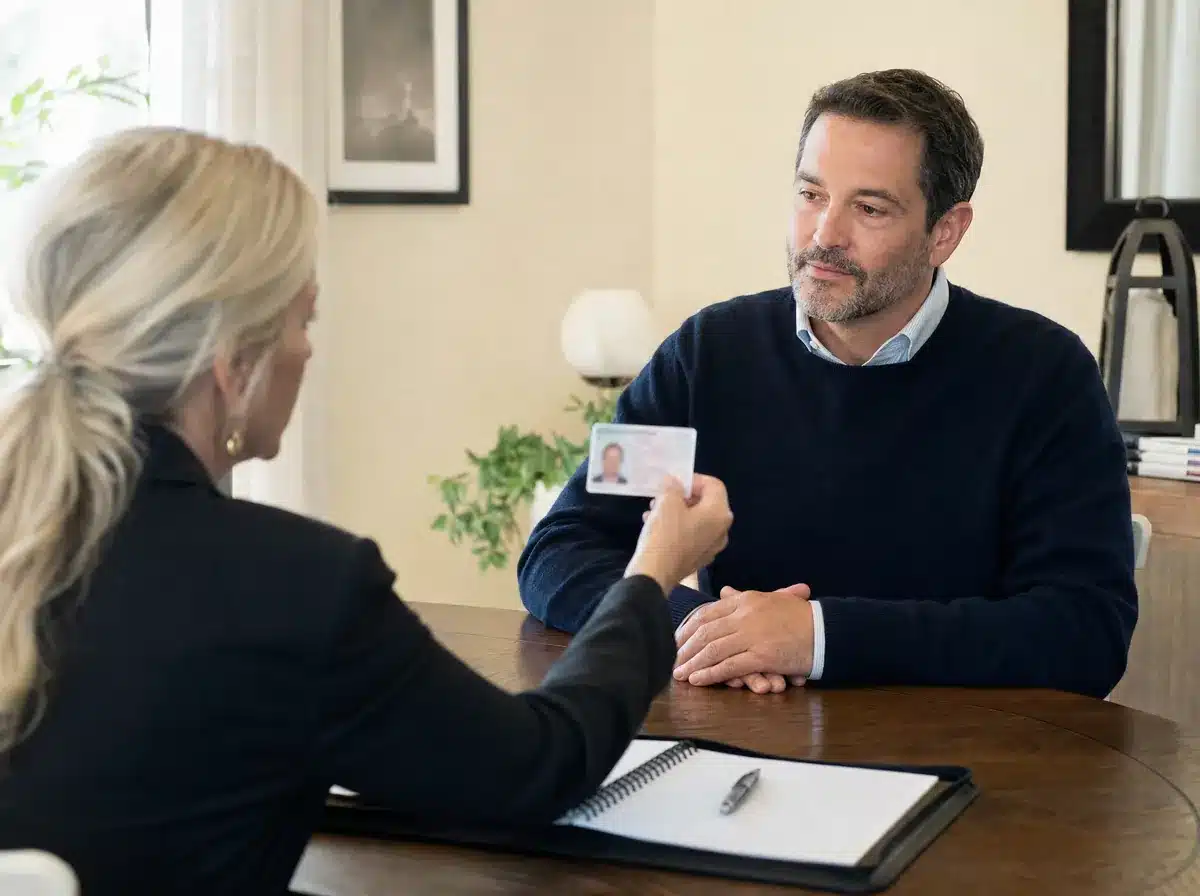
The credible witness alternative. Massachusetts law recognizes two other routes to identity. The first is personal knowledge: if the notary already knows you, no card is needed. The second is a credible witness who personally knows you, is not named in the document, presents acceptable ID of their own and takes an oath before the notary swearing to your identity. The notary records the witness in the journal.
The credible witness is your witness: a longtime neighbor, an adult child, an old friend. We cannot bring one or ask a stranger in the hospital corridor, because the witness has to know you personally. This comes up most at bedsides, where a patient’s wallet is at home, so before a hospital notary visit we ask the family to bring the ID or arrange a credible witness. The notary must also be satisfied that you understand the document and are signing freely.
How much does a Massachusetts mobile notary cost in 2026?
In 2026 a mobile notary visit from HireMobileNotary.com starts at $125, and every mobile rate includes travel, one notary seal and 15 minutes of service. Massachusetts sets no cap on fees for ordinary notarial acts, so the rule that protects you is that the fee must be reasonable and disclosed before you book.
We price by zone from our Tewksbury office. Zone 1, our home base, covers Tewksbury, Gardner, Ashby and Athol from $125 per visit. Zone 2, the nearby towns and our most-booked tier, covers Lowell, Billerica, Andover, Chelmsford, Dracut, Lawrence, Worcester, Fitchburg, Leominster, Concord, Burlington, Woburn and 40+ more communities from $179 per visit. Zone 3, Metro Boston and beyond, covers Boston, Cambridge, Newton, Lexington, Wellesley, Weston, Lynn, Gloucester, North Andover and 110+ more from $250 per visit, with hospital and nursing-home visits included. The town-by-town list is on our notary zones page.
The zone rate does not include second and later seals or time past the first 15 minutes. A family signing a will, a health care proxy and two powers of attorney in one sitting is several seals and perhaps 45 minutes, and we quote that before we dispatch, as we do for loan signings and multi-document appointments.
If you can come to us, in-office notarization at 1215 Main St, Suite 115 in Tewksbury is $45 per notarial act by appointment. For a document headed overseas, the Massachusetts state fee for an apostille is $6 per document plus our service fee; see apostille service. For more on pricing, read what a mobile notary costs in Massachusetts.
The “$1.25 cap” you may read about online comes from an old schedule in M.G.L. c.262 for protesting dishonored commercial paper and has never governed everyday notarizations.
How do you book a mobile notary, and what happens at the appointment?
You book by phone, text or the online form, we confirm the time and the flat zone rate, and the notary arrives with the stamp, the journal and the certificates your document needs. A single document usually takes 15 to 30 minutes.
- Request
Call or text (978) 424-4629 or use the online booking form with the document type, number of signers, address and the window that works. Same-day and after-hours requests are confirmed by reply.
- Confirm
We confirm availability, the zone rate and any extra seals we can already see, and flag a likely name mismatch or missing ID before the visit.
- Prepare
Print the entire document, including the certificate page. Do not sign anything with jurat wording. Gather current photo ID for every signer and have any required witnesses present. See how to prepare for a mobile notary.
- Identify and record
The notary checks each signer’s ID against the document, confirms understanding and willingness, and opens a journal entry with the date, act, document type and ID details.
- Sign and seal
You sign, or acknowledge a prior signature, and take the oath if the act is a jurat. The notary completes the certificate, signs it and applies the official stamp.
- Keep your originals
You keep every original; nothing is filed by the notary. Loan packages go back to the title company or lender the same day.

Why the journal matters. Massachusetts requires notaries to keep a chronological journal of notarial acts. If a deed or power of attorney is challenged years from now, the journal entry is the independent evidence that you appeared, presented identification and signed.
Which documents commonly need a notary in Massachusetts?
The documents that most often bring a notary to a Massachusetts home are powers of attorney, health care proxies, wills, deeds, loan packages and affidavits. Each has its own rules about which act applies and whether witnesses are required, and the witnesses are always yours to arrange.
Power of attorney
Durable, limited and springing POAs under M.G.L. c.190B, acknowledged by the principal.
POA notarizationWills and trusts
Wills need two witnesses you provide; the self-proving affidavit is notarized so witnesses need not appear in Probate Court later.
Wills and trustsHealth care proxy
Under M.G.L. c.201D a proxy needs two adult witnesses, neither of whom is the agent. Notarization is optional but widely requested by hospitals.
Health care proxyDeeds and real estate
Quitclaim deeds, 6D certificates, homestead declarations and refinance affidavits, acknowledged for recording at the Registry of Deeds.
Real estate notaryLoan signing packages
Purchase, refinance and HELOC packages signed as the closing attorney’s signing agent.
Loan signing agentAffidavits and sworn statements
Court affidavits, single-status affidavits and immigration declarations, signed under oath with a jurat.
Affidavit notarizationI-9 and CORI forms
Remote-hire I-9 verification as the employer’s authorized representative, and CORI request forms.
I-9 verificationBusiness and corporate
Corporate resolutions, bills of sale, vehicle title transfers and commercial leases, at your office or ours.
Business notaryDocuments headed abroad are notarized first and then apostilled by the Secretary of the Commonwealth. CORI forms are handled through our CORI form notary service.
Need a Massachusetts notary at your door?
Seven days a week across 177 cities and towns. Flat zone pricing from $125, travel included.
Which documents can a Massachusetts notary not handle or must refuse?
A Massachusetts notary must refuse when the signer is not physically present, cannot be identified, does not appear to understand the document or seems to be signing under pressure. The notary must also decline anything that amounts to practicing law, including drafting your document, explaining what it does or choosing the notarial act for you.
Situations that end the appointment. The signer is not in the room, for example a spouse who “will sign later.” The ID is expired or missing and no credible witness is available. The document has blank spaces where material terms belong. The signer is heavily medicated, confused or unable to communicate a clear wish to sign. In each case the notary stops, and only the travel fee may apply.
Documents a notary cannot certify. Copies of birth, death and marriage certificates come from the town clerk or the Registry of Vital Records, never from a notary, and a recorded deed comes from the Registry of Deeds. A notary also cannot notarize a document in which the notary is named or stands to benefit.
Witnesses. Massachusetts wills under M.G.L. c.190B and health care proxies under M.G.L. c.201D require two witnesses. We do not provide, supply, bring or coordinate witnesses under any circumstances. If your document needs them, you arrange qualified adults who are not named in the document; finding them is your responsibility.
Legal advice and document preparation. A notary cannot tell you whether a durable or a springing power of attorney suits you, cannot fill in the terms of a lease and cannot draft a deed. Those are questions for a Massachusetts attorney; see Massachusetts notary vs attorney.
Mortgage closings. In Massachusetts a real estate closing must be conducted by a licensed attorney. A notary signing agent supports the closing attorney, title company or lender with the signing and notarization of the package, and does not conduct the closing or explain the loan terms.
Immigration and language. A notary public is not an immigration consultant and does not advise on filings; “notario” describes a very different professional abroad. Hanson speaks Arabic and French as well as English, so we can communicate directly with the signer and be satisfied that the signer understands the document, as M.G.L. c.222 s.16 requires; see our Arabic notary service.
Mobile notary vs online notary vs in-office: which should you choose?
Choose a mobile notary when the signer cannot easily travel, when several people must sign together, or when a lender, court or hospital requires wet-ink originals. Choose remote online notarization for a simple document when every party is comfortable on camera and the receiving party accepts an electronic notarization, and choose in-office when you are near Tewksbury and want the lowest per-act price.
Mobile. The notary comes to your home, office, hospital room, care facility or the closing attorney’s conference room. It is the only practical option for a bedridden parent signing a health care proxy, for a will signing where the testator and two witnesses must be in the same room, and for most real estate and loan packages, which still move on paper in Massachusetts.
Remote online notarization (RON). Massachusetts authorized remote online notarization in 2023 Acts c.2. A notary registered for RON performs the act over an approved audio-video platform with identity proofing and applies an electronic seal to an electronic document. It suits a single affidavit or consent form when the signer is traveling, provided the receiving party accepts it; many Registries, lenders and estate attorneys still require paper. See remote online notarization and mobile notary vs online notary in Massachusetts.
In-office. If you can get to 1215 Main St, Suite 115 in Tewksbury, the fee is $45 per notarial act by appointment. It suits a single document or a quick jurat when you live in Tewksbury, Wilmington, Billerica or Lowell. See our Tewksbury notary page.
To decide, count the signers, check whether the document needs witnesses and ask the receiving party whether they accept electronic notarization. Multiple signers or any witness requirement points to mobile; a single e-filed document points to RON; a single paper document near Tewksbury points to in-office. Anywhere in our 177 towns, a search for a notary public near me ends with us coming to you.
Massachusetts mobile notary FAQ
Do you provide witnesses for wills or health care proxies?
No. We do not provide, supply or coordinate witnesses. Massachusetts wills and health care proxies each require two adult witnesses who are not named in the document, and you arrange them before the appointment.
Can a mobile notary come to a hospital or nursing home in Massachusetts?
Yes. Hospital, hospice and nursing-home visits are common for health care proxies, powers of attorney and wills. The signer must have current ID or a credible witness and must be alert enough to understand the document and state a clear wish to sign; if the patient is heavily sedated or confused, the notary must decline.
Can I sign the document before the notary arrives?
Not if it carries jurat wording such as “subscribed and sworn,” because a jurat must be signed in the notary’s presence. An acknowledgment can be signed earlier and acknowledged in person, but the safest practice is to sign every document in front of the notary.
Is a Massachusetts notarization valid in other states and other countries?
A notarization by a commissioned Massachusetts notary is recognized in every other state. For use in another country, the document usually needs an apostille from the Secretary of the Commonwealth after notarization; the state fee is $6 per document.
How quickly can a mobile notary reach me?
Same-day visits are available seven days a week and are confirmed by phone or text rather than assumed. Evenings, weekends and holidays are booked regularly. Call (978) 424-4629 with your town and document type for the earliest window.
Do you handle mortgage closings?
Massachusetts requires a licensed attorney to conduct a real estate closing. We work as the notary signing agent for the closing attorney, title company or lender, handling the signing and notarization of the loan package. We do not conduct the closing or explain the loan terms.

1,190+ signings across Greater Boston, the Merrimack Valley and Central Massachusetts. Bonded, E&O insured and BBB A+ accredited. Fluent in English, Arabic and French. About Hanson


